US $40-trillion debt: Why markets from New York to Tokyo are worried
This week, some of the most important policymakers and economists in the world will gather in Wyoming’s scenic Grand Teton National Park for the annual Jackson Hole Economic Policy Symposium, hosted by the Federal Reserve Bank of Kansas City.
And while the three-day event, starting Thursday, is always keenly eyed by global financial markets, this year’s edition has assumed even more importance given the events that have occurred in the last couple of months.
In what will be his first speech as the Chairman of the US Federal Reserve, Kevin Warsh on Friday will deliver the keynote remarks. And while pressure is on Warsh to communicate better, his decision to be opaque and decidedly less-than-clear at last month’s interest rates decision press conference means expectations are not high.
Story continues below this ad
“Given Warsh’s approach to communication so far, he may provide even fewer clues on near-term monetary policy than markets currently expect,” Teppei Ino, Tokyo Head of Global Markets Research at MUFG Bank, said on Monday.
At the same time, Ino warned it would be “unwise” to assume Warsh and Treasury Secretary Scott Bessent are acting independently. “Depending on Warsh’s message, and how markets interpret it, his speech could once again heighten tensions in bond and FX markets.”
Buying back US bonds
Tensions have indeed been heightened in the global financial markets over the last couple of months or so, with matters coming to a head last week when the US’s total debt crossed $40 trillion, or about 120% of its GDP.
It has taken less than five years for the debt to reach this landmark after breaching $30 trillion in January 2022, with revenues taking a hit from President Donald Trump’s 2017 tax cuts.
Story continues below this ad
On the other hand, spending surged during Covid-19, while the passage of the One Big Beautiful Bill Act in Trump’s second term will increase US debt by $4.7 trillion.
To put these figures into context, India’s debt-to-GDP ratio is around 83%. In dollar terms, this works out to be under $3.5 trillion.
While the level of debt has forever been a talking point between Democrats and Republicans, the US’s handling of it in recent weeks has sent shockwaves through the international market.
In an attempt to cool yields on long-term US government bonds, Bessent last week said the government would buy back at least double the bonds it had already said it would.
The Trump Administration delivers for America’s trusted partners. Economic security is national security. And the U.S.-Japan alliance is built on both.
Friday’s coordinated foreign exchange actions countered disorderly yen movements.
Treasury remains attentive and in close…
— Treasury Secretary Scott Bessent (@SecScottBessent) August 2, 2026
These bond buybacks — done to improve trading by removing bonds that aren’t bought or sold regularly — are supposed to take place in the eight weeks starting September 9, a period that coincides with the US midterm elections.
The bond yields problem
Story continues below this ad
Buying back long-term bonds increases demand for them, which raises their price. Since bond prices and yields move in opposite directions, a rise in prices reduces yields.
Bond yields — which is the cost at which the government borrows to bridge the difference between its income and expenditure — have been a major issue for the US government. High bond yields mean interest rates in the economy stay elevated, which weighs on economic activity.
On February 27, the day before the US and Israel attacked Iran, the 10-year bond yield was 3.97%, while the 30-year bond was trading at 4.64%. On August 17, the day before US debt hit $40 trillion, the 10-year yield was 4.72% and the 30-year at 5.31% — the highest in almost 20 years.
Bond yields have risen despite receding expectations of an interest rate hike by the US Federal Reserve. While this seems counter-intuitive, there are good reasons for it: elevated oil prices have worsened the inflation outlook, there is lack of clarity over the Fed’s future moves, debt is rising rapidly, supply shocks are becoming more frequent, and the AI boom’s funding requirement is rivalling the government’s financing needs and pushing up borrowing costs.
Story continues below this ad
Bessant’s announcement on August 19 that these bond buybacks would be doubled led to an immediate fall in yields – only for them to rise again the next day. On Tuesday, they were trading at 4.7% and 5.23%, respectively.
From New York to Tokyo
This is not the first step the Trump administration has taken to contain US bond yields.
Late July, the US sold euros and bought the yen to prop up the Japanese currency, which had slumped to a 40-year low of 164-per-dollar. But why is the yen the US’ headache?
For Japan to stabilise its currency, it would have to sell dollars and buy the yen. And it can only get hold of dollars by selling some of the US government bonds in its possession – which would push down prices of these bonds and raise US yields.
Story continues below this ad
The trouble for the US is that the country with the biggest holdings of its government bonds is Japan: $1.12 trillion of it as of June. Over March-June, Japan sold $123 billion of US bonds, which added to the upward pressure on yields.
To help Japan out — and indirectly help itself — the US assisted in the defence of the yen.
Fiscal credibility problem
The problem with Bessant’s plan to lower US yields is markets’ lack of confidence in it. According to economists, the only long-term solution to high bond yields is a credible blueprint to improve government finances, with interest payments now making up 15% of all spending at the federal level.
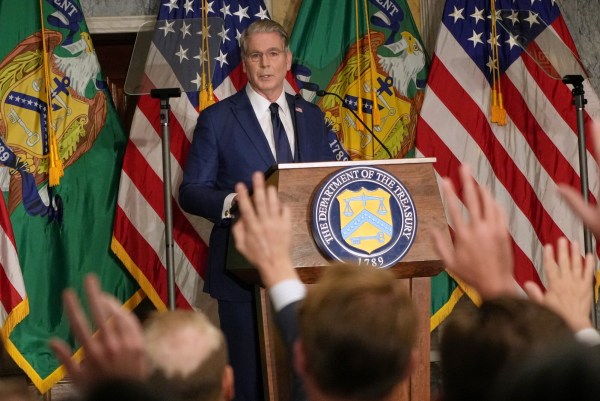 US Treasury Secretary Scott Bessent at a news conference on August 24. AP
“…ultimately, policymakers will eventually need to address the deficit by raising taxes or cutting expenditure,” ANZ economists said Monday.
Story continues below this ad
But room to cut spending is limited, with ANZ estimating around 60% of federal spending is mandated by existing legislation. Another 12-13% or so is defence spending, which is set to rise significantly.
“As a share of GDP, total discretionary spending is already at historic lows and projected to continue to trend lower. Larger cuts to discretionary spending cannot address the budget deficit alone,” ANZ added.
Dollar debasement back on the menu
The combination of Bessent’s bond buyback plans and a difficult fiscal future is why markets think a weaker dollar lies ahead.
According to Chen Zhao, Chief Global Strategist at Oxford Economics’ Alpine Macro, while controlling bond yields is not unusual, it can have its costs, with the direct impact being a fall in the dollar’s value.
Story continues below this ad
“Importantly, the (yield) curve management, together with the joint currency intervention with Japan to prop up the yen last month, suggests that the US government does not mind having a weaker dollar,” Zhao said on Monday.
A weaker dollar also encourages the dollar debasement trade that became popular in 2025 and led to the historic rise in the price of gold. A weaker dollar makes commodities that are priced in the US currency cheaper.
Big if the dollar weakens, what happens to US inflation? This question brings us back to Warsh and his speech at Jackson Hole on Friday.

‘I’m 44 and diabetic: Can I regain muscle lost due to uncontrolled diabetes?’
By Sohail Khan · 26 Aug
Jaya Bachchan once shared why she quit acting: ‘One parent has to be there’ for children
By Sohail Khan · 26 Aug
Homeland for Sindhis now exists only in memories
By Sohail Khan · 26 Aug
Leave a Reply