Railways’ network is almost fully electrified. So why has it launched LNG train to cut emissions?
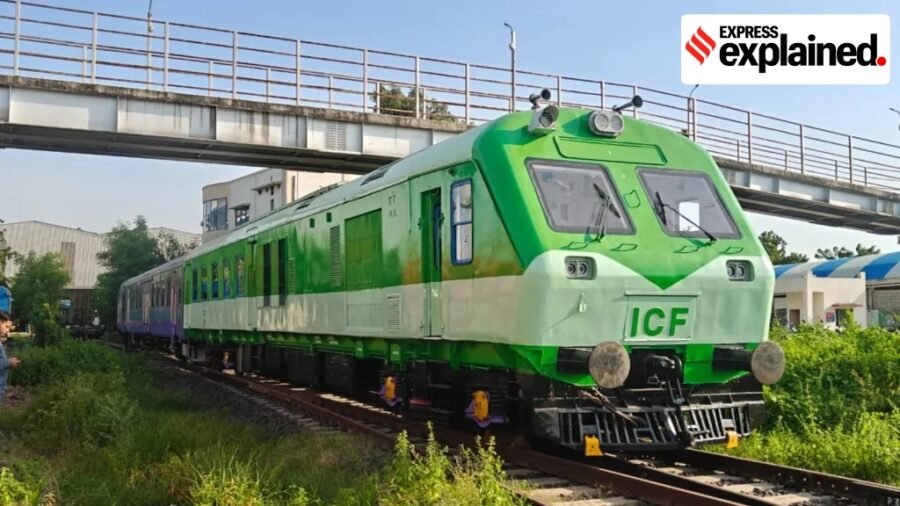
The answer lies in the very configuration, and purpose, of DEMU trains.
What are DEMU trains?
In Indian Railways, most trains are hauled by heavy, standalone engines, called locomotives.
However, DEMU trains — and EMU (electric multiple unit) trains — are “train sets” that don’t have a separate locomotive.
Story continues below this ad
Instead, their movement and control systems are built into passenger coaches at both ends — these coaches are called driving power cars, or DPC. Half of the space of a DPC is taken up by the power packs while the remainder is meant for passengers.
In the case of EMUs, the tractive power — essentially the energy to move the trains — is provided by overhead electric wires. In the case of DEMUs, a diesel engine generates electricity which then powers the train’s electric traction motors.
Since these DEMU trainsets do not have the provision to attach a separate locomotive, they cannot be hauled by an electric one. That is why the conversion to dual-fuel systems with LNG have been found as an alternative to reduce emissions. In fact, the Railways recently launched a hydrogen train by modifying a DEMU rake (or train set). This, however, is not a dual-power train and may not be viable for a mass rollout because handling hydrogen is difficult.
A senior official of the Ahmedabad railway division said that the latest DEMU-LNG conversion was done at a cost of Rs. 1.86 crore. The train will use 40% LNG and 60% diesel during its operation. It has dedicated electronic fuel controls, LNG storage, gas leakage detection and associated safety systems. The DPC retains the capability to operate entirely on diesel whenever required.
How important is this development?
Story continues below this ad
The DEMU was first introduced in Indian Railways in 1994 for non-electrified routes, with a 700-horsepower configuration. In 2002, the Integral Coach Factory developed 1,400-horsepower DEMUs, which were inducted in Railways to replace existing slow-moving locomotive-hauled passenger trains on non-electrified mainline sections and for low-traffic-density branch line services.
The high acceleration potential of DEMUs made the fast passenger services between cities suitable.
However, with the push to lower emissions in the Railways and 99.6% of the network now electrified, the question is what should be done with these trains. They also cannot be easily withdrawn from service as many of them still have some operational life remaining.
“The existing diesel-powered assets continue to remain available for operational requirements. Some diesel powered assets are also required to meet exigencies. The dual-fuel conversion enables productive utilisation of these existing assets while reducing conventional diesel consumption. It also provides operational flexibility, as the DPC can operate in both, dual-fuel or diesel-only mode,” said the senior official of Ahmedabad division.
Story continues below this ad
The Railway official also said that the initiative complements the electrification programme with fuel diversification and there is an export potential for such assets as well.
In Ahmedabad division, the official said that under the existing contract, there is a provision of conversion of 10 DEMU DPCs (five trains) to a dual-fuel configuration.
The two DPCs which have been successfully converted have completed 2,000 km field trials each, said the official.

Cloud cover over pedagogy and academic culture in IITs
By Sohail Khan · 30 Sep
SpaceX Starship engine failure could hit NASA moon mission plans
By Sohail Khan · 30 Sep
India innovated on UPI. Can’t we innovate on merchant fee too?
By Sohail Khan · 30 Sep
Leave a Reply