How South Africa’s new exchangeable pitches could shape the 2027 Cricket World Cup
Story continues below.
Subscribe to see fewer ads.
Large trailers enter the ground and use cranes to drop the pitches into spots that are dug up specifically to match the measurements of the pitch that is to be fitted within. After the matches have been played, they are retrieved and the space is filled in to restore the ground.
This differs from the new EPS in that pitches will be prepared in a tray inside the ground and exposed to usual weather conditions before being fitted.
Evan Flint, a pitch consultant who is involved in introducing the EPS, tells , “So they are constructed in a tray, which is similar to the drop-in. The difference with the drop-in is obviously that the drop-in is picked up with a crane, lifted out of the ground and taken out to the nursery. Ours are done on a hovercraft system. So there are pontoons in the pits. The pit position is where the tray sits in. At the end of that tournament, you could then remove that wicket and exchange it with another wicket that’s been on the boundary.”
Why is it being done?
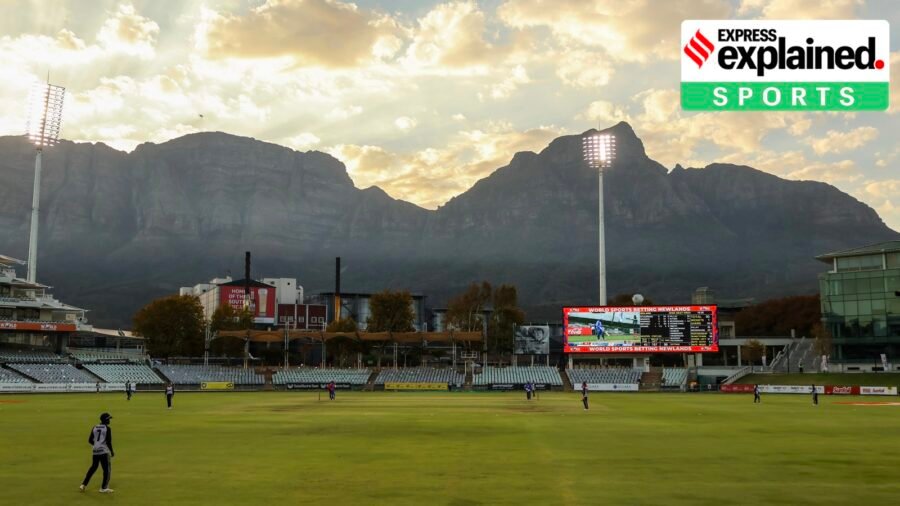
Unlike India, South Africa’s Test fixtures are rotated primarily between Wanderers, Newlands, St George’s Park, Kingsmead and SuperSport Park. With the introduction of SA20, the T20 franchise tournament, curators have faced criticism that the pitches have become slower.
Story continues below this ad
“In recent years, the capacity of each venue has increased because of the number of cricket that is being played. So by rotating these pitches, we can keep them fresh. Around 80% of all the games are played on the middle 1-4 pitches because the broadcasters prefer it that way, and if we move further aside, the boundary sizes get compromised. Since we can’t replace all the pitches ahead of the World Cup, we felt this is the best way to keep them fresh,” Hilbert Smit, a pitch consultant and part of the Project 2027 Cricket South Africa team for the World Cup, tells .
What has been the reception?
Since news of the EPS emerged, there have been fears that the Proteas could lose home advantage. South African pitches are distinctive for the bounce and seam movement they offer.
During Tests, conditions can change drastically, with some strips getting quicker after baking under the sun. The drop-in pitches in Australia have been on the flatter side, and South Africa coach Shukri Conrad feared his team could lose home advantage.
Story continues below this ad
Flint, who has been in charge of Wanderers in the past, plays down those fears. “It’s generally accepted that white ball pitches across the world are made to favour the bat. They are all very, very similar. But what we have done is that each ground has used its own soil and its own grass and its own construction methods. So yeah, there will be variances or differences purely in that. So that should keep that kind of natural characteristics for each venue. But then again, I argue, what are the characteristics of a white ball pitch?”
Retaining home advantage
While Flint’s logic holds true for white-ball fixtures, the main concern remains about Test cricket. But even here, Smit says there is nothing to worry about.
“The two centre pitches that we usually use for Test and international cricket remain locked where they are. We are not touching them. Suppose there are four pitches in the middle; 2 and 3 are left untouched. 1 & 4 will have EPS. So instead of four pitches sharing the load, we will have 8 pitches sharing the load. Since they are constructed in a tray, they will hold more moisture, and that alone is sufficient to say it would be the same as the original pitches,” Smit explains.
Which venues have EPS?
Wanderers has already implemented the model, with a match played last February. Newlands, St George’s Park, Kingsmead and Boland Park have installed EPS but are yet to use it. The plan is to use these pitches for domestic rather than international cricket. “It is sensitive. The concept will work 100%, but we don’t want to rush. We are not ready to use it for a Test match or for the World Cup. But we are using the World Cup as a vehicle to get used to this system because that’s the best way to stop the pitches from deteriorating,” Smit says.
Story continues below this ad
Even Flint concurs: “Just in terms of the World Cup, I don’t think anyone is in a position to play any World Cup matches yet. We haven’t had enough time to sort of test them domestically. That will only happen this season. Wanderers is ahead of them; they were the first ones to have it in, so they could potentially use it for this year’s SA20.”

The mindset shift Virat Kohli is talking about: ‘Promised myself…to play more freely’
By Sohail Khan · 28 Sep
Safe and healthy workplace as a legal right: Does the OSH code deliver?
By Sohail Khan · 28 Sep
Microplastics in bottled water: What 240,000 particles per litre means for your health
By Sohail Khan · 28 Sep
Leave a Reply