Oil prices fall 3% as US shifts to Iran sanctions; brent, WTI drop amid Hormuz risks
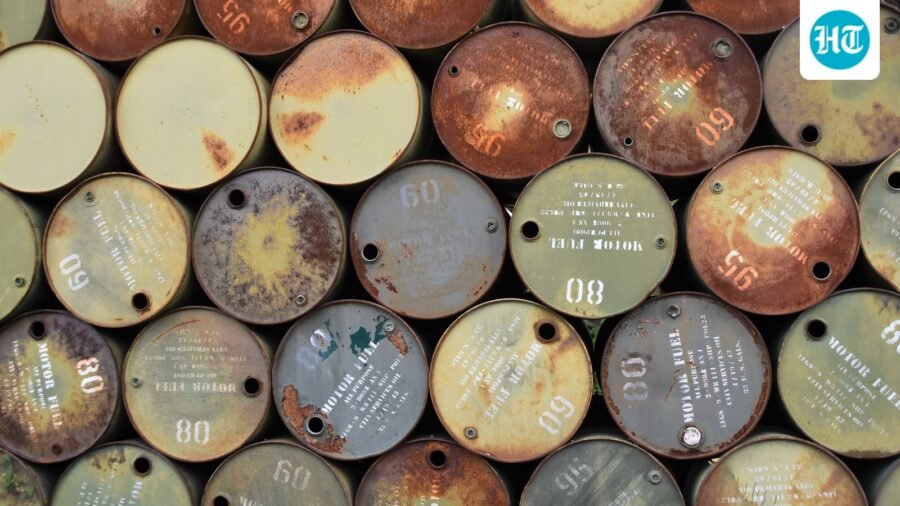
Oil prices fell 3% as the US shifted to Iran sanctions. Brent and WTI dropped as markets watched Iran oil exports and risks around the Strait of Hormuz.
Updated on: Aug 25, 2026, 22:09:20 IST
Prefer HTon Google
Share via
Copy link
Oil prices fell about 3% on Tuesday as the US shifted its focus from military strikes to economic sanctions to pressure Iran. Brent crude, the international oil benchmark, fell 3.3% to $89.14 a barrel. US West Texas Intermediate crude, or WTI, dropped 3.1% to $82.36 a barrel.
Oil prices have now fallen more than 5% this week after the US announced a new round of sanctions against Iran and companies and individuals that continue to trade with the country. The White House has described its new campaign against Iran as an “economic D-Day.”
Treasury Secretary Scott Bessent has called the campaign “the single greatest financial offensive ever.” Bessent said last week that the stronger economic pressure on Iran makes a return to a major war less likely for now.
Deep Dive
Powered ByAsk
“If we are doing the maximum economic pressure, then that means that likely there will not be a large-scale kinetic restart,” Bessent told CNBC’s “Squawk on the Street” on Thursday. The US is also showing signs that it does not expect an immediate return to full-scale fighting.
The State Department is preparing to send evacuated US diplomats back to the Middle East as early as this week, The New York Times reported Tuesday. The planned return of diplomats could signal that Washington does not currently expect all-out warfare to restart.
Strait of Hormuz
President Donald Trump said Tuesday that the US Navy had informed him that all mines had been cleared from international waters in the Strait of Hormuz. CNBC said it had contacted US Central Command for comment. Trump warned Iran against placing new mines in the key waterway. “Iran has been notified that any ship or boat placing new mines will be immediately and systematically destroyed,” Trump said in a Truth Social post.
Trump also said the US is closely watching the Strait of Hormuz through the Space Force. He said the US was watching “every square inch” of the Strait and pointed to Pickaxe Mountain and three other nuclear sites that he said had already been destroyed. Trump said a “Zero Tolerance” policy on placing new mines was now in effect.
Iran says it is ready for more sanctions
Despite the shift toward economic pressure, the US has not completely ruled out military action against Iran. Defense Secretary Pete Hegseth said Monday that further US strikes in the Middle East remained possible.
“If we need to use kinetic strikes, we’ll use them,” Hegseth told reporters. Hegseth warned that the US would respond if Iran made a move against the American military. He said economic pressure is hurting Iran the most right now, but stressed that the US has not ruled out military strikes around the Strait of Hormuz or Iran.
Iran, meanwhile, says it is prepared to deal with tougher US sanctions. Iranian Economy Minister Ali Madanizadeh said on state television that Tehran is “fully prepared” to withstand additional sanctions. Madanizadeh said the Iranian government already has a two-year plan to manage the situation. He said Iran has its own tools and knows how to respond to the US pressure.
China could become a key issue
The latest US sanctions could also put pressure on China, one of Iran’s biggest trading partners. China could face consequences if it continues buying Iranian oil under the new US sanctions plan. Beijing has repeatedly called for a diplomatic solution to the conflict between the US and Iran.
Chinese Foreign Ministry spokesperson Lin Jian said Tuesday that China would do everything necessary to protect its rights and interests. Lin said China opposes unilateral sanctions that it believes have no basis in international law or approval from the U.N. Security Council. He also said economic warfare and maximum pressure cannot solve the problem. Lin said China’s trade and cooperation with Iran are carried out within international law and should not be disrupted.
Analysts at BBH said the latest US sanctions look more like a warning than a major final blow against Iran. BBH strategists said the US expanded sanctions but stopped short of immediately imposing secondary sanctions on other countries that continue trading with Iran.
China is a major pressure point because it is Iran’s largest trading partner and buys roughly 90% of Iran’s oil exports, according to BBH strategists. This makes China one of the biggest challenges for the US if Washington wants its Iran sanctions to have a stronger impact. BBH warned that directly targeting China over its Iranian oil trade could mean going after major Chinese banks and oil refiners.
Such action could create financial disruption, trigger retaliation from China and put pressure on the already fragile relationship between Washington and Beijing. For oil markets, the immediate focus remains on whether the US continues using economic sanctions instead of expanding military action and what that means for Iran’s oil exports and the Strait of Hormuz.
See Less



Leave a Reply