US leverage, India’s limited options: Why is the trade deal taking so long?
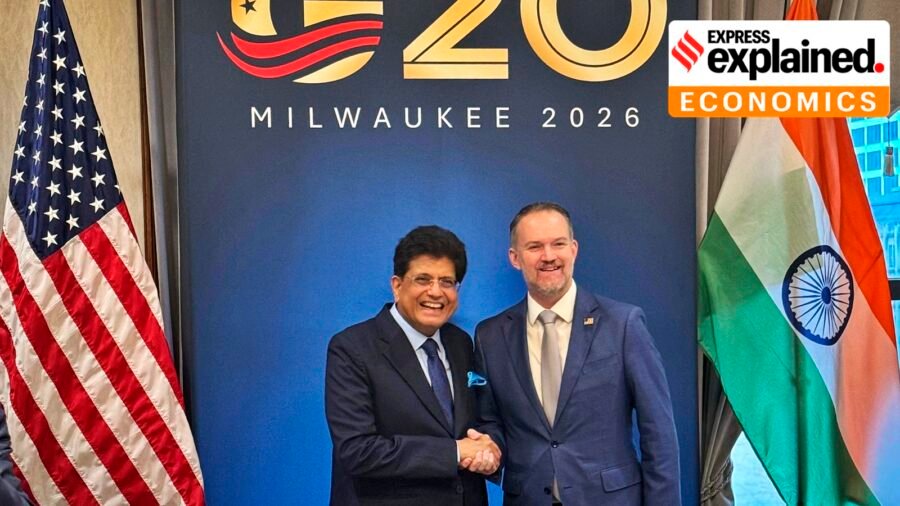
United States Trade Representative (USTR) Jamieson Greer said Thursday (October 1) that trade deal talks between India and the US are in their final phase, but the signing of the deal is “not imminent” as both countries are working to resolve “sticking points”.
Greer’s comment came as a surprise. India and the US had agreed to a framework agreement in February this year. Commerce and Industry Ministry officials have maintained that the countries have already arrived at a deal. And India was believed to have been awaiting comparatively better tariff rates before signing a deal.
A day after meeting Commerce and Industry Minister Piyush Goyal, Greer said the talks were constructive and that India and the US were in their final phase. “At the same time, I don’t think there’s something imminent, but we truly have identified the universe of items that are sticking points. We’re working diligently toward them. My sense is that the president, the Prime Minister, may have another call, very soon on this, just to assess progress in where we are,” Greer said at a press briefing.
Story continues below.
Subscribe to see fewer ads.
Mixed signals on US-India trade
Last month, US President Donald Trump signed into law the Lindsey O. Graham Sanctioning Russia and Iran Act of 2026, which provides for up to 100% tariffs on key buyers of Russian energy (such as India).
Unlike the previous US tariff architecture under the International Emergency Economic Powers Act — which was struck down by the US Supreme Court — these new proposed tariffs cannot be challenged in court.
The Russia sanctions law also sent mixed signals to India. The US in February had agreed to remove the additional 25% tariff on imports from India in recognition of India’s commitment to stop purchasing Russian oil. India committed to “negotiate a robust set of bilateral digital trade rules that address discriminatory or burdensome practices and other barriers to digital trade”.
Apart from the Russia-related tariffs, India is awaiting a decision on an investigation launched by the US under yet another tariff mechanism — Section 301 of the Trade Act of 1974. The investigation is expected to establish if India has excess industrial capacity and is hurting American companies with its output. The first set of Section 301 tariffs had resulted in 10% tariffs.
Story continues below this ad
With the new set of Section 301 tariffs expected to come in, Indian exporters said that the uncertainty is changing the nature of orders. US buyers are no longer placing bulk orders and are diversifying imports. This could mean lower export orders for Indian businesses in the long term till the deal is not signed. Top US trade partners have been placed in a 10-15% tariff bracket, and India has sought better rates than ASEAN countries and China.
Goyal, in the US, also said that India’s manufacturing capacity serves its domestic and global needs and that the country does not have structural excess capacity. The minister added that India shares the concern of several G20 members that trade-distorting support in some countries leads to dumping and predatory pricing, and it addresses such practices through evidence-based WTO measures, including anti-dumping and countervailing duties.
Steep demands
Under the framework agreement, India had said it intends to purchase US products worth $500 billion — energy, aircraft and aircraft parts, precious metals, technology and coking coal — over the next five years. However, experts have pointed out that there is no commitment on the part of the US to purchase Indian products, making the deal lopsided.
Story continues below this ad
The US and India had also agreed to “strengthen economic security alignment to enhance supply chain resilience and innovation through complementary actions to address non- market policies of third parties, as well as cooperation on inbound and outbound investment reviews and export controls”.
“If India is compelled to negotiate provisions on economic security alignment which are similar to those contained in the various Agreements for Reciprocal Trade between the US and some countries, then it would substantially curtail India’s sovereignty on foreign policy, trade and other economic matters,” a trade expert who did not wish to be named said.
Beyond trade
The US’s recent trade war with Canada has shown that American demands have gone far beyond goods or digital trade. Canadian Prime Minister Mark Carney has hinted that the US wanted his country to refrain from signing a deal with China under the terms of a bilateral pact. US demands from India may have also gone beyond trade.
In an investment climate report on India released last month, the US State Department said that India’s Foreign Exchange Management Act or FEMA restricts concurrent foreign direct investment and foreign portfolio investment. It creates a redundant and uniquely burdensome restriction that blocks independent funds within the same investment group from participating in initial public offerings, the report added.
Story continues below this ad
Further, it said that the effective tax rate paid by foreign banks is 4.63 percentage points higher than domestic banks at 38.22%.
“This higher effective tax burden may ultimately affect the relative attractiveness of India as a market for foreign lenders, potentially influencing their decisions on capital allocation, pricing, and the scale of their local operations,” the US State Department said.

How ‘namjai’ captures the spirit of Thai food culture
By Sohail Khan · 2 Oct

10 weekend getaways from Delhi within 300 km that are perfect for a bike ride
By Sohail Khan · 2 Oct
Leave a Reply