Flydubai flight: How tighter post-9/11 rules could have impacted cockpit access
Story continues below.
Subscribe to see fewer ads.
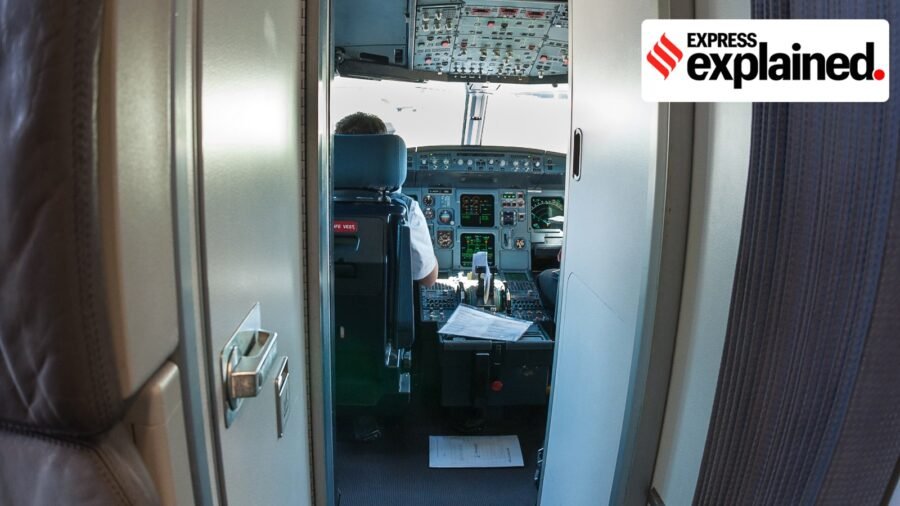
How a cockpit door functions
A cockpit door separates the flight panel — the crucial flight control system with numerous buttons, gauges, switches and levers — and the pilots handling it from the rest of the crew and passengers on board.
Generally, the door lacks handles and can be opened only with the pilots’ coordination. A crew member seeking to enter the cockpit during a flight must first enter the entry code on a keypad panel attached outside. Once the correct code is input, the pilots receive a signal. They then switch the door setting on their flight panel to “unlock”.
The panel has three settings — normal, unlocked and locked. In the normal mode, the cockpit door is locked, but the cockpit can be accessed after a 30-second delay once the correct code is entered, according to a BBC report. In the locked setting, as described earlier, pilots must allow access as a second layer of protection.
Story continues below this ad
How this system came about and why it’s been criticised
The 9/11 attacks saw 19 al-Qaeda terrorists hijack four commercial aeroplanes. Two of them were flown into New York’s twin towers, the third was flown into the Pentagon (the headquarters of the US Department of Defense in Arlington), while the fourth plane was prevented from flying towards Washington, DC, by passengers and crew who fought back.
Story continues below this ad
The events transformed the world, broader geopolitics, and the way people travelled. Before 9/11, there were fewer limitations at airports and on flights, and security checks were nominal. As journalist David Schaper wrote for NPR, “It’s hard to fathom now, but we used to be able to arrive at the airport just minutes before a flight. We’d keep our shoes and coats on as we went through a simple metal detector, and virtually anyone could go right to the gate without a boarding pass or even showing an ID.”
Cockpit doors were no exception. While they were kept at times locked during flights, a law passed in November 2001 mandated additional safety. The Aviation and Transportation Security Act (ATSA) provisioned funds to “fortify cockpit doors to deny access from the cabin to the pilots in the cockpit” and “provide for the use of video monitors or other devices to alert the cockpit crew to activity in the passenger cabin”.
In accordance with ATSA and a January 2002 mandate, agencies in the US worked to ensure that air carriers reinforced cockpit doors on commercial aircraft in order to protect from intrusion, small-arms fire and fragmentation devices such as grenades. By April 2003, all air carriers met the requirement, according to the Philadelphia International Airport website.
Story continues below this ad
Cockpit doors today are made of hard material and are bullet-resistant. The 9/11 attacks also put an end to the common practice of pilots flying the plane with the doors open, and allowing visitors (such as crew members or even passengers) inside while the plane was airborne.
Over time, however, the strict system has come under criticism. In the aftermath of the flydubai incident, aviation expert Philip Baum told The Guardian, “We have as an industry lost more lives on commercial aircraft as a result of aircraft-assisted suicide since 9/11 than we have due to terrorism.” Other experts argue that the safety safeguards are essential for pilot and aircraft safety.
An infamous case was the 2015 Germanwings Airbus A320 flight from Spain to Germany, where one co-pilot wrested control of the plane by locking the other pilot out of the cockpit. He then deliberately crashed the aircraft into the French Alps, killing all 150 people onboard.
It prompted a questioning of norms on cockpit entry. At the time, the BBC reported, the German aviation safety authority mandated that when two pilots are inside, one can exit the cockpit but only for a minimum period. Other airlines have a “rule of two”, the report said, “where if a pilot leaves the cockpit for any length of time, another crew member must replace them. However, this is not the case with Lufthansa or other major airlines.”
Story continues below this ad
The European Union Aviation Safety Agency also briefly mandated that two crew members stay within the cockpit at all times, but the requirement was later relaxed. Today, the two-person rule is the norm in airlines across the world.


US leverage, India’s limited options: Why is the trade deal taking so long?
By Sohail Khan · 2 Oct
10 weekend getaways from Delhi within 300 km that are perfect for a bike ride
By Sohail Khan · 2 Oct
Leave a Reply