Unwise to ignore what Xi’s US visit pageantry masked
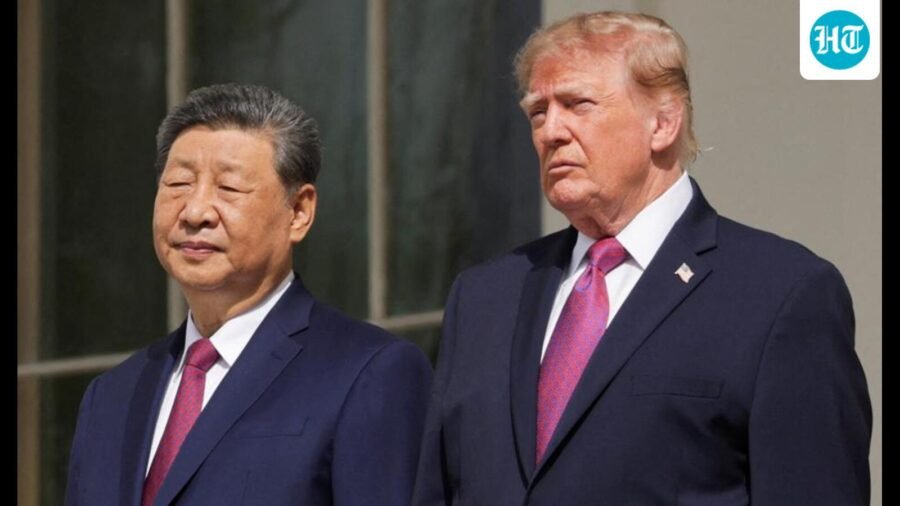
The pageantry in Washington masked consolidation of a significant strategic shift. India would be unwise to overlook it
Published on: Oct 3, 2026, 06:10:42 IST
Prefer HTon Google
Share via
Copy link
The prevailing view about Chinese President Xi Jinping’s State visit to the US late last month is that it was high on pageantry and low on substance. This misses the broader point: Modest deliverables were expected, and the visit was never about concrete outcomes; but it also consolidated a new stage in the recalibrated great power relationship and showed how US President Donald Trump and Xi are managing the changing equilibrium.
The gestures were extraordinary. Trump received Xi on the tarmac at Joint Base Andrews, something no US President had done for a visiting leader (except the Pope) since 1962. This was the two presidents’ third meeting in less than a year. Two more are fixed: APEC in Shenzhen in November and the G20 in Miami in December.
The recalibration began with China’s forceful retaliation against Trump’s so-called Liberation Day tariffs of April 2, 2025, with matching tariffs and, more tellingly, leveraging of its near monopoly over rare earth magnets. Alarm in the American markets pushed Washington towards a tactical truce — the Busan understanding of October 30, 2025. At the Beijing summit in May this year, the US accepted the Chinese relationship template of “constructive strategic stability”.
In Washington, the year-long Busan truce was extended by just two months, to January 10. Tariff relief was agreed on $30 billion of “non- sensitive” goods each way. A China-US AI dialogue and an incident-communication channel were established. Both sides agreed to operationalise a trade board.
The two readouts diverge sharply. Beijing led with the relationship formula as its headline outcome; Washington buried the same words deeper in the text. The White House lists a hard purchase commitment, Chinese coal imports, and a rare-earth ask; Beijing confirms none of this. The lone security outcome, a militaries’ memorandum on crisis communication, appears only in the Chinese account. Xi pressed Trump to “adhere to the correct position of opposing Taiwan independence”; the US did not contest this, and its own declared position is that it does “not support” independence. Xi amplified the “constructive strategic stability” principle, with cooperation as its mainstay, competition within limits, differences kept under control, and peace within reach.
The balance has tilted towards Beijing. In practice, the US now treats China as a peer, able to inflict economic pain the US is not prepared to bear. Four phrases sum up how: recalibration, a K-shaped relationship, a strategic stalemate, and a G2 overlay, not an actual G2 grouping.
Washington’s restraint extends to tools it already holds. A Section 301 investigation into China’s industrial overcapacity, launched earlier this year, has been repeatedly postponed. The $14-billion arms package for Taiwan, which Trump has called a “bargaining chip”, remains on hold. Days before Xi’s visit, Trump signed the Sanctioning Russia and Iran Act, authorising tariffs of up to 100% on large buyers of Russian oil and gas. China is, by far, the largest such buyer, ahead of India. Yet the law has so far been waved chiefly at India, not China, which has the capacity to retaliate.
All this said, the rivalry — though muted — remains robust in substance. The relationship is K-shaped: leader-level diplomacy is on the rise, even as competition in trade, technology, and military domains continues underneath. The US has placed curbs on import of Chinese drones and robots and accused Chinese firms of “industrial-scale” distillation of American AI models; Beijing, meanwhile, steers its firms away from Nvidia chips and has delivered only two-thirds of the rare earths promised at Busan. US treasury secretary Scott Bessent summed this up as the Chinese “kicking under the water”, and the US being ready to kick back. Washington’s ambassador in Beijing, David Perdue, said bluntly on X, in English and Chinese, two days after the visit: China had “weaponised” its rare-earth controls; the US would not “kowtow”; rebuilding independence in rare earths, magnets, pharmaceuticals, and shipbuilding meant “a bumpy road over the next year”.
Nor has Beijing changed its basic assessment. It sees the US as a declining but dangerous superpower, bent on containing and suppressing China. Its strategic community now speaks of a “strategic stalemate”, a term from Mao’s 1938 essay “On Protracted War”. For Mao, stalemate was the middle and longest stage, when the weaker side builds strength and prepares for “strategic counter-offensive”. Seen this way, Busan, Beijing, and Washington represent “campaign buffer periods” to be used, not settlements.
China is in no hurry to displace the US outside the western Pacific. Nor is it equipped or inclined to be a security anchor elsewhere. Beijing sees the Trump presidency as a window to consolidate its gains before 2028, when elections in Washington and Taipei will test it.
The resulting equilibrium is unstable, but relatively resilient as it rests on mutual vulnerability. A new Taiwan arms package, which Congress is pressing for, or an abrupt change in Trump’s stance could upset it. Both sides are buying time. China faces a property overhang, weak domestic demand, and growing debt. The US is a distracted superpower.
If Washington and Beijing coordinate tacitly, their combined weight can shape decisions for others on select issues. Five implications stand out for India:
First, a G2 overlay could produce rules that affect India without allowing for its voice, as on AI.
Second, a Washington that treats arms sales to Taipei as a bargaining chip with Beijing, fawns over Xi, and holds back its own tools against Beijing, raises questions for the durability of US commitments in Asia.
Third, a China locked in a protracted contest has reason to reduce friction with India while discouraging it from drawing closer to the US. This partly explains the recent thaw, which is tactical and reversible, as Beijing is also aware of India’s reduced strategic space vis-à-vis the US.
Fourth, India must prepare for periodic, bounded US-China escalation followed by renewed truces, rather than a full rupture.
Finally, India should pursue differentiated de-risking towards both, reducing dependence on China for critical inputs without creating new dependencies on the US.
The pageantry in Washington masked consolidation of a significant strategic shift. India would be unwise to overlook it.
Ashok K Kantha is Subhas Chandra Bose Chair Professor of IR at Chanakya University, Bengaluru. The views expressed are personal
Get Current Updates on India News, Elections 2024, Lok sabha election 2024 voting live , Karnataka election 2024 live in Bengaluru , Election 2024 Date along with Latest News and Top Headlines from India and around the world.
See Less
In democracy’s journey to future, Gandhi is the wise guide and co-traveller
By Sohail Khan · 3 Oct
Delhi’s new master plan can soothe parking pains
By Sohail Khan · 3 Oct

Leave a Reply