In democracy’s journey to future, Gandhi is the wise guide and co-traveller
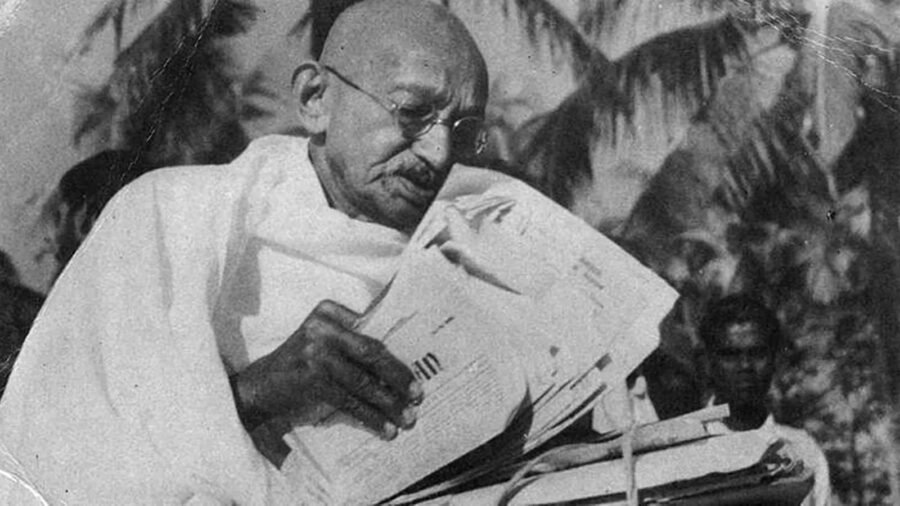
Is Gandhi relevant for imagining the future trajectories of democracy in India? I do not want to explore this question in typical Gandhian fashion to express my gratitude to the father of the nation on his birth anniversary. Instead, I want to take up the challenge posed by Yogendra Yadav for all of us in one of his recent articles in this newspaper (IE, “Democracy needs renewal. Our idea of Swaraj offers some answers,” September 22). Yadav has forcefully argued that we need to employ Gandhi, and other thinkers and practitioners of modern India, as “resources” to reimagine a more egalitarian futuristic institutional architecture.
Yadav’s invitation also points towards an interesting paradox. Gandhi is usually commemorated as a symbol of protest politics. People’s movements, campaigns led by civil liberty groups and popular protests of various kinds recognise the significance of Gandhian techniques, especially the non-violent Satyagraha. That has been the reason Gandhi’s image as an activist continues to survive even eight decades after his death. Despite being celebrated as a successful protester, Gandhi is not seen as a relevant figure for any serious discussion on institutional-building. Even the admirers of Gandhi prefer to remain silent on this issue.
Advertisement
It is true that Gandhi had always been critical of the idea of the modern state. He preferred to call himself a philosophical anarchist; he celebrated his inconsistencies and context-specific responses to emerging questions of public life. Hind Swaraj (1909) is the only book that he refused to amend, change, update or edit. These examples certainly underline Gandhi’s non-conformist attitude. Yet, one cannot ignore a constructive impulse in his writings and politics.
Gandhi encourages us to oppose injustice of all kinds by adhering to the values of truth and non-violence. At the same time, he is deeply interested in developing alternative, humane, decentralised, inclusive, and above all, truthfully democratic public institutions. In an article written in 1925, Gandhi argued: “I remain loyal to an institution so long as that institution conduces to my growth, to the growth of the nation. Immediately I find the institution instead of conducing to its growth impedes it, I hold it to be my bounden duty to be disloyal to it” (Young India, August 13, 1925).
Gandhi’s creative intellectual positioning is very relevant for us to revisit the three fundamental questions Yadav has raised: Social hierarchies and economic disparity that makes one-person-one-vote insignificant; politically controlled mass media, which prevents the formation of an effective public opinion; and political centralisation that leads to a person-centric authoritarianism.
Advertisement
Caste-based prejudices, communal stereotypes and the supremacy of rich and powerful individuals have reshaped our public life in the past three decades. Violence against Dalits, women and minorities has increased in an unprecedented manner, while the poverty and economic helplessness of the majority of Indians has not yet become an electoral issue. From Gandhi’s standpoint, we can think of a critically constructive response: The marginalisation of Dalits and minorities is primarily talked about as a group-specific issue. It creates an impression that their concerns are not at all “national”. The binary between national interests and the marginalisation of deprived groups has emerged as an unwritten guiding norm of policy discourse. Against this backdrop, one can propose to have a robust cultural policy framework not merely to democratise the institutional culture but also to create an environment in which the poor, Muslim, Dalit, and woman can feel secure that his/her anxieties are going to be addressed as “national issues”.
Gandhi was aware of the significance of an informed and reasonable public opinion. For him, “… a Satyagrahi… must first mobilise public opinion against the evil which he is out to eradicate… when public opinion is sufficiently roused against a social abuse even the tallest will not dare to practice or openly to lend support to it. An awakened and intelligent public opinion is the most potent weapon of a Satyagrahi” (Young India, August 28, 1929). This suggestion is very useful in the present context, when the dividing line between news and propaganda has become increasingly blurred. The linkage between the media economy and political power is very apparent.
Gandhi offers us a threefold solution to deal with this issue: A peaceful politics of action (for instance, a movement for making the media accountable without compromising the freedom of expression); a politics of discourse that may transform the struggle for human emancipation into a dominant narrative of public life. And finally, a politics of belief and commitment. For Gandhi, “a person who claims to be a Satyagrahi always tries by close and prayerful self-introspection and self-analysis to find out… whether he is not himself capable of those ‘very evils’ against which he is out to lead a crusade” (Young India, August 28, 1929).
Let us now turn to the third challenge — the problem of political centralisation and the authoritarian structure of political parties. Gandhi approaches this question from a very different vantage point. He identifies political centralisation as an outcome of a systemic process, which is produced and nurtured by professional politicians as well as voters. Recognising the numerical significance of voters in democracy, Gandhi proposes the idea of an informed and morally conscious voter. He writes: “… we need an electorate, which is impartial, independent and intelligent. If the electors do not interest themselves in national affairs… and if they elect men with whom they have private relations or whose aid they need for themselves, this state of things can do no good to the country; on the contrary, it will be harmful” (Young India, June 9, 1920). This argument may sound impractical at the moment. But no one can deny the significance of an electoral morality to make democracy more egalitarian and inclusive.
Yadav’s invitation to travel with Gandhi as a co-traveller, therefore opens up a new possibility: Gandhi may give us hope, aspiration and intellectual solidarity to think what at the moment seems unthinkable.
The writer is a political scientist

Delhi’s new master plan can soothe parking pains
By Sohail Khan · 3 Oct
Unwise to ignore what Xi’s US visit pageantry masked
By Sohail Khan · 3 Oct

Leave a Reply