Why melting glaciers could ‘put 20% of India’s GDP at risk’, and one change that can help
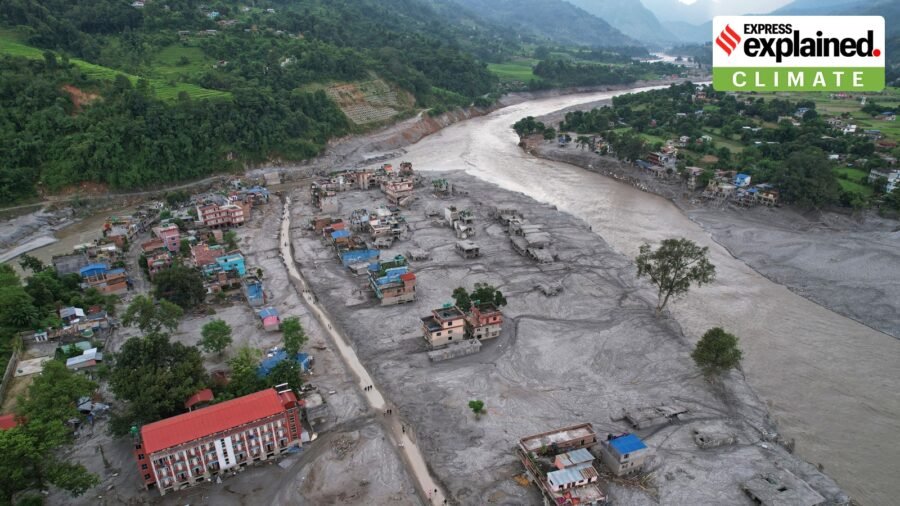
The recent floods in Nepal have put the Himalayas’ melting glaciers under the spotlight. But damage from the warming Himalayas does not always come in the form of a spectacular disaster. It also means slow economic drain, as glaciers retreat, water supplies become less reliable and the rivers that sustain agriculture, industry, cities and hydropower change. A new report puts a number to the economic dependence: more than one-fifth of India’s GDP is underpinned by the Himalayas.
The report, ‘A resilient Himalaya: protecting a region at risk and securing future prosperity’, was compiled by the global consultancy Systemiq, in partnership with Integrated Mountain Initiative, and supported by the International Centre for Integrated Mountain Development (ICIMOD), Nepal, and GB Pant National Institute of Himalayan Environment, Uttarakhand.
The report estimates that Rs 64.8 lakh crore, or 21.5% of India’s FY24 GDP, is dependent on the Himalayas. This does not mean that glacier melt would wipe out 21.5% of India’s GDP. The report describes the figure as a measure of economic activity that can be traced to dependence on Himalayan water, rather than an estimate of climate damages.
Story continues below.
Subscribe to see fewer ads.
And while a lot of this damage is because of global warming, the report also highlights a local source of emissions India has the power to control.
Why glaciers matter to India’s economy
Glaciers act as natural stores of water. They hold water as ice and release meltwater into rivers, particularly during the dry season. But as warming accelerates melting, this extra flow cannot continue indefinitely. Himalayan river basins are expected to reach “Peak Water” around the middle of this century — the point at which glacier meltwater reaches its maximum, after which flows begin to decline as the ice reserve shrinks.
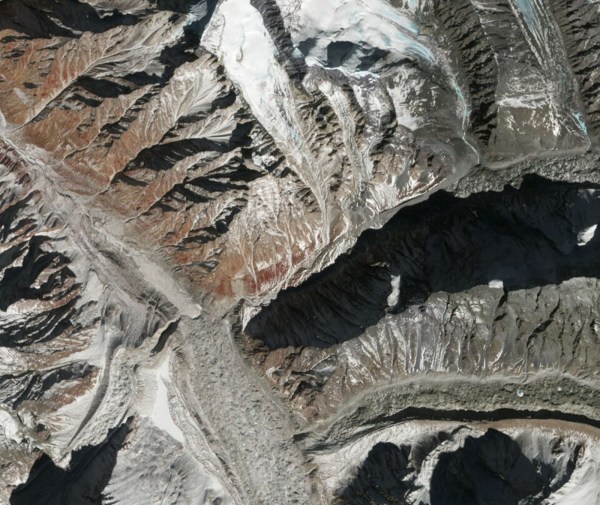 The retreating Gangotri glacier, as seen from the European Union’s Copernicus Sentinel-2 mission in 2018. Gangotri is the primary source of the Bhagirathi river, which eventually becomes the Ganga.
On current trajectories, the Hindu Kush Himalaya could lose up to 80% of its present glacier volume by 2100, the report says. That matters because the Himalayas feed the Indus, Ganga and Brahmaputra river systems, supporting agriculture, cities and industry downstream.
“The rivers that carry risk downstream also carry the water that sustains India’s economy: wheat and rice across the Indo-Gangetic plain, tea in Assam and Bengal, hydropower in the Northeast, and pilgrimage economies in downstream towns,” the report says.
Story continues below this ad
About how it calculated the 20% of the GDP figure, the report explains the three layers it used, “(1) direct: GSDP of Himalayan states; (2) indirect: downstream agriculture, manufacturing, hydropower, and services reliant on Himalayan-fed rivers and groundwater recharge (rain-fed production excluded); and (3) induced: supply-chain (e.g., tractors sold from southern states to IndoGangetic Plains) and wage-spending effects (e.g., spent on food and services).”
The report also highlights that the Himalayas are already a major disaster hotspot. They account for 18% of India’s land but around 35% of its disasters. Disasters can create food and water insecurity, disrupt supply chains, displace people and increase macroeconomic and sovereign-debt pressures, creating a cycle in which reconstruction spending leaves less money for future resilience.
The black carbon connection
The report identifies black carbon — soot produced by incomplete combustion — as a polluter that is causing damage and which India can control faster.
“Recent modelling attributes about one-third of glacier mass loss in the Himalayas to South Asian black carbon. Industry, primarily brick kilns, contributes 32-42% of South Asian anthropogenic deposition across the region. Cutting kiln emissions therefore tackles local air pollution and glacier melt through the same plume,” the report states.
Story continues below this ad
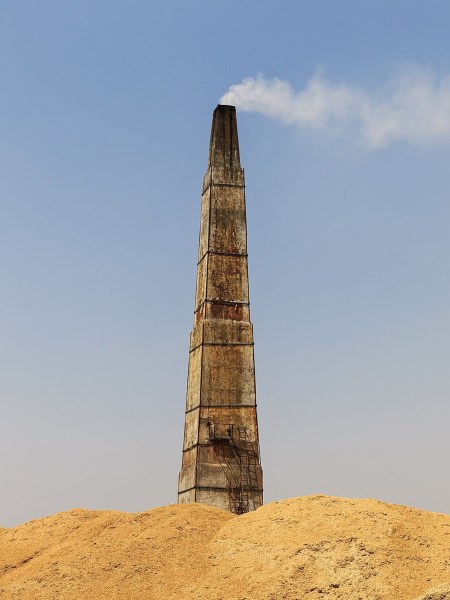 Brick kilns are a common site across India.
The report proposes a targeted fund to modernise brickmaking, upgrade viable kilns, retire the worst-performing ones and reduce demand for fired bricks.
Other experts agree with the dangers of black carbon. “Black carbon has a real, major, and measurable effect on the Himalaya. When it lands on snow, it darkens the surface, so the snow absorbs more sunlight instead of reflecting it. Modelling shows this “snow darkening” effect alone adds about 40 watts/m² of surface heating in spring season across the Himalaya,” Nimish Singh, President and Director, Gateway Research, the India arm of the Institute for Governance and Sustainable Development, told .
Singh also said that while fixing brick kilns would have measurable benefits, “brick kilns are not the whole story.” “Kilns are flexible. Converting kilns to zigzag technology (a method of firing the bricks in a way that fuel is burnt more efficiently) cuts black carbon and particulate emissions by roughly 70% and fuel use by 20–30%. But adoption is uneven in India. Punjab and Haryana have completed the switch to zigzag kilns. Uttar Pradesh, India’s largest brick producer, is still at only 56%. The rest of India is running on traditional tech,” Singh explained.
He, however, added that, “Real progress needs kilns, cookstoves, transport, and crop-residue burning to be tackled together, coordinated at the airshed scale rather than kiln by kiln or city by city.”


From Ralph Lauren to Fendi: Why Indian crafts are easy to borrow but hard to protect
By Sohail Khan · 17 Sep

Leave a Reply