From Ralph Lauren to Fendi: Why Indian crafts are easy to borrow but hard to protect
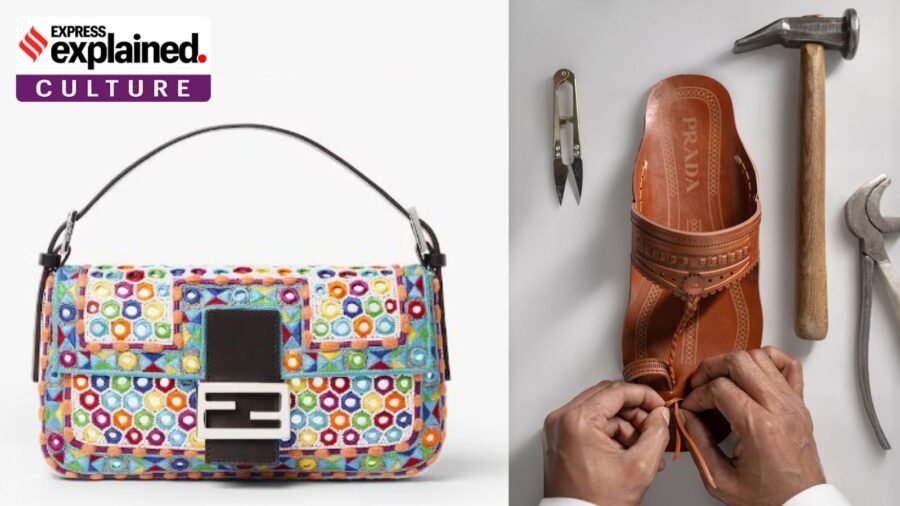
India’s crafts and weaves are skills and visual languages carried across generations, embedded in particular regions and communities. Yet when these traditions enter the global luxury fashion system, the people and places behind them become invisible.
After the cultural misappropriation of Kolhapuri chappals by Prada, luxury fashion brands Ralph Lauren and Fendi have once again watered down the Indian origin and denied inspiration or credit for their new products. During its spring/summer 2027 show at the New York Fashion Week, Ralph Lauren showcased a pink evening gown with aari (hook embroidery from Gujarat) work, describing it as “hand-applied embellishments.”
Fendi’s autumn collection has a mirror-work Baguette bag, made in Italy over 138 hours, using 39,500 beads and 475 mirrors, and priced at $10,000. It is a knock-off of the mirrored purses that you would find in crafts fairs here.
Story continues below.
Subscribe to see fewer ads.
This raises a larger question as to why is it so much easier for a traditional Indian craft to be commercially appropriated than it is for the community behind it to demand recognition, ownership or participation in the value it creates? “The difficulty begins with a fundamental contradiction: Intellectual property is territorial, while culture is not,” says Safir Anand, senior partner and head of Trademarks, Contractual and Commercial IP at the law firm Anand and Anand.
Who owns a craft that nobody invented alone?
A centuries-old craft technique does not fit neatly into the categories of conventional intellectual property. There may be a particular artistic expression, a design, a geographical identity or a protected name. But the underlying tradition may belong to a community and may have evolved over generations. “Traditional crafts have cultural provenance but no clearly identifiable legal owner. That is the gap which is exploited, the space where conversation needs to innovate,” says Anand.
Professor Nirbhay Rana, Professor of Practice at Masters’ Union on fashion design and innovation, makes the same distinction. A Geographical Indication (GI) can protect the name, origin and reputation of a qualifying product, but not necessarily every motif, stitch or visual element associated with a craft. “The central principle should be representation and custodianship: the people who have sustained and transmitted the tradition should have a meaningful role in decisions concerning its protected commercial use,” he says.
That is why institutional capacity matters. Producer organisations, cooperatives and other representative bodies can help document provenance, organise authorised users where relevant, negotiate collectively and pursue enforcement. “Under India’s GI Act, both registered proprietors and authorised users have rights to seek relief for infringement. Recognising a right and giving a community the practical capacity to exercise that right are two different things,” he says.
Story continues below this ad
Who owns something that has been collectively developed over generations? For Anand, individual ownership can exclude the very community that preserved the craft. “Where a craft has a registered GI, the position becomes considerably stronger. Within India, registered proprietors and authorised users can bring infringement proceedings and seek remedies including injunctions and damages and account of profits. But cross-border litigation can be resource-intensive, so a formal conversation giving the communities collective legal identity, documented provenance, enforceable rights, and a mechanism for attribution and benefit-sharing can help,” he says.
What can a community claim?
Traditional craft complicates the very idea of authorship. The person who first created a technique may be unknown, impossible to identify or irrelevant to the way the tradition has actually developed. One generation passes knowledge to another; each generation may alter it slightly; the community continues to practise it. “However, this absence of an identifiable author cannot become an invitation to appropriate work,” Anand says.
Rana suggests the law could recognise the community as custodian where a continuing relationship exists between a cultural expression and the community that has preserved, practised and transmitted it. “Historical records, regional practice, oral testimony and community knowledge could help establish provenance,” he says.
The challenge of documentation
But documentation itself presents another challenge, according to designer Raghavendra Rathore. Traditional knowledge cannot simply be recorded and handed over to an outside institution. Some knowledge may be sacred or restricted, and documenting it should not result in someone else gaining control over it.
Story continues below this ad
“A carefully maintained digital registry could document motifs, techniques, names, regions and custodial communities. Such a registry would not necessarily grant ownership over every visual similarity, but it would make it much harder for a company to claim that a centuries-old Indian tradition was created in a European design studio,” he says.
Then there’s the issue of imbalance. Against a multinational fashion corporation, the disparity in resources can be enormous. “A right without the resources to monitor, negotiate and enforce it is often only a right on paper,” says designer Raghavendra Rathore. The government, he feels, should help with registration, recognition and enforcement of the craft but ownership should remain with the community.
“Governments may change, but cultural custodianship passes across generations. Protection must ensure artisans are represented and fairly rewarded,” he adds.
Can origin be protected?
A luxury brand may be able to draw upon an aesthetic. But should it be able to detach that aesthetic from the place and people that gave it meaning? For Raja Pratap Kakarawada, textile specialist and design consultant at the Development Commissioner for Handloom & Handicrafts, the answer is clear: the place of origin needs to be credited rather than treated as though the craft emerged within the luxury brand’s own creative vocabulary.
Story continues below this ad
“European brands get by with the ‘inspired’ logic. Besides, their design laws and copyright frameworks are more robust than underdeveloped and developing countries. Sometimes, the work may not be manual and be made on a 100% machine-oriented basis, then it can’t be called Aari but computerised crewel work. That then becomes an escape route,” he adds.
Can traditional craft evolve without losing its value?
There is a danger in trying to protect traditional crafts too aggressively: the very law designed to preserve them could end up freezing them. Historically, techniques have moved between communities, ideas have travelled, and artisans have continually adapted motifs, colours, materials and methods. As Rathore points out, the purpose should be to prevent extraction, false claims of authorship and commercial exploitation without acknowledgement, “not to prevent culture from moving.”
That distinction is at the heart of the debate over a sui generis, or a specially designed, legal framework for traditional cultural expressions. Anand argues that a specialised framework could address questions that conventional copyright and design law cannot easily answer: “Who represents the community? When should consent be required? When should attribution be mandatory? When should a commercial user share economic benefits? And how should legitimate inspiration be distinguished from misappropriation?”
The objective, however, should not be to give communities an absolute monopoly either over every future use of a traditional technique. “Protection should not turn a living craft into a museum piece,” he says.
Story continues below this ad
The World Intellectual Property Organisation (WIPO) is already working towards international rules that could address issues such as misappropriation, attribution, community rights and benefit-sharing. However, the international framework is still being negotiated. “Interestingly, WIPO already adopted a 2024 treaty dealing with genetic resources and associated traditional knowledge, showing that international IP law is beginning to recognise these issues beyond conventional copyright and patents and hence, the opportunity is significant,” says Anand. According to Kakarawada, the Berne Convention gives creators and communities legal avenues to challenge unauthorised use, depending on the specific work and applicable laws.
The challenge for any future legal framework is to protect the value of the inheritance and ensure that when that inheritance generates new commercial value, the communities that sustained it are not excluded from it.


Why melting glaciers could ‘put 20% of India’s GDP at risk’, and one change that can help
By Sohail Khan · 17 Sep
For AI governance, hard laws over hollow words
By Sohail Khan · 17 Sep
Leave a Reply