Why have copper prices hit a record high?
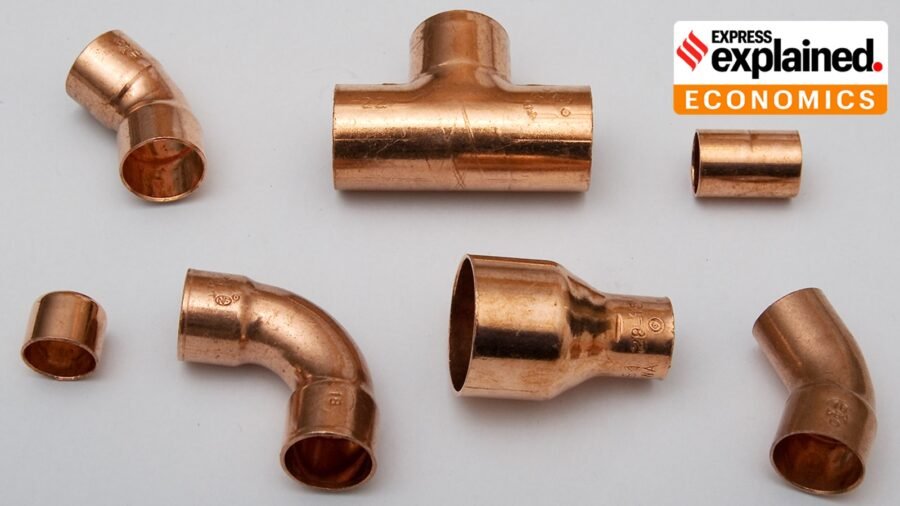
Despite prospects of steady global economic growth being clouded by trade tensions, the West Asia conflict, and uncertainty, copper prices have surged in recent months to hit a record high of $14,708 per tonne on Tuesday (September 8).
Three-month copper futures, which are contracts for future purchase, on the London Metal Exchange (LME) remained above the $14,000-per-tonne mark for most of August before climbing in September.
The rally comes after a period of volatility. Copper prices crossed the $12,000-per-tonne mark in December last year, recording their biggest annual gain since 2009, before cooling to $11,929.5 per tonne in March. The decline came amid concerns that higher energy costs stemming from the West Asia conflict could weigh on global economic growth and weaken demand for industrial commodities. So, what has happened now?
Story continues below.
Subscribe to see fewer ads.
Why copper price rise matters
The red metal is essential to the modern economy, with uses ranging from housing and manufacturing to power grids, clean energy, artificial intelligence and defence. Thus, its price is often seen as a barometer of economic health. A rise in copper prices is considered a signal of robust economic growth, while falling prices tend to raise concerns about an economic slowdown.
However, the current rally appears to have a different story.
According to industry insiders, the surge is less about expectations of stronger global economic growth and more about concerns over potential tariffs by the United States, which could come into effect from January 2027 and are already influencing copper trade flows and inventories.
US-led factors
While US President Donald Trump imposed a 50% tariff on semi-finished and derivative copper imports in August last year, refined copper has so far been exempted from these duties. However, there is a proposal to impose a 15% tariff on refined copper imports from January, which will be further increased to 30% in 2028.
Story continues below this ad
“In anticipation of US tariffs, people are selling materials from LME warehouses to warehouses of US COMEX (Commodity Exchange). As a result, there has been a shortage of copper stocks that can be traded on the LME. That is why the futures prices have gone up,” an industry executive told .
This has resulted in a huge buildup of inventories in the US, two industry sources told . “Inventory at LME is currently at 2,65,000 tonnes, and inventory at Shanghai Futures Exchange (SHFE) is at around 63,000 tonnes. However, the inventory of US’ COMEX is at around 7,00,000 tonnes,” An industry source familiar with the global copper market told .
The difference has also created arbitrage opportunities. An arbitrage opportunity arises when the same commodity is priced differently in two markets. Copper is traded on multiple exchanges, including the LME in London and COMEX in the US. When prices are lower in one market and higher in another, traders can buy copper in the cheaper market and sell it simultaneously in the more expensive one, profiting from the price gap.
However, the global copper market industry source said arbitrage was only one factor behind the recent surge in prices, with stockpiling ahead of the potential imposition of tariffs being the more significant driver. “The current arbitrage difference between LME and COMEX would be around $400-$500. But beyond arbitrage, it is the anticipation of the tariff which has mainly pushed up stockpiling, leading to a price surge,” the industry source added.
Story continues below this ad
Sumit Jhunjhunwala, Vice President & Sector Head, Corporate Sector Ratings, ICRA Ltd, also said that copper prices have remained elevated mainly due to constrained mine supply and the ongoing geographical rebalancing of inventories.
“The COMEX stocks have risen sharply as refined copper was front-loaded in the US market amid tariff uncertainty, while relatively low London and Shanghai exchanges’ inventories indicate tighter availability outside the US,” Jhunjhunwala said, adding that prices could remain elevated due to such factors in the short term.
“Nevertheless, any major delay or lower-than-expected US tariff could reverse these inventory flows, potentially releasing accumulated stocks into global markets and exerting downward pressure on copper prices and upstream producers’ profitability,” he added.
Copper in US-China trade war
Last year, too, Trump’s imposition of a 50% tariff on semi-finished and derivative copper imports prompted US buyers to stockpile the metal ahead of its implementation on August 1, heavily contributing to the surge in copper prices.
Story continues below this ad
The move followed a report submitted by the US Secretary of Commerce, which found that copper imports threatened to impair US national security.
In 2025, the United States imported $16.2 billion worth of copper products. China accounted for 20% of these imports, followed by Mexico at 17%, the European Union at 14%, Canada at 10% and Vietnam at 8%, according to data provided by the US Congressional Research Service.
In April that year, Trump announced a 50% tariff on the full value of semi-finished copper products and a 25% tariff on the full value of copper-intensive derivative products. The latter rate was reduced to 10% where at least 95% of the copper, steel and aluminium used in the product was sourced from the US.
These tariff measures are part of broader trade tensions between the US and China, with China being the world’s largest consumer of copper.

Satire | Needed: License raj for stand-up comedians
By Sohail Khan · 10 Sep
No gym, no problem: 5 activities that can keep you moving and burn calories
By Sohail Khan · 10 Sep
India’s political class is losing the young
By Sohail Khan · 10 Sep
Leave a Reply