India’s political class is losing the young
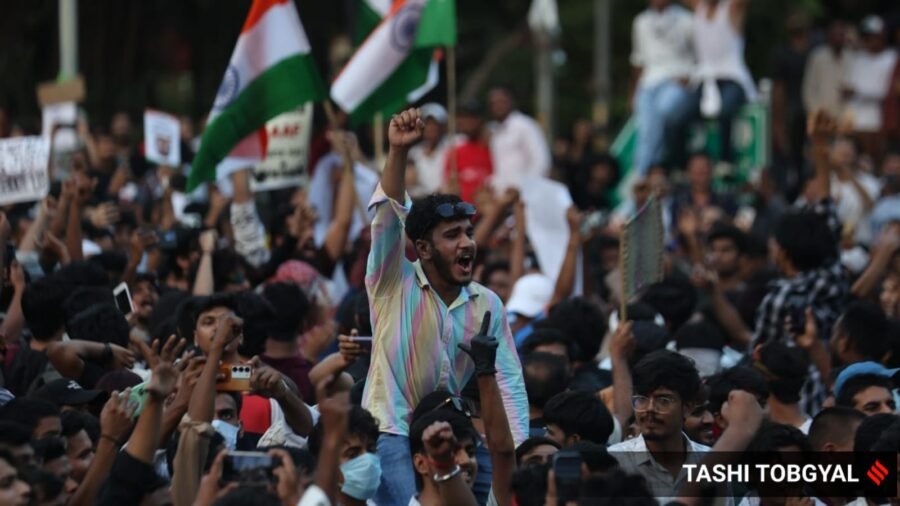
It pains me to write this; in good times, this discussion would not be necessary, especially in a democracy. Regrettably, Parliament and the state assemblies are among the least trusted institutions today. It is ominous for a country when its youth especially, comprising nearly half the population, seems convinced that the political class operates purely out of self-interest. Look no further than the recent Jantar Mantar protests; a quintessential preview of the convulsions about to grip Indian politics.
In such exciting times, the similarities between all political parties, particularly, the Rahul Gandhi-led Congress and the Modi-led BJP, rather than their contradictions, are truly worrisome and deserve contemplation. Both Congress and the BJP are centralised in terms of picking chief ministers and appointing party presidents. Ultimately, the story is the same — leaders quickly get swept up in the adulation of surging crowds; parties centralise and lose sight of the difference between the party and the state.
Advertisement
It is ironic that while both parties use minorities in their distinct ways, each picked the wrong fight, burned through political capital and ended up alienating a sizeable majority. Both sides can offer justification that this does not apply to them.
Our republic was among the first to institutionalise universal adult suffrage. But, even after 80 years of independence, female representation languishes. Women are denied not just parity but even minimal equity, both in candidate selection and in the distribution of ministerial berths.
All this, even as ticket distribution for Lok Sabha and assembly elections remains hostage to caste and, now, sub-caste considerations. The share of tickets to the youth is equally dismal. Parties forget that over time, theories and strategies of winning elections are toppled by stubborn facts on the ground.
Advertisement
Just as Rahul Gandhi cannot outrun the consequences of decisions made by his predecessors or of his own management of Congress, Prime Minister Narendra Modi cannot escape the compounding weight of his own legacy in power, clearly disproving the celebrated statement of Stanford Professor Jeffrey Pfeffer: “Success excuses (almost) everything.” To win or retain power, both parties rely increasingly on hand-outs and welfarism. All other politically relevant parties fare worse on all these cited parameters.
Like the Congress did subtly over decades before it lost its focus on strengthening the party and winning elections, the BJP has succeeded in unabashedly seeding its cadre into all institutions and continues to strengthen the party and its finances, ensuring its permanence.
At the other end, there is a clear atrophy in thinking and even many staunch Congress loyalists are convinced that the Gandhi siblings are singularly responsible for the decline of the party. In reality, they failed to stem the structural collapse decades in the making. Even though it is usually moral guilt, not the mere fact of losing that tarnishes an idea; 15 years of electoral failures should have been morally sufficient to awaken the institutional conscience to hand the baton to a leader outside the family. That is the core distinction in their internal architecture; the BJP structurally rewards electoral delivery, while Congress remains a tightly-guarded family enterprise. This fundamental variance explains their diverging political outcomes.
Further, in an era where elections are free but seemingly unfair, dislodging a powerful incumbent that can use the machinery of the state for its own ends is difficult. How comfortable does it make life for the BJP? It is blessed by the epic incompetence of his opponents. Yet, while the BJP managed to scrape through the last parliamentary elections, it failed to notice that Indian society has changed immensely and that winning is a streak, until it is not. Look closer and cracks appear. Employment is far, far short of what was expected, with this crisis feeding into politics. The reality on the ground is far more varied and nuanced. While the BJP government’s economic record is not necessarily poor, it is complicated and certainly lopsided.
Admittedly, a party, when in the opposition, can pivot on issues out of convenience, which Congress has done. Governments enjoy no such leeway; they cannot afford to get it wrong the first time. Politics is won by those who define the battleground and the BJP was indeed a master at setting the agenda. Lately, it is almost at its mercy. It has to convince the youth, its supporters and maybe even their own Members of Parliament, that there is hope.
This brings one to the expanding vacuum for a disruptive third alternative. The template has already been set in Tamil Nadu, where the dramatic rise of actor-turned-politician, C Joseph Vijay’s Tamizhaga Vettri Kazhagam, shattered a decades-old duopoly, proving that when the electorate grows weary of historical options, the political equilibrium can shift overnight.
The malaise of discontent is global. The younger a population, the more reactive it is to state neglect as young people feel fundamentally unfulfilled by life. A pervasive sense of disempowerment is creeping in. By the 2029 Lok Sabha elections, two-thirds of India’s population will be under the age of 35. In an era of social media saturation, distinguishing heroes from villains has never been harder for them.
As its politics becomes increasingly capricious, what does this mean for India’s future? Is it an authoritarian alternative that channelises the disillusionment into securing overwhelming power with just 30 per cent of the vote share, or a fractured mandate that ruptures the country politically or simply a stable government? Although much of this story is still unwritten, for swing voters, it may come down to what bothers them most and not what they desire.
The writer is chairman, Bharat Krishak Samaj

The Nobel-winning science of optogenetics: Explained
By Sohail Khan · 5 Oct
5 Indian festivals worth travelling for: From Onam in Kerala to Durga Puja in Kolkata
By Sohail Khan · 5 Oct