Why Amit Shah’s 2029 UCC push is going through states, not Parliament
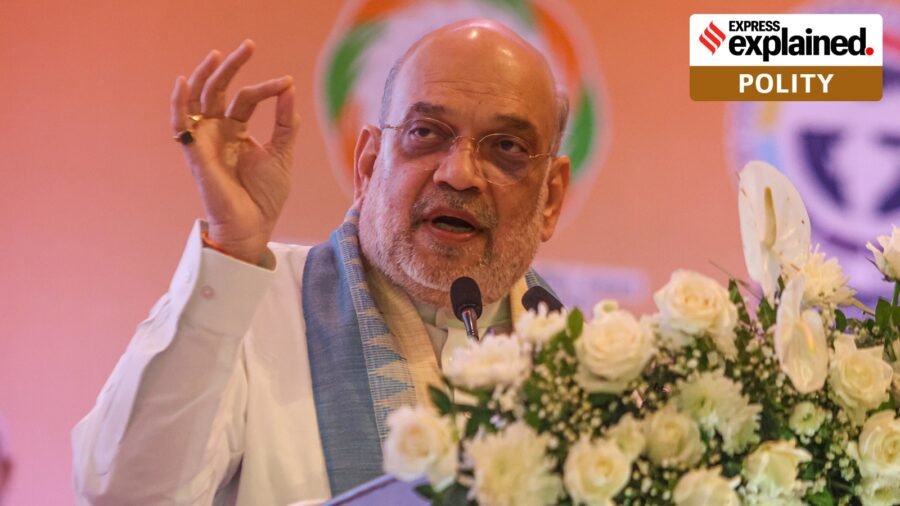
Union Home Minister Amit Shah said Sunday (September 13) that the Uniform Civil Code (UCC) will be implemented in all 21 BJP-NDA ruled states before the 2029 Lok Sabha elections. “We have introduced the Uniform Civil Code (UCC) in several states and I am confident that in the 21 BJP-NDA ruled states, we will introduce the UCC before 2029,” Shah said in Mumbai. He cited the abolition of triple talaq as part of the government’s effort to provide equal rights to Muslim women.
What is the significance of Shah’s statement?
UCC is a key unfinished item among the BJP’s longstanding ideological objectives, which included the construction of the Ram temple in Ayodhya and the abrogation of Article 370, both now achieved. The BJP has endorsed UCC for a long time. Shah himself, after Gujarat passed its UCC Bill in March, said having one law for every citizen had been a commitment of the party “since its inception”.
The UCC is rooted in the RSS thought, although the organisation’s approach has been more cautious on the manner and timing of implementation. In 2023, when the Modi government first made UCC a major political issue, RSS sources told that it required deeper study and wider consultation because it affected every section of society. The Sangh’s preference was for BJP-ruled states to enact their own codes first, with the Centre potentially considering an overarching law later.
Story continues below.
Subscribe to see fewer ads.
In March 2024, RSS general secretary Dattatreya Hosabale welcomed the Uttarakhand model and said it should be studied and implemented across the country, while stressing wide consultation.
Shah’s 2029 formulation therefore turns what was a state-first strategy into a time-bound political programme.
Why is BJP pursuing UCC state by state rather than bringing a national law?
There is a constitutional as well as political logic. Marriage, divorce, adoption, wills, intestacy, succession and joint family matters fall under Entry 5 of the Concurrent List, giving both Parliament and state legislatures legislative competence.
But the political reason is more important. A single national code would have to negotiate India’s enormous variation in personal laws and customary practices, particularly among tribal communities and in the Northeast. This was precisely the concern expressed by BJP and RSS sources in 2023. One BJP functionary told then that UCC could not simply be “codified” like the criminal law because an Uttarakhand or Himachal tribal community had very different practices from one in Chhattisgarh or the Northeast.
Story continues below this ad
The state route allows the BJP to test different models, deal with local customs and demonstrate implementation without first confronting the full political and constitutional complexity of a nationwide law. It also keeps UCC politically alive while allowing the party to present it as a measure of equal rights and social reform.
Where has UCC been passed and what do these laws say?
Four BJP-ruled states have passed UCC legislation — Uttarakhand, Gujarat, Assam and Madhya Pradesh. Uttarakhand is the only one where the code is currently in force.
Uttarakhand, which implemented its UCC in January 2025, provides common rules on marriage, divorce, inheritance and succession, prohibits polygamy and mandates marriage registration. Its most distinctive feature is the regulation of live-in relationships: couples are required to register the relationship and its termination, while children born from such relationships are recognised as legitimate.
Story continues below this ad
Gujarat, whose Assembly passed its Bill in March 2026, broadly follows the Uttarakhand model, covering marriage, divorce, succession and live-in relationships and prohibiting bigamy. Assam, which passed its Bill in May, also covers marriage, divorce, succession and live-ins, prohibits polygamy and makes live-in registration compulsory.
Madhya Pradesh, whose Bill was passed in July, additionally covers adoption and contains provisions relating to triple talaq and nikah halala. It too requires registration of live-in relationships and prohibits polygamy.
A significant common feature is that Scheduled Tribes are excluded from these laws, with Uttarakhand also exempting certain communities protected by constitutional customary-law provisions. The four codes are therefore similar, but not identical — and none is literally universal.
What is the position of the Opposition and BJP allies?
Story continues below this ad
Opposition parties have generally questioned whether the BJP’s UCC is genuinely a gender-equality reform or an attempt to alter the personal laws of minorities through a majoritarian framework. Congress opposed the Gujarat Bill as “anti-Muslim”, while in Madhya Pradesh it criticised the legislation as an RSS agenda. Opposition parties in Assam also sought wider consultation and raised concerns over the tribal exemption and regulation of live-in relationships.
The issue is more complicated for BJP’s NDA allies. JD(U) has consistently said it is not opposed to UCC but wants it to emerge through consensus rather than being imposed. Nitish Kumar had told the Law Commission that a UCC should respect India’s “delicate balance” between different religious and ethnic groups. TDP has similarly called for discussion and consensus and, in 2024, said it would ensure that Muslim interests were protected.
If UCC is in the Constitution, why is it controversial? What has the Law Commission said?
Article 44 of the Constitution says: “The State shall endeavour to secure for the citizens a uniform civil code throughout the territory of India.” But it is part of the Directive Principles of State Policy, not the Fundamental Rights. Under Article 37, the Directive Principles are fundamental to governance but are not enforceable by any court.
Story continues below this ad
The debate, thus, is about what should be made uniform and how that uniformity should be reconciled with freedom of religion, customary practices and constitutional protections for tribal communities. The Constituent Assembly itself had no consensus on what a UCC would entail, which was among the reasons it was placed among the Directive Principles.
The 21st Law Commission, in its 2018 Consultation Paper on Reform of Family Law, said a UCC was “neither necessary nor desirable at this stage”. It argued instead for reforming discriminatory provisions across personal laws while preserving India’s diversity.
Its emphasis was on achieving “equality within communities” between men and women rather than “equality between” communities, and on making piecemeal changes rather than imposing absolute uniformity. It also flagged the constitutional protections enjoyed by tribal and northeastern communities as a complication.
The 22nd Law Commission reopened the issue in 2023, seeking fresh views from the public and recognised religious organisations. It said more than three years had elapsed since the 2018 consultation and that developments, including court orders, warranted a fresh examination.


India needs a smarter SIR. Aadhaar can help
By Sohail Khan · 14 Sep
In German far-right party AfD’s rise, a bigger question for democracy
By Sohail Khan · 14 Sep
Leave a Reply