India needs a smarter SIR. Aadhaar can help
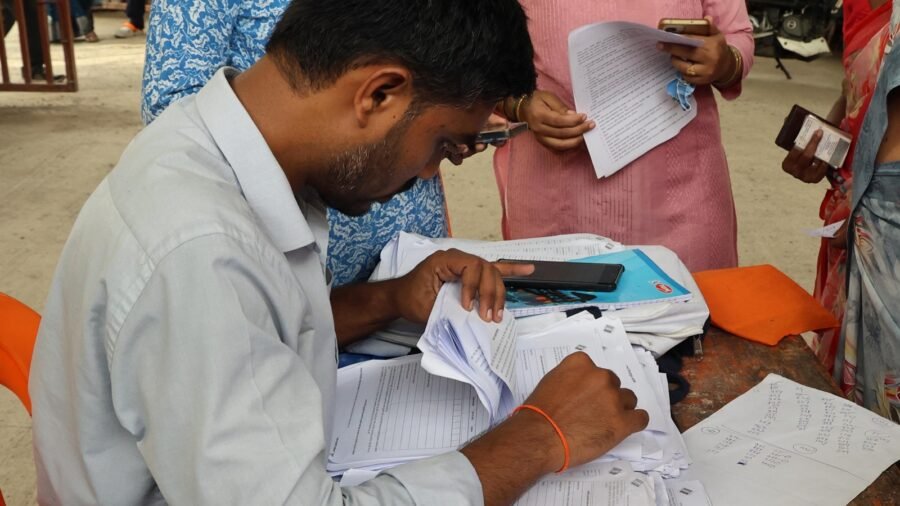
The Special Intensive Revision (SIR) of the electoral rolls by the Election Commission (EC) is no longer a one-off event. Rolling out in phases since June 2025, it now extends to almost the entire country and has already deleted over 13 crore names. On May 27, 2026, the Supreme Court (SC) upheld the exercise — while holding, crucially, that the final determination of citizenship belongs to the Ministry of Home Affairs (MHA) under the Citizenship Act, not to the EC. The goal of the SIR — clean, accurate and inclusive rolls — is beyond dispute. The method is not.
That method revives a document-intensive, house-to-house verification mothballed for over two decades and applies it, in the smartphone age, on a near-national scale. Lakhs of officials go door to door; crores of citizens must prove their eligibility on paper within compressed deadlines. The burden falls hardest on the poor, the elderly, migrants and women — and now that in some states, there is threat of linking SIR deletions to welfare records, a wrongful removal can cost a family its rations and its pension. The cost of error is not hypothetical: Even now, the SC is pressing the EC over the slow disposal of appeals against SIR deletions in West Bengal — voters struck off and still waiting to be heard.
Advertisement
It is also ruinously expensive, and by design it recurs. It mobilises around 10 lakh public servants — mostly school teachers — and costs the exchequer thousands of crores, every cycle. An Aadhaar-based alternative would involve a very small expenditure by comparison — a modest, one-time build on digital infrastructure the country has already paid for, and almost nothing per verification.
The deeper difficulty is that citizenship cannot be settled in the field at all. The documents the SIR demands are not universal, and the government now concedes it. A passport — held by under 8 per cent of Indians — was clarified this June by the Ministry of External Affairs to be a travel document, not proof of citizenship. Aadhaar, by statute, proves identity and residence but not citizenship; voter ID and PAN prove none of it; and birth registration was, for decades, patchy for the poor, women and rural India. If even the passport cannot establish citizenship, a household paper-check certainly cannot.
History confirms it. The Multipurpose National Identity Card pilot was abandoned as unworkable. The Assam National Register of Citizens excluded 19 lakh people, caused enormous distress, and resolved nothing. The National Population Register that followed enumerated “usual residents” — citizens and non-citizens alike — because the MHA found a field test of citizenship impractical. The SC has now placed the constitutional full stop: Citizenship is for the MHA, not an electoral officer at the doorstep.
Advertisement
There is a persistent objection that Aadhaar is “only” an identity, unfit to prove age or residence. Every alternative is weaker: PAN was itself cleaned using Aadhaar, passports are issued on the strength of Aadhaar, and a doorstep survey can establish no one’s date of birth. And Aadhaar’s data has no motive to lie built into it: It was created as a bare identity carrying no benefit or entitlement, so nothing was gained by misstating one’s age, and the address had to be genuine because the Aadhaar letter was posted to it.
For the electoral roll, moreover, only one fact about age matters — is the person 18 or older? Aadhaar answers it without a date at all. Biometrics are not captured below the age of five, so anyone whose own fingerprints and iris were recorded in an enrolment around 2013 or earlier was at least five then, and is at least 18 now. To discard the largest, most carefully audited enrolment in history is a counsel of nihilism: If we will not trust our own most-used record, we can trust nothing, and the state cannot recognise its own people.
The tools, moreover, are not hypothetical. Aadhaar covers 1.36 billion residents and has already done, at scale, what roll-cleaning needs — de-duplicating PAN, closing benami accounts, and removing crores of ghost beneficiaries from welfare, saving over Rs 2.7 lakh crore. Two everyday services prove the point: Digi Yatra moves crores of travellers through more than 100 airports by Aadhaar face authentication, and Jeevan Pramaan lets 1.47 crore pensioners prove, by their face and from a phone, that they are alive. If the state trusts this at the airport gate and to release pensions, it can trust it to verify a voter — and Aadhaar was built on privacy by design, returning only a yes-or-no, never the underlying data.
The alternative is therefore simple. A voluntary application — on mobile or web — would let any voter link Aadhaar to the Voter ID and complete face authentication in a single step, with no document and no visit to any office. That one act proves the voter is alive, removes duplicates (each Aadhaar is unique) and ghosts (a non-existent person cannot authenticate), settles age from the Aadhaar’s vintage, and cross-checks the address Aadhaar delivered to the door. Linkage stays voluntary; those who decline use the ordinary manual route, a small residue given near-universal coverage. Citizenship is handled exactly as the Court requires — identify everyone first, let analytics flag the few genuine outliers, and refer only those to the MHA.
The recommendation follows plainly. The EC should commission such an Aadhaar-EPIC face-authentication application, with UIDAI, as the primary means of revising the rolls, and stop spending thousands of crores every cycle on a 19th-century method that harasses the honest majority and cannot find the few it targets. A small fraction of that money, spent once, would clean the rolls faster, far more cheaply, and with a fully auditable trail. The government already trusts this technology to move citizens through its airports and to pay their pensions. It should trust it to decide who is on the voter list. The technology is ready. The policy should follow.
The writer is former Secretary to the Government of India and Founding Director General, UIDAI (Aadhaar). Views are personal


In German far-right party AfD’s rise, a bigger question for democracy
By Sohail Khan · 14 Sep
Mehbooba Mufti writes | The 80-20 Hindu-Muslim political game is making losers of us all
By Sohail Khan · 14 Sep
Leave a Reply