What makes whisky, rum and vodka different? Not much, if you’re in India
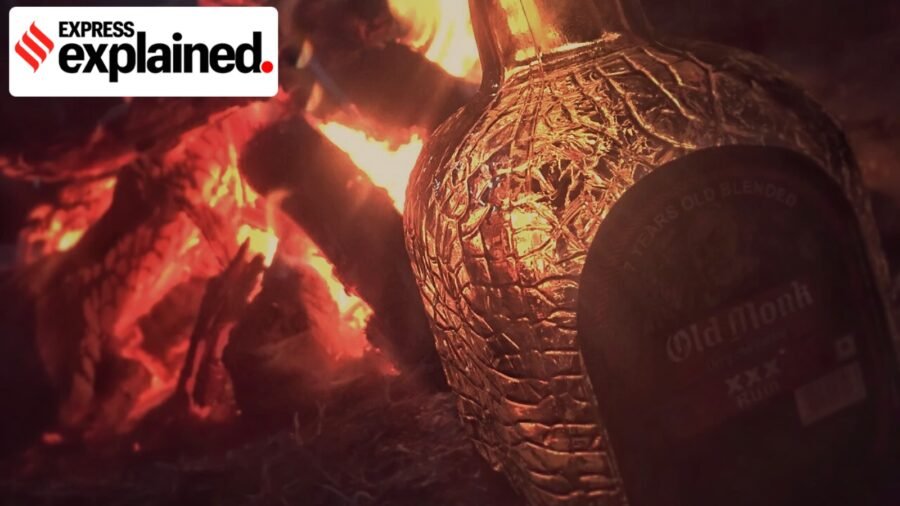
On Thursday, the Food Safety and Standards Authority of India (FSSAI) informed the Bombay High Court that the popular alcoholic beverage Old Monk could not be legally sold as rum. The reason: the product uses artificial flavours to neutral spirit.
Old Monk is not the only one — popular brands such as Gold Reserve and McDowell’s No.1 are also under the lens.
The regulatory body has flagged the use of artificial flavouring that mimics the profile of aged liquor. It has also brought up misleading label claims regarding the maturity of these spirits.
The case brings to light a very Indian phenomenon — what we call whiskey is essentially rum, and what we call rum mostly seems to be flavoured neutral spirit.
How are rum and whiskey actually supposed to be made? And why is the Indian Foreign Made Liquor (IMFL) industry different? We explain.
How is alcohol classified?
The classification of alcohol is determined by three things: the agricultural raw material, the method of distillation and the maturation process.
Generally, spirits are understood to be alcoholic beverages that are made by fermenting fruits, grains or molasses and then distilling the material. Spirits contain no sugars or sweeteners and are typically high alcohol by volume (ABV) beverages. All liquor is a derivative of spirits but the opposite does not hold true.
Story continues below this ad
Countries have their own rules for defining alcoholic beverages, such as the EU’s Regulation 2019/787 and US rules under 27 CFR Part 5. These frameworks detail the prerequisites for classifying alcoholic beverages. The six primary spirits are widely recognised to be:
Whisky: Traditionally, whisky is made from a mash of grains — such as barley, corn, rye and wheat — that can be used in various combinations or on their own. The grain mash is malted, fermented and then distilled to a lower proof — that is, a lower alcohol concentration — to ensure that the spirit retains the grain’s natural flavour. Both EU and US regulations mandate that whisky must be stored and aged in oak containers. This is the maturation process that gives the liquor the specific shade of amber coloring, the aroma and its own flavour profile. India is the world’s largest whisky consumer. Whether what we are consuming is whisky at all is something we will address further on.
Brandy: This spirit is produced by distilling wine or fermented fruit juice. Despite grapes being the most common base, there are variants that can be produced using apples or plums. It is typically aged in oak barrels after the distillation process. It has a low carbohydrate content.
Story continues below this ad
Tequila: Tequila and the broader category of agave spirits are exclusively distilled from the fermented juice of the agave plant. This spiky plant, that thrives in hot and dry regions, is commonly found in the Americas region, with Mexico spearheading much of the production. It is subject to strict geographical indication laws. True tequila must be produced from the blue agave plant that grows in specific regions of Mexico.
Rum: Rum is supposed to be exclusively made from sugarcane, its fermented juice, the molasses — a thick and dark syrup left over from processing sugarcane — or other by-products. The defining taste and aroma are expected to develop naturally. Most rum undergoes a period of maturation in wooden casks that rounds out the flavour.
Vodka and Gin: These are classified as neutral spirits. Vodka is distilled from material such as grain or potato and pushed to a highly rectified proof, which is at or above a certain ABV. Vodka undergoes extreme distillation to strip the liquid of character, aroma, taste and colour which yields a pure and unaged spirit.
Story continues below this ad
Gin uses the same neutrality as its base but earns a distinct classification. This is because its distinctive flavour is developed after distillation using a range of botanicals such as juniper berries.
Why is the Indian market different?
The Indian market has historically operated differently from how global standards dictate spirit and alcohol identity. During the late British period, the Indian-Made Foreign Liquor (IMFL) sector emerged and produced domestic versions of Western spirits.
The processes of distillation and barrel maturation, however, are expensive and time consuming. And there are the fluctuating procurement costs for raw material and excise duties. So, instead of fermenting grain for whisky or aging sugarcane for rum, the mass-market IMFL sector took a different route — extra neutral alcohol (ENA).
It is derived by boiling fermented molasses (or other agricultural produce) to extract alcohol, which is then distilled to get a minimum purity of 96%. The result is a highly rectified, colorless and flavourless product.
Story continues below this ad
Globally, ENA is the foundation for vodka or gin. In India, it is the base of all IMFL. Mix it with artificial flavouring compounds and you get a drink that is whisky or rum only in name, rather than spirit.
And considering that most Indian whiskies are made of molasses, they would qualify as rum in many international markets.
According to the FSSAI Food Safety and Standards (Alcoholic Beverages) Regulations, 2018, whisky can be made either with malted grains or with neutral spirit.
Story continues below this ad
It says: “Whisky is an alcoholic beverage made by distilling the fermented extract of malted cereal grains such as corn, rye, barley, or using neutral grain spirit or rectified grain spirit, or neutral spirit of agricultural origin, or their mixture.”
For rum, too, the regulations permit the use of neutral grain along with sugarcane products, but add that it should retain its characteristic taste and aroma. “They shall not contain any colouring matter other than caramel,” the regulations say.
The section on rum reads: “Rum is an alcoholic distillate obtained from fermented juice of sugarcane, sugarcane molasses, or any other sugarcane product, and shall not contain any colouring matter other than caramel. It may also be prepared from neutral, rectified, distilled spirit of agricultural origin. Rum without colour shall be designated as white rum. Rum shall possess the characteristic taste and aroma associated with the product.”
The FSSAI’s argument
The FSSAI’s recent objections are based on recent facility inspections and laboratory tests where they found the addition of external flavours was used to mask the neutrality of the spirit. According to the regulator, these additives masked the beverages’ natural characteristics.
Story continues below this ad
On August 2, the Ministry of Health and Family Welfare clarified in a press release that there is no internationally recognised manufacturing practice where a rum flavour is added to rum or whisky flavour to whisky. This statement was seconded by the FSSAI.
The FSSAI’s opposition to this practice has also impacted product labels and maturation claims — particularly Old Monk’s XXX Matured Rum, whose label claimed the liquid was “7 years blended”. Laboratory testing revealed that over 95 percent of the bottle’s contents consisted of unaged, neutral ENA, with matured rum spirit constituting less than 5 percent of the total blend.
Under Indian regulations, any age claim on a blended spirit must reflect the absolute youngest spirit in the mix. Any product containing 95 percent fresh neutral alcohol cannot legally be marketed as a seven-year-old product.
In democracy’s journey to future, Gandhi is the wise guide and co-traveller
By Sohail Khan · 3 Oct
Delhi’s new master plan can soothe parking pains
By Sohail Khan · 3 Oct