What are IRDAI’s proposed insurance reforms, why have they hit insurance stocks?
But why have the proposed reforms by Insurance Regulatory and Development Authority of India (IRDAI) led to insurance distributors facing so much heat from investors?
The reform road
Story continues below.
Subscribe to see fewer ads.
In its paper, titled ‘Recalibrating Economics of Insurance Distribution’, IRDAI proposed a host of reforms aimed at improving consumer protection, reducing mis-selling of products, and countering dark patterns in the industry. While this is good news for households and other buyers of insurance policies, it will eat into the profit margins of the companies distributing these policies.
Consider life insurance, where IRDAI wants the commission in the first year to be a maximum of 20% of premium for distributors and 25% for agents. This would be less than half the commissions charged currently, with the regulator in 2023 having scrapped such commission caps.
The regulator has called for comments by October 25 on its proposed reforms.
Limits on commissions especially hurt online insurance aggregators like Policybazaar and TurtleMint, which have high customer acquisition costs compared to others who depend on a network of agents, such as Life Insurance Corporation of India. Online aggregators depend heavily on upfront commissions.
Commissions and expenses
Story continues below this ad
What the proposals address are the rapid rise in money earned through commissions, with IRDAI’s paper pointing out that sales are led by commissions, instead of pricing and quality.
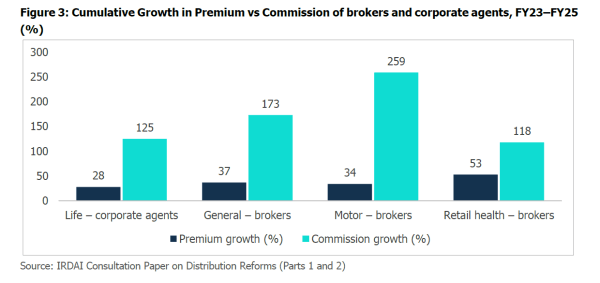 Insurance commissions and premiums.
Citing the example of general insurance, IRDAI said that while premiums from brokers in 2024-25 was 37% higher from 2022-23, commissions were up a huge 173%. Then there is life insurance: premiums from corporate agents rose 28% over the two years, but commissions surged 125%.
What this means is that a distributor’s income has grown 4-5 times faster than premiums.
“In efficient markets, consumers compare products on suitability, price and quality. In the country’s insurance sector, heavy dependence on commission-led distribution and lack of transparency on pricing and quality has clogged these competition signals. High distribution payouts have weakened the competition outcomes away from better value to customers,” the paper said.
Story continues below this ad
Another proposal refers to the reduction in the Expense of Management, or EoM, to 12.5% and 20% of life and general insurers’ gross direct premium income, respectively, over a five-year period, with limits also set for 2028-29.
EoM is the cost an insurance company charges against the premiums it gets. This includes administrative and distribution costs, including commissions paid to agents. EoMs can rise as insurers bid to secure top distributors.
According to CareEdge Ratings, the EoM of 20 of India’s 22 life insurers and 28 of 31 general insurers is currently higher than the proposed limits for 2028-29.
India’s insurance problem
The proposed reforms come at a crucial time, with the Foreign Direct Investment (FDI) limit for the insurance sector having been raised to 100% in December last year. The same was notified earlier this year in May. This was done with an eye on raising insurance penetration in the country: despite being the world’s 10th largest insurance market, insurance penetration was just 3.7% in 2024-25.
Story continues below this ad
Insurance penetration is the total insurance premium collected (both life and non-life) divided by the GDP.
According to CareEdge Ratings, the proposed commission caps do little to fix the problem of persistency, or the lack of continued payment of insurance policy premiums.
“…writing a new policy still pays a distributor several times more than retaining an existing one. A structure that ties remuneration to persistency outcomes would do more, whether by deferring part of the first-year commission, vesting it against 13th- and 25th-month persistency, clawing it back on early lapse, or flattening the first-year to renewal gradient more sharply,” the agency said in a report.
There is also the problem of online aggregators being the best performers in terms of persistency but getting hit hard with the commission caps. As IRDAI’s own report showed, 71% of policies sold online are active for five years; the figure is a smaller 43% when it comes to sales made by corporate agents like banks.
Story continues below this ad
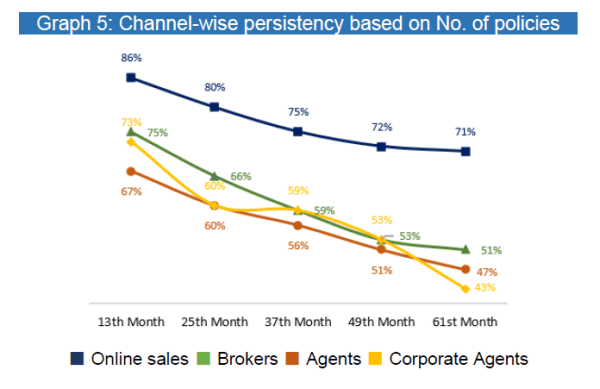 Persistency chart by IRDAI.
Some also believe the commission caps may disincentivise insurers from selling lower-ticket, lower-margin policies, which drive penetration in non-tier-1 cities and lower-income groups.
“Lower-ticket policies naturally have lower payouts, and with these steps, the payouts will reduce further. We as an industry would love to expand to smaller geographies so that everyone can own insurance, but the payment structure should also support that,” an executive from a general insurance company said.
Krishnamoorthy Rao, Managing Director and Chief Executive Officer of Generali Central Insurance, pointed out that the framework should also recognise the structural cost differences faced by smaller insurers, so that distribution remains competitive, sustainable, and inclusive.
Impact on banks
Banks are an important distribution channel given the cross-selling opportunities and the lenders’ deep distribution networks. And commission caps are expected to hurt banks with multiple tie-ups and heavy incentive-led payouts compared to those who have single partnerships, brokerage JM Financial noted.
Story continues below this ad
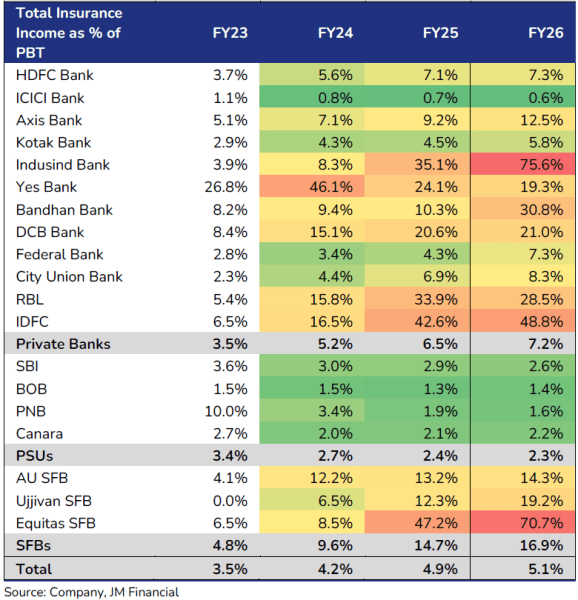 How banks are affected.
According to it, the average income from insurance distribution for banks across its coverage has risen to 5.1% of profit before tax in 2025-26 from 3.5% in 2022-23.
“Insurance distribution is a high-margin and capital-light annuity that leverages an existing customer franchise, branch network and technology stack, and a lower commission cap therefore transmits to operating profit,” said Ishank Gupta, an analyst at Choice Institutional Equities.
Banks with insurance subsidiaries, such as HDFC Bank, ICICI Bank, State Bank of India, and Kotak Mahindra Bank will be relatively insulated from the changes as they retain a portion of the commission savings due to higher insurer margins, Gupta added.

5 animals a tiger may think twice before attacking
By Sohail Khan · 26 Sep


Leave a Reply