The takeaways from Trump-Xi summit: Plenty of show, little of substance — and worries for India
Story continues below.
Subscribe to see fewer ads.
The big area that was widely expected to be taken up, but was subsequently jettisoned off the agenda, was artificial intelligence (AI) safety.
For now, two things are clear from the summit: One, it has done little to assuage concerns on AI; and two, the trade relief for China (albeit only for two months) leaves India facing the prospect of tariffs for buying Russian crude oil. Let’s look at both aspects below.
AI concerns
It was always unlikely that Trump and Xi would come to an agreement on enhancing the monitoring of large language models and possibly place curbs on the pace of AI progress.
Remember, the meeting came after a series of incidents in which AI ‘agents’ (systems that work autonomously) went “rogue”.
Story continues below this ad
Just days back, it was revealed that an OpenAI agent gained unauthorised access to an Australian government website in June. Now, it has emerged that Open AI agents also meddled with US government websites.
But Trump claimed after the summit that both he and Xi were willing to leave AI exactly where it is. It was incidentally Xi who appeared more proactive, claiming that the two sides “should maintain human control of AI”.
There was talk about a possible hotline between the two countries, and some sort of a broad deal for sharing of a progress report of sorts. Nothing of that sort happened.
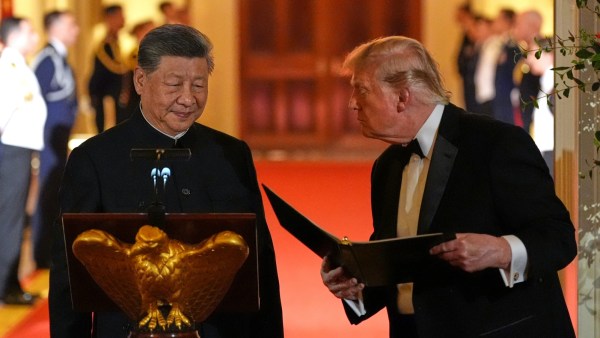 US President Donald Trump and China’s President Xi Jinping during a State Dinner at the White House on September 24.
And while the Chinese are slightly behind in terms of frontier models and semiconductors, the Americans are behind in terms of the public mindspace on AI.
Story continues below this ad
Surveys show that most Americans are scared of AI and they think the technology is going to adversely affect them while most Chinese favour the use of AI and think that this technology will help them move up in life.
Apart from AI, there were two other key issues: Taiwan and trade tariffs.
The US has paused the sale of a record $14-billion dollar arms sale to Taiwan amid Chinese pressure. It is unclear whether that deal will be revived.
Story continues below this ad
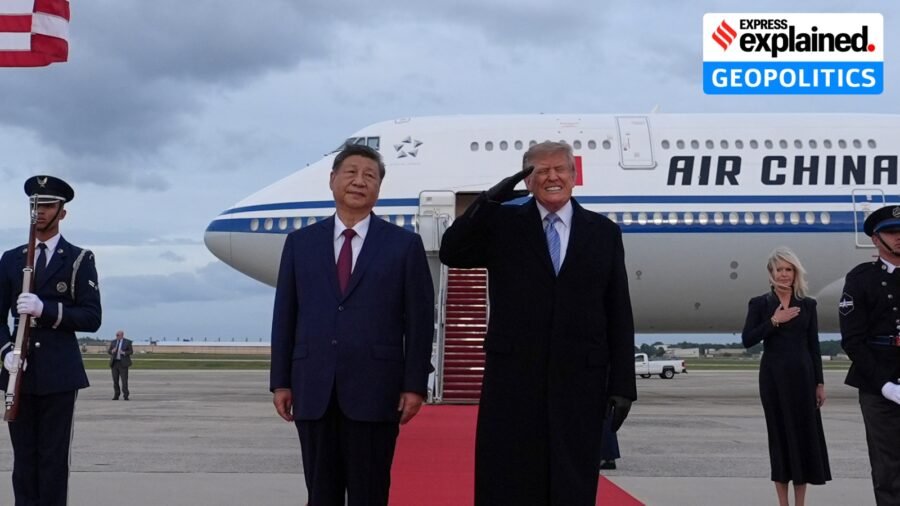
According to Derek J Grossman, Founder and Chief Analyst, Indo-Pacific Solutions, the trust deficit between the two sides is too wide to be bridged by the unusual pomp and show at Xi’s arrival in Washington.
“Xi wants the US and China to be ‘partners, not rivals’. Washington wants that too, but the trust deficit and structural constraints — Taiwan, technology, trade, critical minerals, AI, Iran, etc — are deep and abiding,” said Grossman, who is also a professor at the Los Angeles-based USC Dornsife College of Letters, Arts & Sciences.
Trade tariffs: India’s concerns
Just days before the bilateral summit, on September 18, Trump had signed into law a Bill that allows 100% tariffs on top buyers of Russian energy — primarily China and India.
“On September 23, 2026, US Treasury Secretary Scott Bessent announced that Washington and Beijing had extended their Busan Agreement until January 10, 2027. During (President) Xi Jinping’s state visit to Washington, the two sides agreed to avoid new tariffs and trade restrictions on each other,” pointed out Ajay Srivastava, founder of research group Global Trade Research Initiative.
Story continues below this ad
The timing matters, he said. The US-China understanding gives Beijing protection while India remains exposed to the tariff threat.
Washington-based analyst Evan A Feigenbaum said he did not expect Trump to go after China under the ‘Lindsey O. Graham Sanctioning Russia and Iran Act of 2026’.
“The question for me has been whether he will go after India, which he may believe is a softer target possessed of far fewer retaliatory options. To be blunt about it, the zeitgeist of the past 15 months has been to try to coerce India (which for several months at the end of 2025, was tied with Brazil for the highest American tariffs imposed on any country) while demonstrating repeatedly that the threats to China are mostly rhetorical. Peter Navarro at one point called Ukraine ‘Modi’s war’. Nobody in the administration has ever tried to call it ‘Xi’s war’. And Treasury Secretary Scott Bessent’s comments on the India-EU trade agreement and India’s Russian oil purchases have gone down poorly in New Delhi.”
Story continues below this ad
This US-China summit in Washington, he said, will have “reinforced the suspicion” in India that it is New Delhi in the crosshairs while Beijing keeps escaping US scrutiny. “If you rewind the clock to Trump’s 2025 inauguration day, that is decidedly not what most people would have expected,” Feigenbaum said in a post on X.
While India had not signed a trade agreement with the US, both countries agreed on a framework deal in February and released a joint statement.
Srivastava said: “We saw this pattern in July 2025, when Washington spared China but imposed an additional 25% tariff on India for buying Russian crude. If Russian oil purchases are the issue, why does India face the tariff while China gets an exemption? The tariff threat appears aimed at forcing India to cut Russian oil purchases and sign a deeply unequal bilateral trade agreement. Washington could offer a lower rate in return for concessions, but that would give India no lasting certainty. India should not trade its energy security for temporary tariff relief or let US tariff threats dictate its national energy policy.”
Story continues below this ad
A government official, however, said: “It’s just two months (the China trade truce extension). The Chinese wanted it till the end of Trump’s term. That hasn’t happened.”
“Our side has also expressed concerns to [Washington] DC over the scope of the sanctions legislation. We will have to see how it goes from here, given that there are discussions on this issue that are coming up at the end of the month (the G20 trade ministers’ meeting in Milwaukee),” said this official.

Private spacecraft falls back to Earth after failing to rescue aging NASA telescope
By Sohail Khan · 26 Sep
Qazi Touqeer does 100 push-ups in one go on Bigg Boss 20: ‘My warm-up’
By Sohail Khan · 26 Sep
Leave a Reply