West Asia crisis shows conflicts have global impact: Modi at SCO Summit
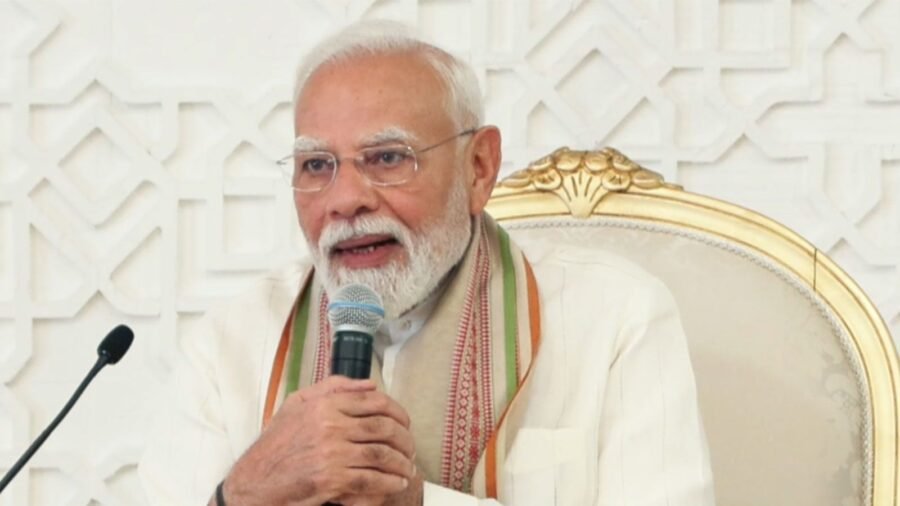
Prime Minister Narendra Modi Tuesday told leaders at the Shanghai Cooperation Organisation (SCO) summit that the crisis in West Asia has shown that a “conflict in one region does not remain confined there”, warning that it affects global energy security, maritime trade, and supply chains.
Speaking at the SCO summit in Kyrgyzstan’s capital Bishkek, Modi said India believes that “the resolution of all tensions and conflicts is possible only through dialogue and diplomacy, not on the battlefield”.
The remarks came as the war in West Asia, which began in February this year with US and Israeli attacks on Iran, entered its sixth month with no end in sight. Iranian President Masoud Pezeshkian is also attending the summit.
Story continues below this ad
“In today’s interconnected world, the scope of security has expanded significantly. The crisis in West Asia has demonstrated that a conflict in one region does not remain confined there; it impacts global energy security, maritime trade, and supply chains,” Modi said.
“The Global South bears the brunt of these consequences. Therefore, India has consistently maintained that the resolution of all tensions and conflicts is possible only through dialogue and diplomacy, not on the battlefield,” Modi said.
‘No room for double standards’
Modi also raised the issue of terrorism, saying it “remains a grave challenge for all of humanity”
“In the fight against it, we cannot limit ourselves to a mere ‘action-reaction’ mindset. We must dismantle the entire ecosystem of terror financing, recruitment, radicalisation, and safe havens. We must speak in one voice to declare that there is no room for double standards on this critical issue,” he said as Pakistan Prime Minister Shehbaz Sharif listened.
Story continues below this ad
“Countries that use terrorism as an instrument of state policy and provide shelter and support to terrorists must be sent a strong message: terrorism cannot be a strategic asset for anyone,” Modi said.
India and Pakistan had a four-day military confrontation in May last year, after the terror attack in Pahalgam in April last year. India has accused Pakistan of the terrorist attack.
Chinese President Xi Jinping and Russian President Vladimir Putin are attending the SCO summit. Both leaders are expected to attend the BRICS leaders’ summit in Delhi on September 12-13.
Underlining the need for “robust and reliable connectivity”, Modi said India supports all initiatives that “connect markets, facilitate trade, and open new avenues for growth”. “However, respect for the sovereignty and territorial integrity of all nations is paramount in these endeavours. This is also the core spirit of the SCO Charter.”
Story continues below this ad
“In the future, the scope of connectivity will expand further. Alongside roads, railways, and air corridors, we must simplify customs procedures, promote digital documentation, and enhance the efficiency of logistics networks,” he said.
India wants access to Central Asia through Iran, since Pakistan doesn’t grant India overland transit access to the Central Asian region.
Relevance of SCO
The PM also recalled India’s three key pillars of its vision for the SCO: S – Security, C – Connectivity, and O – Opportunity, and underlined the grouping’s importance.
“Over the past 25 years, the SCO has developed a strong tradition of dialogue and cooperation across the vast expanse of Eurasia. Together, we have made valuable contributions to the well-being of our people as well as to the progress of humanity. We have laid a solid foundation for cooperation over these 25 years. Now, our goal for the next 25 years should be to translate this cooperation into tangible results,” he said.
Story continues below this ad
“Today, as the world navigates through uncertainty and instability, we must transform our shared geography into shared opportunities, and bring about positive changes in the lives of our people through our efforts,” he said.
This meant, he said, the countries must ensure that the benefits of SCO cooperation “directly reach our people”.
“Our greatest asset lies in the bonds between our people. For India, the SCO represents a confluence of great civilisations, cultures, and ideas. Over the next 25 years, we must place people-to-people ties at the heart of our cooperation. The true yardstick of our success should be the number of new opportunities created for the youth through our efforts, the new markets opened for our entrepreneurs, the extent to which our farmers have benefited from technology, and the improvement in the lives of our citizens.”
The PM said cooperation within the SCO “should not be merely government-driven but people-driven”. He also highlighted youth engagement within the SCO under Kyrgyzstan’s chairmanship and said India has launched initiatives such as the Start-up Forum, the Young Authors’ Conclave, and the Young Scientists’ Forum within the SCO framework.
Story continues below this ad
“Last year, India proposed the SCO Civilizational Dialogue Forum. I am happy that its first session will be held in India this year. I am confident that with your active participation, this forum will become a powerful platform for vibrant dialogue within the SCO,” he said.
Quoting Kyrgyzstan’s great litterateur Chingiz Aitmatov, who said, “We often look more at the things that separate us, and less at the things that unite us”, Modi said the same message is “relevant for SCO today”.
“Our diversity is our identity. Our shared purpose is our strength. We should move forward from Bishkek with this resolve. From shared geography to shared opportunities, from vision to outcomes, and from government-driven cooperation to people-driven partnership.”
“With this belief and this commitment, India is ready to contribute to the common journey of the SCO family,” he said.
Rahul Gandhi’s ‘vote theft’ jab after 2.07 crore Maharashtra voters deleted
By Sohail Khan · 1 Sep

Leave a Reply