Uttar Pradesh 2027: first big test of BJP after Gen Z protests
Every election in India matters. But few State elections carry the political significance of the 2027 Uttar Pradesh Assembly election.
Uttar Pradesh is not merely India’s most populous State. It is also the political heartland of the BJP’s Hindutva project and the State that has played a decisive role in Narendra Modi’s rise to national power. The 2027 contest, therefore, could offer the first major electoral verdict on whether the political dominance built by the BJP over the past decade remains intact—or whether the party is beginning to confront a more serious challenge.
Since Narendra Modi became Gujarat’s Chief Minister in 2001, his political trajectory has been almost relentlessly upward—from the politics of his home State to the national stage. His influence gradually expanded beyond Gujarat, and after he emerged as the BJP’s prime ministerial candidate in 2013, he went on to reshape India’s national political landscape.
The 2024 Lok Sabha election, however, marked a departure from the BJP’s previous electoral trajectory. For the first time since Mr. Modi became Prime Minister, the BJP could not secure a majority on its own and had to form the government with the support of its allies. The result was particularly significant because the party had set an exceptionally high electoral benchmark for itself with the “Abki Baar 400 paar” slogan.
Yet the BJP demonstrated its electoral resilience soon after. In Assembly elections held following the 2024 Lok Sabha polls, the party and its allies repeatedly managed to recover political ground, including a decisive victory in West Bengal in 2026.
But then came a challenge of a very different nature.
The Gen Z moment
The recent Gen Z protests at Jantar Mantar arguably presented Narendra Modi and the BJP with one of the most significant challenges to the Prime Minister’s political image in recent years.
The protests disrupted the perception of Mr. Modi’s political invincibility and challenged the near-demigod status that has surrounded his political persona for much of the past decade. The mobilisation, spearheaded by the Cockroach Janata Party, brought a range of demands into the political conversation and placed the BJP on the defensive. The political consequences of that moment are still unfolding.
For the BJP, the challenge is to contain the political mood that emerged from the protests. For the Opposition, the opportunity is to convert that mood into an electoral constituency.
And the first major test of whether either side succeeds will come in the Assembly elections expected in early 2027, particularly in Uttar Pradesh.
Uttar Pradesh: The Hindutva test
If there is one State where the 2027 Assembly election could be seen as a referendum on the electoral durability of Hindutva politics, it is Uttar Pradesh.
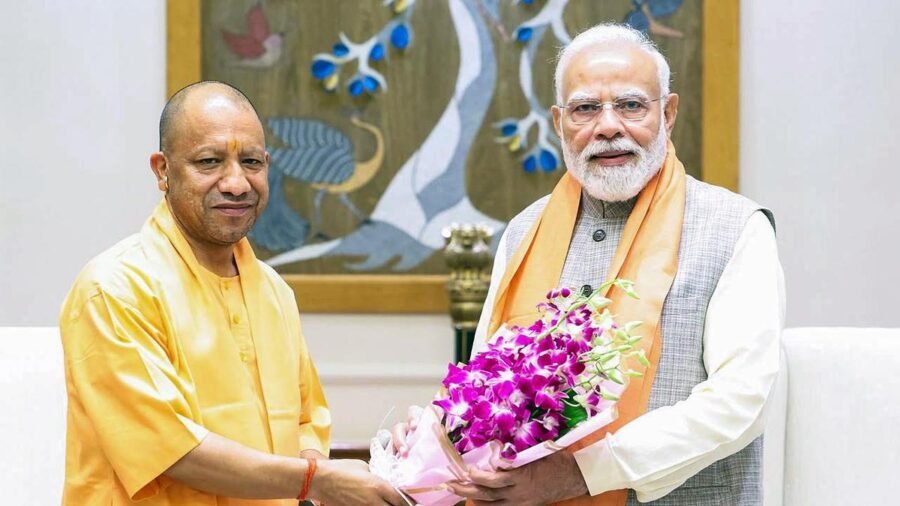
The State is governed by Yogi Adityanath, arguably the most prominent face of Hindutva politics after Narendra Modi. A BJP victory in 2027 would reinforce the political dominance that the party has established in the State since 2017. A serious reversal, on the other hand, could force the BJP to reassess its political strategy in the country’s most politically consequential State.
The 2024 Lok Sabha election already provided a warning.
The BJP won 33 of Uttar Pradesh’s 80 Lok Sabha seats, while the Samajwadi Party won 37 and the Congress six. The Rashtriya Lok Dal won two seats, while Apna Dal (Soneylal) and the Azad Samaj Party won one each. The result gave the INDIA bloc 43 seats, compared with 36 for the BJP-led NDA.
The Assembly-segment arithmetic was even more striking.
When the 2024 Lok Sabha results are mapped onto Assembly segments, the INDIA bloc led in 224 of Uttar Pradesh’s 403 Assembly segments, compared with 174 for the NDA—a difference of 50 segments.
Within the INDIA bloc, the SP led in 184 segments, the Congress in 39 and the Trinamool Congress in one. On the NDA side, the BJP led in 162 segments, the RLD in eight and Apna Dal (S) in four.
These figures should not be mistaken for a forecast of the 2027 Assembly election. Lok Sabha and Assembly elections are different contests, shaped by different issues, candidates, alliances and turnout patterns.
But they are nevertheless an important warning signal.
The BJP’s political map in Uttar Pradesh is no longer as comfortable as the 2022 Assembly results suggested.
Numbers from CVoter add to BJP’s concerns
The latest August 2026 CVoter Mood of the Nation findings reinforce this sense of a competitive political environment.
According to the survey, if a Lok Sabha election were held today, the NDA would receive around 42% of the vote in Uttar Pradesh, while the INDIA bloc would be close behind at 40%.
The survey projects the INDIA bloc to win 41 of the state’s 80 Lok Sabha seats, compared with 38 for the BJP-led NDA.
The numbers should be read as a snapshot of the current political mood rather than as a prediction of the 2027 Assembly election. Yet the narrow vote-share gap is significant. It suggests that the BJP’s political dominance in Uttar Pradesh cannot simply be taken for granted.
For a ruling party accustomed to commanding a substantial electoral advantage, a two-percentage-point gap between the two principal alliances is hardly comfortable territory.
Akhilesh Yadav senses an opening
Akhilesh Yadav has already begun to capitalise on the political space opened up by the BJP’s setback in the 2024 Lok Sabha election. The SP president has remained consistently aggressive in his attacks on the Yogi Adityanath government, using press conferences and public interventions to challenge the BJP on issues ranging from governance and employment to law and order. The question now is whether he can convert that political momentum into a broader electoral coalition in 2027.
The opportunity is particularly significant because of the size of Uttar Pradesh’s young electorate. According to the Election Commission of India’s Atlas 2024, 21.19% of the State’s electors were aged 18–29 as of May 20, 2024—roughly one in every five voters. The recent youth protests have demonstrated how issues such as employment, recruitment examinations, paper leaks, education and economic opportunities can generate political mobilisation and, potentially, cut across traditional caste and party loyalties. How effectively Akhilesh can tap into this constituency could become an important factor in the 2027 contest.
Along with channelising the youth sentiment in his party’s favour, the larger test for Akhilesh lies in his PDA—Pichhda, Dalit, Alpsankhyak strategy, which emerged as a central plank of the SP’s politics after the 2024 Lok Sabha election. The real test of PDA in 2027 will not be whether it can consolidate Muslims and Yadavs, the two communities that have traditionally formed the core of the SP’s electoral support. The bigger challenge will be whether Akhilesh can persuade non-Yadav OBCs and Dalits that the SP is their political home.
This is where the electoral arithmetic becomes considerably more complicated. Non-Yadav OBCs are a diverse constituency comprising communities such as Kurmis, Mauryas, Shakyas, Kushwahas, Lodhs, Sainis and others. The Dalit electorate is similarly fragmented among Jatavs, Pasis, Koris and several other communities. Neither constitutes a homogeneous voting bloc, and both have been actively courted by the BJP. Among Dalits, the BSP also retains a political presence despite its declining electoral strength. The direction of the Dalit electorate in the wake of the BSP’s political decline—and which political formation succeeds in drawing the largest share of these voters—could prove to be one of the defining factors in the 2027 Assembly election.
The 2024 Lok Sabha election suggested that such an expansion is possible. The SP’s strong performance demonstrated that its appeal could extend beyond its conventional social base. But translating that success into the 2027 Assembly election will require sustained organisational work, credible local leadership, greater representation and, most importantly, a sense among these communities that the SP is genuinely speaking for their interests.
BJP still remains a formidable election machine
Anger among youth and the success of Akhilesh’s PDA in the 2024 Lok Sabha polls and a two-percentage-point gap between the two principal political formations, as shown in CVoter’s latest Mood Of The Nation survey, doesn’t mean that the BJP enters the 2027 election as a weak political force.
The BJP remains perhaps India’s most formidable electioneering machine, with a deep organisational network, a powerful cadre structure, considerable financial resources and an established ability to convert political narratives into electoral campaigns.
Its performance in elections held after the 2024 Lok Sabha polls demonstrates precisely that resilience. The party has repeatedly shown that it can absorb electoral setbacks and return to the battlefield with an aggressive campaign strategy.
This is why the 2027 contest cannot be reduced to a simple story of BJP decline.
The real question is whether the BJP can contain the emerging political discontent before it coalesces into an alternative electoral coalition.
For students of Indian politics, this is what makes Uttar Pradesh 2027 particularly fascinating.
The BJP has the advantage of incumbency, organisation and a powerful political narrative. Yogi Adityanath remains a formidable electoral campaigner. The Opposition, meanwhile, has the momentum of the 2024 Lok Sabha election and an increasingly assertive Akhilesh Yadav.
But the emerging third variable is the young voter.
If the Opposition can make the concerns of Uttar Pradesh’s 18–29-year-old electorate central to the election, and if it can convert the political energy visible in recent youth protests into an electoral constituency, the BJP could face a significantly tougher contest than the 2022 results would suggest.
For now, the signals remain mixed. The BJP’s organisational strength means it should never be underestimated, while the Opposition has yet to demonstrate that it can translate anti-incumbency, youth discontent and the 2024 Lok Sabha momentum into a coherent Assembly-level coalition.
In democracy’s journey to future, Gandhi is the wise guide and co-traveller
By Sohail Khan · 3 Oct
Delhi’s new master plan can soothe parking pains
By Sohail Khan · 3 Oct