Tensions over mosque demolition in Ujjain: What did the court rule on earlier petitions against it?
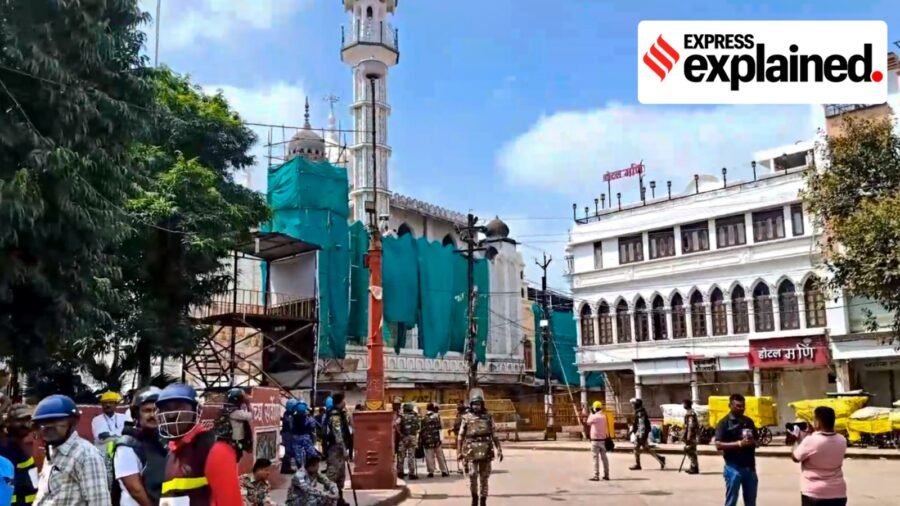
Shahi Masjid demolition: Ujjain residents and police clash; stones pelted, tear gas fired
Read: https://t.co/mZcZJGXM1W pic.twitter.com/KugoiOIxsB
Road widening and objections
Story continues below.
Subscribe to see fewer ads.
The administration has cited the Simhastha Kumbh, which will begin in March 2028, for the road-widening work being undertaken in the city. The Simhastha Kumbh is held every 12 years, with a large number of devotees taking a dip in the Kshipra River.
On Sunday, Chief Minister Mohan Yadav arrived with a pickaxe to begin removing a part of his ancestral house that is to be demolished for road widening, stating that it exemplified how people of Ujjain have come together for the purpose. “Whether Hindu, Muslim, Sikh, Christian or Parsi, people have even moved their places of worship back,” he said.
The same night, however, community members gathered in and around the Shahi Masjid. Imam Mohammad Ibrahim told that the mosque and other religious sites should be excluded from the exercise and claimed that the mosque dates back to 1390. He also said that a petition has been filed in the High Court, which will be heard on Monday.
What the court held earlier
The court earlier dismissed two petitions in a September 9 ruling. According to the order, the two sets of petitioners claimed an interest in the religious place and were administering the affairs of the mosque, which is registered as a Waqf property.
Story continues below this ad
Waqf refers to when a person permanently dedicates a property, movable or immovable, for any purpose recognised by Muslim Law as pious, religious or charitable. Other examples of waqf land include educational institutes and agricultural land.
The proposed demolition would tear down a portion of the prayer hall (Jamat Khana) of the mosque, a 120-foot-tall minaret, and the Mazhar Chouk Shahi, the order noted. The petitioners argued that the action would violate their fundamental rights under Articles 14 (equality before the law), 25 (freedom of conscience and free profession, practice and propagation of religion), and 26 (freedom to manage religious affairs, subject to public order, morality and health) of the Constitution.
One petitioner also argued that the municipal corporation acted arbitrarily. The counsel for the corporation, however, responded that due procedure was followed, including issuance of notices to the Waqf Board. It was also stated that all religious constructions causing a hindrance in the road-widening process “are being treated equally and are being removed in the larger public interest.”
“About 80 religious structures are being shifted/removed across the city for the road widening as per the master plan. Moreover, 11 religious structures – 10 temples and 01 mosque have already been removed on the subject road,” the order said.
Story continues below this ad
In the judgment, Justice Sandeep N Bhatt cited a prior judgment to state that road-widening work must fulfil certain criteria, including surveys, issuing notices, and hearing objections before communicating a reasonable notice for the rejection. It was held that the corporation did not act arbitrarily or treat this case differently.
The court further said there were “numerous disputed questions of fact involved in the present matter, including the petitioner’s capacity to file this writ petition”.
Deeming the corporation’s action to have followed necessary legal provisions, the court said that the Simhastha Kumbh, 2028, was to be considered, “whereby the expectations of crores of devotees are required to be kept in mind, as well as the need to provide better facilities and to manage the traffic of such events”.
The premises in question, it said, were “almost opposite to the Mahakaleshwar Temple and very near to the Kshipra River; and for the consideration of the larger public safety and larger public interest, the action taken by the respondent is found to be after following the necessary provisions of law.” The petitions were then dismissed.

CCTV is no cure for weak drug regulation
By Sohail Khan · 29 Sep
ECINET, ERONET: What are the Election Commission’s electoral roll systems?
By Sohail Khan · 29 Sep
Leave a Reply