ECINET, ERONET: What are the Election Commission’s electoral roll systems?
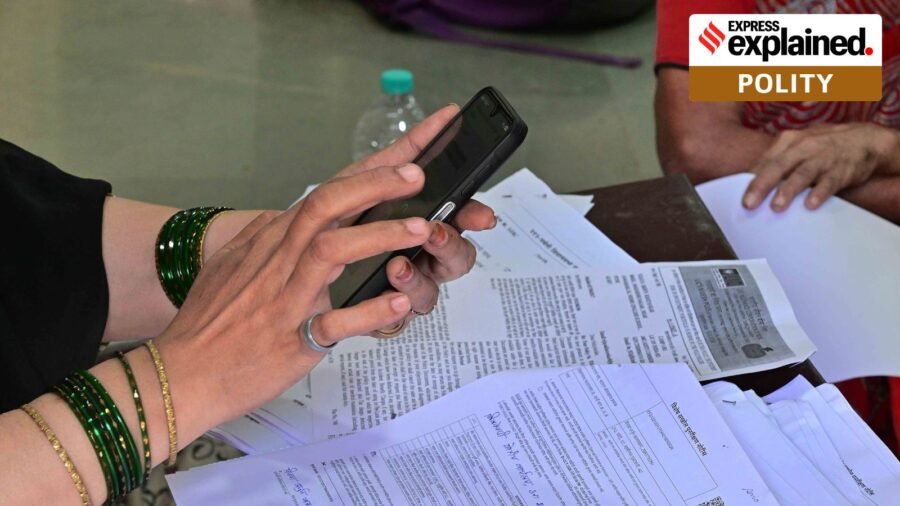
So, what exactly are ERONET and ECINET, and how are they connected to the preparation and revision of electoral rolls?
First, what is the Special Intensive Revision?
Under Section 21(3) of The Representation of the People Act, 1950, the ECI “may at any time… direct a special revision of the electoral roll for any constituency or part of a constituency in such manner as it may think fit”.
The Registration of Electors’ Rules, 1960, says the revision of rolls can be carried out “either intensively or summarily or partly intensively and partly summarily, as the Election Commission may direct”. In an intensive revision, the electoral roll is prepared afresh; in a summary revision, the roll is amended.
Story continues below this ad
Summary revisions take place every year and before each Lok Sabha and state Assembly election.
And what are the powers of the ERO?
Under the Representation of the People Act, 1950 and the Registration of Electors Rules, 1960, the responsibility for updating the electoral roll rests with the Electoral Registration Officer.
The ERO is typically an officer at the rank of the sub-divisional magistrate who prepares the voters’ list, hears claims and objections and decides which names will stay and which get deleted. Each Assembly seat has one ERO.
investigation revealed that the ERO, who should have the final call on what names enter the electoral roll, was being held back by the software, a concern that Sandhu flagged on August 14. Effectively, they were only able to add or delete a name, reverse a decision or process an appeal, with the ultimate decision resting centrally in New Delhi.
Story continues below this ad
So, what are ECINET and ERONET?
The Election Commission describes ERONET as a “centralized form processing system” for handling voter registration, migration and deletion. It replaced 36 separate systems and databases used by states to manage their electoral rolls.
ERONET is intended to aid the Electoral Registration Officer (ERO) in the capacity of a “decision support system”, in preparing and revising the electoral roll of an assembly constituency.
Under the Representation of the People Act, 1950, the Electoral Registration Officer (ERO) is the statutory authority responsible for preparing and revising the electoral roll of an assembly constituency. Therefore, ERONET cannot unilaterally decide if a person gets on or off the voter list, but can flag duplicate entries corresponding to a voter’s identical demographic details for the ERO’s attention. The ERO may then examine the records and if needed, conduct field verification before taking a decision.
In contrast, ECINET is a newer, broader platform that brings together electoral applications and services that were previously spread across multiple platforms. Officially launched in January 2026, it rationalised over 40 applications and websites used by voters, candidates, political parties and election officials.
Story continues below this ad
Major services for voters range from registration and searching electoral rolls to tracking applications, downloading electronic voter identity cards and finding information about polling stations and candidates.
Its electoral roll functions, previously handled by ERONET, are officially described by the EC as the “Electoral Roll module of ECINET Portal (previously ERONET)”.
The ERO is also authorised to resolve “logical discrepancies” detected in the ECINET software in the process. These are mismatches that arise when the software tries to map an elector to a parent or grandparent on the roll from the last SIR, such as a parent’s name that doesn’t match, an age gap between parent and child of under 15 or over 50 years, an age that doesn’t progress correctly between the old roll and the new, or a case where the elector submitted no document, or only Aadhaar.
What concerns were raised and how has the EC responded?
Story continues below this ad
The present controversy stems from the software design itself: While the statutory authority to determine the electoral roll rests with the ERO, the question is whether the design or functionality of the system can constrain the ERO’s discretion.
investigation revealed that concerns around electoral software were first flagged in November 2025. Concerns had previously been flagged about ERONET — which handled the roll management system now overseen by ECINET — and observed that the IT system of the time must not restrict the statutory powers of EROs.
In its initial response to the investigation, the Commission said on September 23 that EROs and District Electoral Officers “function as per statutory powers for registration and deletion under law”, and that its digital platforms “operate under strict data security protocols to prevent unauthorized tampering.”
Subsequently, the EC on Sunday (September 27) announced that ECINET would be reviewed by a committee headed by a senior Deputy Election Commissioner and would include an independent expert from an IIT or IIIT. It also said that field officers seeking greater flexibility in the system would be granted the same, while directions issued by Commissioners to officers will be “meticulously complied with”.

Essar eyes $18-billion US steel plant: Why Indian firms are investing in US amid tariffs
By Sohail Khan · 29 Sep
The volume knob we often forget to turn down
By Sohail Khan · 29 Sep
Woman loses 43 kg in 8 months: What experts say about losing 10 kg in a month
By Sohail Khan · 29 Sep
Leave a Reply