Essar eyes $18-billion US steel plant: Why Indian firms are investing in US amid tariffs
Story continues below.
Subscribe to see fewer ads.
While Essar Group’s investment pledge is one of the largest in the last few months, several Indian companies are boosting investment in the US.
JSW Steel in June had announced investments worth $500 million. JSW Cement Managing Director Parth Jindal had said that investment “has all been possible due to the policies of the Trump administration”.
Indian pharma companies have also announced big-ticket investments, led by Sun Pharmaceutical’s plans for a $11.75 billion acquisition of New Jersey-based Organon & Co. For the year ended December, 2025, Organon reported $6.2 billion in revenue and adjusted earnings of $1.9 billion (before interest, taxes, depreciation and amortization). Organon had a debt of $8.6 billion and cash balance of $574 million.
Market access curbs
While outflow of investments strengthens companies and the home economy through productivity gains, several investment decisions by US trade partners in the last 12 months are driven by protectionist measures in the US.
Story continues below this ad
The Trump administration had earlier this year doubled tariffs on steel, aluminium and copper from 25% to 50% under Section 232 of the Trade Expansion Act of 1962, which is not part of the negotiations for a trade deal.
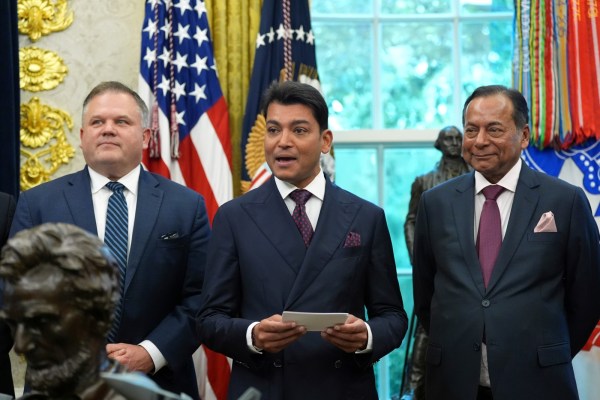 Mesabi Metallics Chairman Rewant Ruia speaks as Essar Capital Director Prashant Ruia, right, and Mesabi Metallics CEO Joe Broking listen during an event with President Donald Trump in the Oval Office of the White House.
Trump in June had said that tariffs on generic drugs in the US will be raised 100% after two years and to 200% thereafter to “reshore” generic pharma production in the US, adding that companies deciding against building plants in the US will be “penalised”.
Trump’s threat comes after several such ultimatums, largely designed to attract investment in the US. Actual tariffs on drugs have been exempted in most tariff instruments his administration has used, starting with those under the International Emergency Economic Powers Act, Section 122 of the 1974 Trade Act, and Section 232.
Investment commitment under trade deal
Investment announcements in the US by Indian companies also come amid negotiations for a trade deal and demands by US negotiators to attract investment in exchange for market access. All major American trade partners have agreed to invest in the US under the bilateral trade deal. Japan agreed to invest $550 billion, South Korea $350 billion and the European Union $600 billion.
Story continues below this ad
Trump has been threatening to reimpose tariffs on South Korea and the EU because of slow progress on investment. South Korea confirmed its first project under a $350-billion US investment pact on Tuesday and said it is considering two others. US officials had criticised Seoul for moving too slowly on the investments, especially compared with countries such as Japan.
Worries over investments in India
While corporate investment has shown signs of revival during the last quarter, weak investment has been a major worry for Indian policymakers.
Data showed that India saw a jump in net foreign direct investment (FDI) inflows in July, with data released late Friday by the Reserve Bank of India showing that it soared to an over five-year high of $7.35 billion. This is the highest monthly inflow since May 2021’s $8.80 billion.
On a gross basis, FDI in July was $14.58 billion, the third-highest in the last six years. Compared to July 2025, the latest net and gross FDI figures are up 64% and 24%, respectively.
Story continues below this ad
The latest FDI print comes even as the government warns of challenges on the external front, with Chief Economic Advisor V Anantha Nageswaran cautioning on Friday that “even if we tick (all the) boxes”, money may not flow in immediately.
The government and the RBI have tried to encourage foreign inflows in the last four months, with the concessional swap window for Foreign Currency Non-Resident (Bank) deposits turning out to be overwhelmingly successful. However, the rupee is not too far away from its all-time low of 96.96 per dollar. It closed at 95.82 on Friday.

The volume knob we often forget to turn down
By Sohail Khan · 29 Sep
Woman loses 43 kg in 8 months: What experts say about losing 10 kg in a month
By Sohail Khan · 29 Sep

Leave a Reply