Sea level rise: Can a country retain its statehood even if it loses its territory?
Two, the thermal expansion of seawater, a process by which water expands as it warms up. With global temperatures rising, oceans are becoming warmer, and as a result, the volume of water is increasing as well. Thermal expansion of seawater is responsible for one-third to half of global sea level rise, according to the National Aeronautics and Space Administration (NASA).
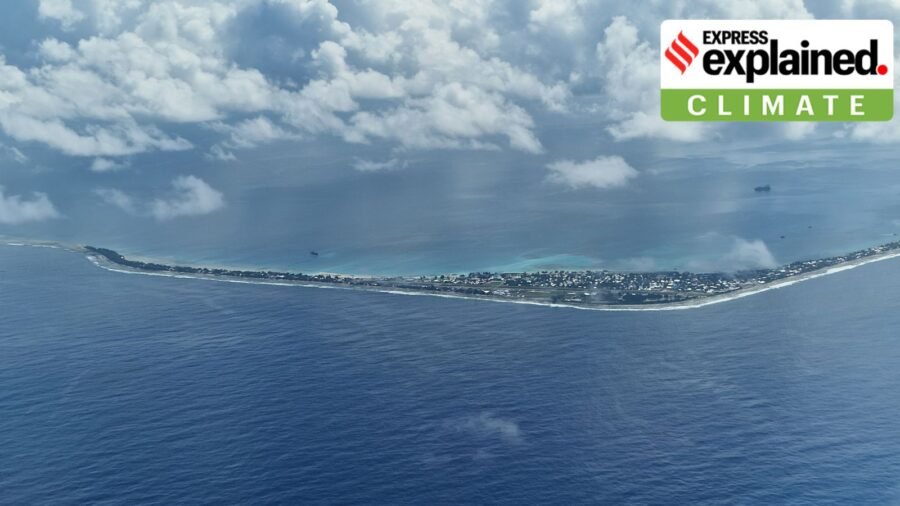
Low-lying islands are particularly vulnerable because much of their land lies only a few metres above sea level. Rising seas can therefore cause coastal erosion, flooding and saltwater intrusion into freshwater sources, while threatening homes, infrastructure and habitable land.
How fast are sea levels rising?
According to the World Meteorological Organization’s (WMO) State of the Global Climate 2025 report, the global mean sea level in 2025 was comparable to 2024 records.
Story continues below this ad
The global mean sea level is the average height of the sea surface. It is measured by satellites using radar altimeters, which measure the height of the sea surface.
Tide gauges along global coastlines have also been used to measure the global mean sea level since the late 19th century. Today the two measures serve complementary roles: satellites provide near-global coverage, tide gauges provide ground truth data used to calibrate and validate the satellite-based estimates.
In 2025, global mean sea level was comparable to the record-high levels observed in 2024 in the satellite altimetry record, according to the State of the Global Climate 2025 report.
The rate of global mean sea-level rise since 2012 is higher than the rate of global mean sea-level rise in the earlier part of the satellite record, 1993–2011.
Story continues below this ad
Can a country lose territory without losing statehood?
Rising sea levels also have legal implications for some island nations, as the loss of territory and habitability raises questions about their continued statehood. Under the 1933 Montevideo Convention, a state is defined using four main criteria: a permanent population, a defined territory, a government and the capacity to enter into relations with other states.
In 2015, the low-lying Republic of Kiribati said that climate change effects were threatening its existence as a nation. Similarly, in 2021, Tuvalu’s representative Simon Kofe addressed the COP26 standing knee-deep in seawater from a location he claimed was once dry land that had been lost to coastal erosion.
The prospect of territory becoming uninhabitable also raises questions about the “permanent population” criterion. However, the International Law Commission’s 2025 report notes that the traditional criteria for statehood do not resolve the question of continuity of statehood in the context of climate-related sea-level rise.
The Declaration on Sea Level Rise specifically addresses this issue, noting that territory loss does not automatically mean loss of statehood. It affirms the presumption of continued statehood in the face of sea level rise, as well as the sovereignty, sovereign rights and responsibilities, and UN membership of such states, consistent with international law.
Story continues below this ad
The declaration calls for international support for such states whose land territory has been affected by sea level rise. It also says states can maintain their maritime zones despite physical changes caused by sea-level rise, in accordance with the United Nations Convention on the Law of the Sea (UNCLOS). The International Law Commission similarly concluded that states are under no obligation to update their baselines or outer limits of maritime zones because of sea-level rise.

No fuel without PUC in Delhi: What this certificate says about your vehicle
By Sohail Khan · 28 Sep
I wanted a minimalist wedding until I walked into Delhi’s Chandni Chowk
By Sohail Khan · 28 Sep
Leave a Reply