Revisiting the farmer question
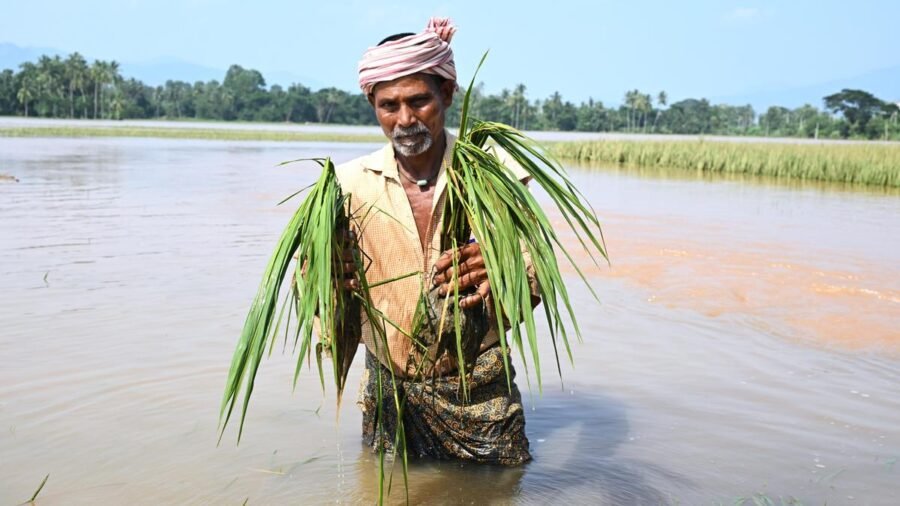
India may no longer be an agriculture dominated economy, but it remains deeply dependent on it. While only about 15–18% of GDP now comes from agriculture, the sector continues to employ around 46% of India’s workforce. A large part of rural India depends directly on farming and allied activities for its livelihood. This creates an uncomfortable paradox: while India has transformed into an economy driven by industry and services, the economic viability of farming has not kept pace. This is why, as we observe M. S. Swaminathan’s birth centenary year and his death anniversary, the recommendations of the National Commission on Farmers (NCF), which he chaired, need to be revisited.
One of the biggest challenges in Indian agriculture is small landholdings; about 86% of farmers own less than two hectares. Small plots constrain economies of scale, crop diversification and the adoption of new technologies and farming practices. Water is another structural constraint. Around half of all farmed land relies entirely on unpredictable rain, exposing farmers to drought and erratic monsoons. Elsewhere, intensive irrigation has created the opposite problem: groundwater depletion. The Cauvery dispute is ultimately a manifestation of competing demands on a finite resource while Punjab’s dilemma illustrates the consequences of unsustainable extraction.
Moreover, climate change is intensifying these vulnerabilities. Erratic rainfall, floods, droughts, and heat waves are increasingly translating into crop losses, while, rising costs of seeds, fertilizers, pesticides, and fuel squeeze farm margins.
Farmers often receive only a miniscule share of the final value of what they produce. Weak storage and processing infrastructure, fragmented supply chains and multiple intermediaries often leave cultivators with little bargaining power.
What the NCF got right
The NCF offered a comprehensive response to many of these problems. Its central insight was that agricultural distress was fundamentally an income and livelihood problem, not merely a productivity problem. Farmer policy, it argued, should be judged by the economic well-being of farmers rather than by increases in production or yield. The Commission, therefore, looked beyond land ownership to timely access to productive resources such as water, credit, technology, livestock, fisheries and other natural resources. It called for closer links between research institutions and cultivators.
Its approach also emphasised ecological sustainability. Higher productivity could not come at the cost of soil health and water security. Efficient water use, sustainable farming practices and conservation of natural resources were integral to agricultural policy.
The NCF also recognised that farmers were at the wrong end of an unequal value chain. It proposed district-level agricultural infrastructure; direct marketing linkages; stronger integration between agriculture and rural industry; and better storage, grading, packaging, processing and transportation. It sought to strengthen farmers’ bargaining power. Importantly, the Commission did not assume that everyone dependent on rural India could or should remain solely dependent on cultivation. It proposed a broader livelihood-security framework encompassing agriculture and allied activities, rural enterprises and non-farm employment.
In several respects, this thinking converged with the economic philosophy of former PM and farmer leader Chaudhary Charan Singh. Both placed emphasis on the viability of small farmers, remunerative agriculture, rural purchasing power and decentralisation, while warning against an economic model where an urban-industrial economy overwhelmed interests of rural India.
Over the last two decades, several of NCF’s recommendations have been implemented through separate schemes and missions. However, the Commission’s larger vision of making farming economically viable, reducing risk, strengthening farmers’ bargaining power and integrating production with markets has not been implemented as an integrated framework.
Given the profound changes since 2006 —climate stress, migration, technological change, and the growing importance of value chains— the case for revisiting its recommendations is arguably stronger today.
The NCF also anticipated a dilemma that is in sharp focus today: Indian agriculture cannot remain insulated from global markets, but neither can small farmers be exposed to those markets without adequate protection. With India now implementing Free Trade Agreements while also dealing with tariff pressures from the U.S., NCF’s ideas have renewed relevance. The challenge is to ensure that greater integration with global markets becomes an opportunity for Indian farmers rather than another source of vulnerability.
The answer is not protectionism, but a combination of remunerative prices, risk management, farmer aggregation, productivity enhancement, value addition, and carefully designed trade safeguards. India needs to implement the integrated farmer-income architecture and measure net farm income per household rather than simply tonnes/hectare. It should shift from MSP-centric thinking to income-risk management and the policy should combine MSP with crop insurance, income support, irrigation, cheap credit, storage, processing, and market linkages.
The task today is not to mechanically reproduce the NCF recommendations, but to update and complete their underlying vision for the agriculture sector and allow Indian farmers to participate in global markets from a position of strength. Making the NCF a constitutional body could be a useful starting point.
Priyambada Jayakumar is historian, public speaker, columnist, handloom advocate, and the author of ‘The Man Who Fed India’

Light on truth: on the Tamil Nadu G.O. and RTI
By Sohail Khan · 29 Sep
Tackling food loss and waste — India’s opportunity
By Sohail Khan · 28 Sep
The 80s nostalgia holds caste bias
By Sohail Khan · 28 Sep
Leave a Reply