Maharashtra is parched, but here’s why drought can’t be declared before October
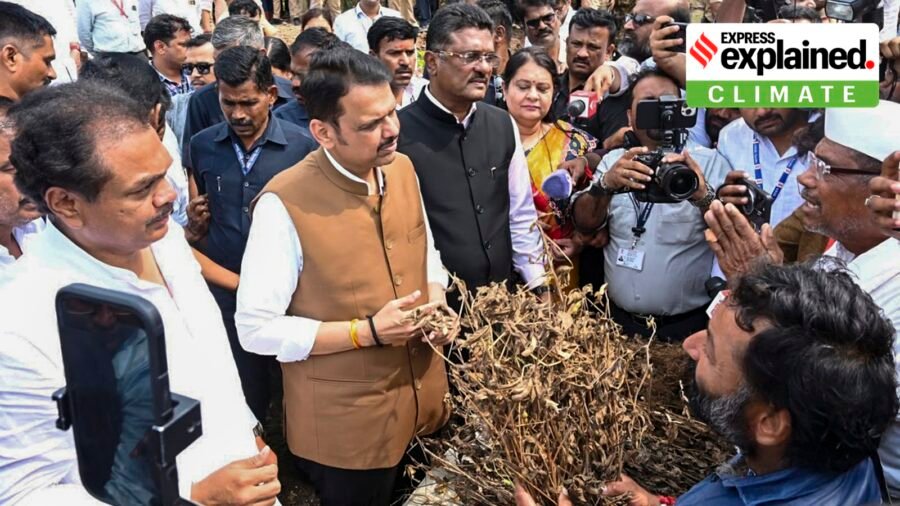
Calls to declare a drought are rising in Maharashtra, with the El Niño-driven rain deficit hitting the state’s agriculture-dependent economy hard. Water scarcity has compounded the crisis, setting back the kharif season and clouding prospects for rabi.
While Opposition leaders, including Sharad Pawar, have asked that a drought be declared, Chief Minister Devendra Fadnavis has said the government is taking “all steps necessary” to deal with the “alarming” situation.
Why hasn’t drought been declared in Maharashtra officially?
Under the National Disaster Response Fund (NDRF) rules, drought declaration for kharif (the monsoon cropping season, which runs from June to October) requires an assessment that can begin from October 5, once the monsoon starts to withdraw. For rabi, (the winter cropping season from October to April), assessment can be held in March 2027.
Story continues below.
Subscribe to see fewer ads.
There is no single definition of drought accepted across India. States have the authority to declare a drought based on local conditions. But the state government’s report should conform to parameters specified under NDRF norms, and disaster relief funds can be unlocked by the Centre.
Maharashtra has decided to submit a proposal to the Centre for financial assistance after October 5.
The state government has begun surveys and panchanamas to assess crop loss, so that the administration can quantify losses in terms of both food production and finances. Once this report is submitted, before releasing relief funds, a central team will visit the affected regions to make its own assessment.
Under NDRF rules, drought declaration is based on crop loss, the moisture adequacy index (used to assess soil health), and rainfall deficit, along with decline in food production and labour migration in search of work. Sowing must fall below 50 per cent of total cultivable kharif/rabi area, drinking water shortage must be severe, groundwater tables must be shrinking, there must be fodder shortage, and rainfall deficit must be up to 70 per cent.
Story continues below this ad
Across Maharashtra, kharif sowing was delayed this season due to erratic rain — instead of June 10, sowing began only on July 15. Post-sowing rain failure then stunted flowering and fruiting. The worst-hit crops are soybean and cotton, the mainstay for small and marginal farmers in Marathwada and Vidarbha. The dry spell has also stunted sugarcane growth in Marathwada and parts of western Maharashtra.
During the monsoon session in July, the CM announced a Rs 40,385-crore farm loan waiver, with an additional Rs 50,000 incentive for those who repaid loans regularly.
What is the water situation in Maharashtra?
A major concern is drinking water scarcity. Data up to September 20 shows Maharashtra’s 138 major dams at 85 per cent capacity and 264 medium dams at 65 per cent — down from 96 per cent and 77 per cent, respectively, at the same time last year. The state’s 2,630 small/micro dams are worse off, at just 43 per cent, compared with 57 per cent a year ago.
Region wise, Marathwada, with the maximum number of dams at 929, has 46 per cent water as compared with 81 per cent last year. It is followed by Amravati division at 64 per cent, Nagpur division at 72 per cent, Pune at 88 per cent, Nashik at 83 per cent and Konkan at 76 per cent.
Story continues below this ad
What is the status of rainfall in Maharashtra?
According to the India Meteorological Department (IMD), 31 of 36 districts in Maharashtra are rain-deficient, with 20 of these facing a deficit of 25 to 58 per cent. Beyond the deficit, shifting rain patterns have added to the damage: in more than 100 of the state’s 355 drought-hit talukas, gaps between rain spells have stretched to 40–60 days. As a result, the main kharif crop, sown across 147 lakh hectares, has withered.
In a departure from past patters, where rain did fall, it was short and intense — damaging soil health and causing erosion in some areas. Maharashtra’s agriculture is largely rain-fed; its irrigation potential, at under 20 per cent, is much lower than in states like Uttar Pradesh and Bihar.

Fatty liver: 6 popular hacks rated from -10 to 8 by a gastroenterologist
By Sohail Khan · 23 Sep
350 hours for Rashmika Mandanna, 500 for Shakira: The making of two showstopping looks
By Sohail Khan · 23 Sep
I have voted for three decades. Why is my SIR incomplete?
By Sohail Khan · 23 Sep
Leave a Reply