ExplainSpeaking: Will the Indian economy’s size triple in next 10 years?
In India, by its own account, JPMorgan Chase has provided over $80 billion (or Rs 7.7 lakh crore or trillion) as credit and capital to clients across various industries since 2019. Additionally it has spent $90 million (Rs 861 crore) in philanthropic contributions since 2015.
A brief history of GDP targets
This is not the first time someone in authority has given a projection for India’s economy. For a while now, the current government has been chasing the $5-trillion economy mark.
The initial reference to the $5-trillion mark was made by Prime Minister Narendra Modi in a speech at the World Economic Forum in 2018. At that time, he had said that the size of India’s economy will be $5 trillion by 2025. In 2018, India’s annual gross domestic product (or GDP, which is the measure of the size of any economy) was $2.7 trillion. In a speech later in 2018, the PM advanced this target to 2022. According to the data from the International Monetary Fund (IMF), as of the end of 2025-26 (which IMF refers to as 2025), India’s GDP was $3.9 trillion.
Story continues below this ad
Over the years, however, the $5-trillion target gave away to the target of becoming Viksit Bharat by 2047. In hard numbers, this was referred to as becoming a $35 trillion economy by 2047.
In October last year, during the Berlin Global Dialogue, India’s Commerce and Industry Minister Piyush Goyal claimed that in 20-25 years, India will be a $30 trillion economy. Here’s an explainer on that claim.
So, how likely is it for India to triple its GDP size in the next 10 years?
The answer crucially depends on whether Dimon was talking about India trebling its GDP in Indian rupee terms or in US dollar terms.
Typically, India’s GDP is initially assessed in Indian rupee terms (called the Nominal GDP).
Story continues below this ad
For international comparisons, GDPs of different countries are recalculated in US dollar terms. This recalculation is done by using the exchange rate of any given currency with the US dollar.
Since India’s rupee weakens against the US dollar every year, achieving this goal in US dollar terms is considerably tougher than achieving it in rupee terms. For instance, between 2014 and 2026, the Indian rupee has depreciated by 3.2% each year against the US dollar.
It should be noted that the calculations in this piece are all about nominal GDP, and not “real” GDP, which is calculated after taking away the effect of inflation, and is often the more commonly talked about version of GDP.
Trebling nominal GDP in US$ terms
CHART 1 shows that trebling the size of annual GDP in the next 10 years would require India to double the rate at which the economy grows each year.
Story continues below this ad
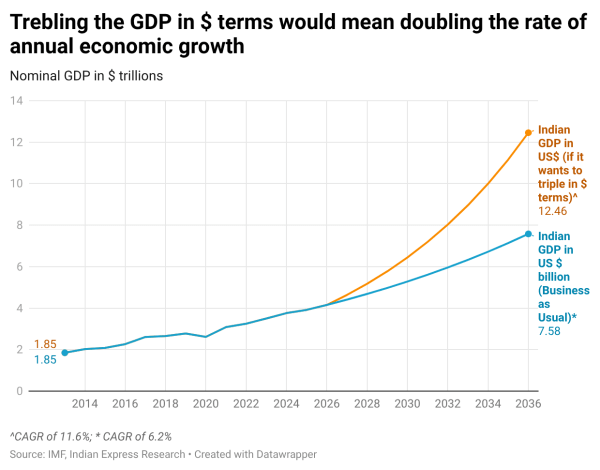 Chart 1.
Between 2014 and 2026, India’s GDP in US dollar terms has grown at a compounded annual growth rate (CAGR) of 6.2%. If India continues to grow at this rate, then in 2036, India’s GDP will only be $7.6 trillion. This is far lower than a trebling from the 2026 level of $4.2 trillion.
To triple the GDP size to $12.5 trillion by 2036, India would have to grow at 11.6% each year in US dollar terms between now and 2036 — that’s almost double the rate achieved in the past 12 years.
To achieve this rate in US dollar terms, India’s nominal GDP (in rupees) would have to grow at 15% (14.7% to be exact) each year until 2036.
To understand how ambitious this growth rate is, it helps to note that India’s nominal GDP (in rupees) grew at a CAGR of 10% between 2014 and 2025. What’s more, this 10% growth rate is based on the old GDP series that was discarded earlier this year for overstating India’s GDP.
Trebling in INR terms
Story continues below this ad
In contrast, trebling nominal GDP in INR terms is a much more likely possibility.
To triple in Indian rupee terms India would have to register an average growth rate of 11.6% of nominal GDP — that’s still higher than the 10% rate achieved since 2014 but far easier to achieve than the 14.7% required to triple in US dollar terms.
CHART 2 shows the contrast between the trajectory required to triple the GDP in dollar terms as against trebling in rupee terms.
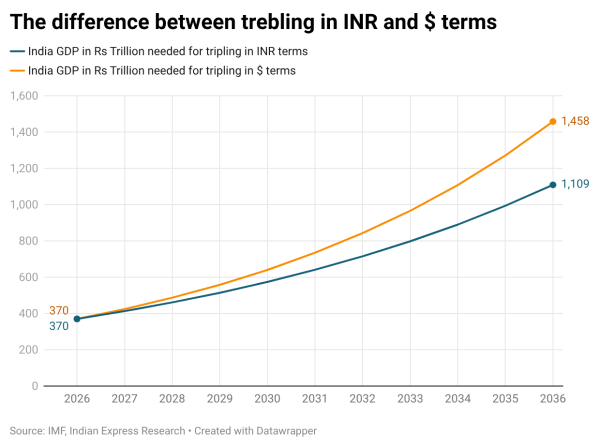 Chart 2.
Which one might Dimon be referring to?
Story continues below this ad
For any international investor, who invests using US dollars, the only returns that matter are the ones in dollar terms. If the Indian economy grows at 10% in rupee terms in a particular year but this growth happens in such a manner that rupee depreciates by 10% against the US dollar, then India’s growth in dollar terms in that year will be zero.
The same argument holds true for foreign investors and how they calculate the returns on their investments. It is more likely that they expect India’s GDP to treble in dollar terms.
While expecting a trebling of GDP is a great sign of confidence in India’s growth story, as shown in the calculations above, achieving it is a tall order, especially given the evidence of the past 12 years.
Do you think India is set to treble its GDP in the next 10 years? What should India do more to boost growth?
Story continues below this ad
Share your views and queries at udit.misra@expressindia.com
Take care,
Udit

Fatty liver: 6 popular hacks rated from -10 to 8 by a gastroenterologist
By Sohail Khan · 23 Sep
350 hours for Rashmika Mandanna, 500 for Shakira: The making of two showstopping looks
By Sohail Khan · 23 Sep
I have voted for three decades. Why is my SIR incomplete?
By Sohail Khan · 23 Sep
Leave a Reply