Inside Pandit Jasraj’s home: From a ‘Wall of Honour’, zardozi peacock wall, to a 65-year-old tanpura
Story continues below.
Subscribe to see fewer ads.
Hand-embroidered wall on Tussar Silk
The living room is designed around plush, curved cream sofas, giving the space a contemporary yet comfortable feel. Velvet and striped accent cushions add texture and colour to the seating arrangement.
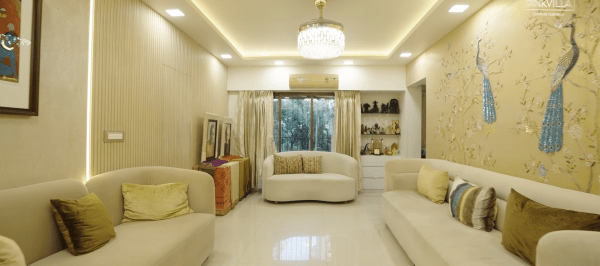 The intricate zardosi work turns the wall into a statement piece
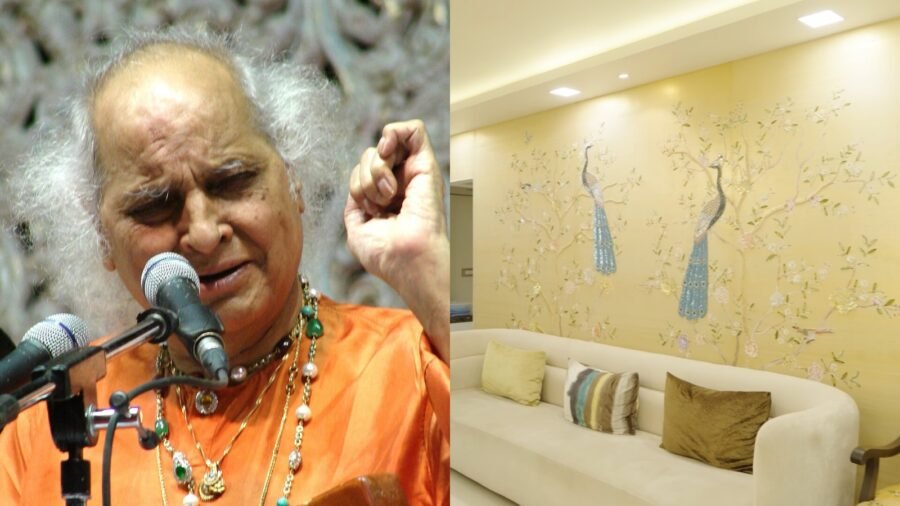
One of the most striking elements is the feature wall behind the seating area. Covered in textured gold Tussar Silk fabric, the wall features hand-embroidered and sequined peacock motifs, accompanied by delicate floral branches. The intricate zardosi work turns the wall into a statement piece while retaining the home’s traditional aesthetic.
The adjoining dining area continues the blend of classic and contemporary elements. A dark wooden dining table is surrounded by high-backed chairs upholstered in yellow floral fabric. In one corner stands a traditional tall brass lamp, or samai, adding an unmistakably Indian touch.
Story continues below this ad
A ‘Wall of Honour’ dedicated to Pandit Jasraj
The home’s connection with Indian classical music becomes particularly evident in a dedicated gallery wall. At its centre is a large oil painting by M R Achrekar. Durga shares that the portrait of Pandit Jasraj was made in 1969 by the legendary artist, who worked in several films as art director with Raj Kapoor.
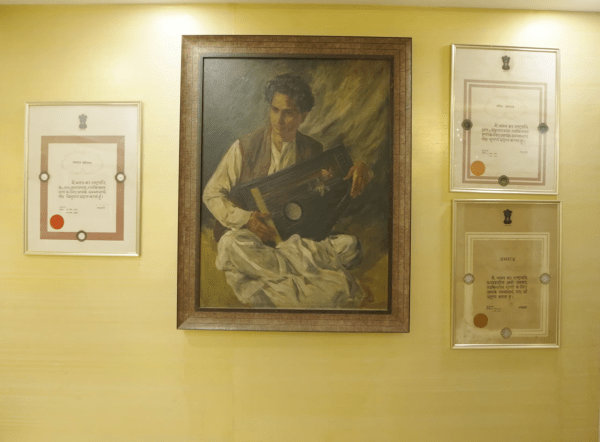 The artwork and accolades form a visual record of the musician’s contribution and achievements
The portrait is surrounded by framed Padma awards. The late vocalist received the Padma Shri in 1975, the Padma Bhushan in 1990, and the Padma Vibhushan in 2000.
Together, the artwork and accolades form a visual record of the musician’s contribution and achievements, turning the wall into both a personal tribute and a display of musical heritage.
A prayer room steeped in tradition
The home also has a dedicated spiritual space, where a carved silver mandir serves as the centrepiece. The altar is decorated with idols, brass diyas and fresh floral garlands.
Story continues below this ad
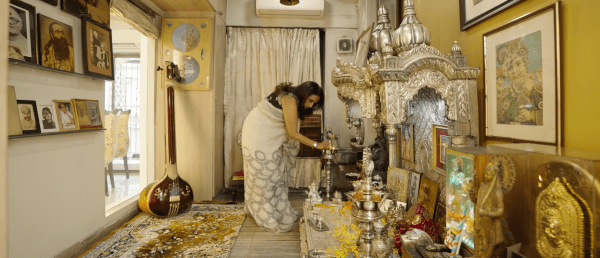 The temple features a 65-year-old tanpura
Adding to the room’s musical character is a traditional tanpura placed beside the altar on a patterned oriental rug. The 65-year-old instrument, an important part of Indian classical music, sits naturally within the space.
The surrounding walls feature portraits of spiritual gurus, along with a framed painting of Lord Krishna. Wall shelves and carefully arranged religious displays complete the intimate prayer area.
Bedrooms bring in colour and playful details
While the common areas largely rely on beige, cream and gold, the bedrooms introduce brighter colours and more contemporary elements.
The primary bedroom features white marble flooring and mirrored floor-to-ceiling wardrobe doors, giving the room a spacious, polished look. A low platform bed sits against a vibrant yellow accent wall, creating strong contrast with the otherwise neutral interiors.
Story continues below this ad
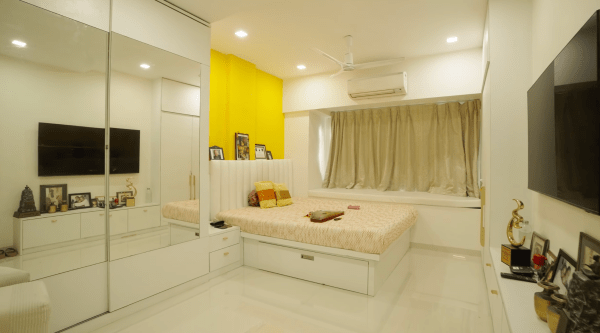 The room features an iconic Krishna photo frame
A cushioned bay-window seating area offers a separate nook within the bedroom, uses natural light, and adds another layer of comfort.
Rainbow-themed kids bedroom
The kids’ bedroom takes a more playful approach. Its most distinctive feature is a rainbow-shaped upholstered headboard, paired with a bright yellow suspended swing chair. The swing is set against scalloped teal wall padding, creating a colourful visual contrast.
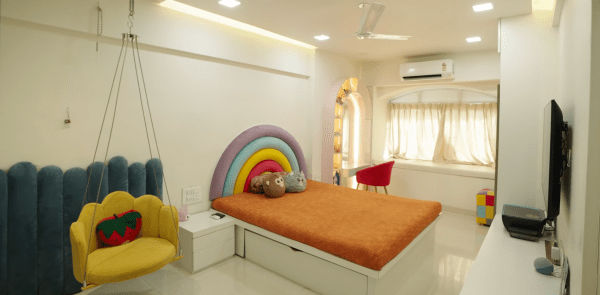 A rainbow-themed kids bedroom
An arched vanity mirror adds another decorative element while maintaining the rounded shapes seen elsewhere in the space.
Rubeena Singh, Founder of The Verve Collective, interior stylist, and home decorator, explained why homeowners are incorporating family heirlooms, antiques, and inherited objects into contemporary interiors. The expert highlighted that people are adding personality and uniqueness to their spaces. “While they want their spaces to look beautifully considered, they don’t necessarily want them to feel like they have been picked straight out of a catalogue or showroom. An heirloom or inherited object brings something that simply cannot be replicated: a memory, a story and a personal connection,” Rubina said.
Story continues below this ad
Highlighting the growing inclination for sustainability among millennials, she said, “Instead of constantly buying new, there is greater value in looking at what already exists within the family and finding a new relevance for it,” she said.
“An old cabinet can be refurbished and sit beautifully in a contemporary room, a family textile can become a piece of art, or an inherited object can be styled in an entirely new context. For me, it is that combination of individuality, emotional value and conscious consumption that makes these pieces so relevant to contemporary homes today,” Rubina explained.

C Raja Mohan: The ghosts of 1945 are being recruited for today’s contest over Asia
By Sohail Khan · 29 Sep
Heart attack symptoms when you’re alone: What to do in the first few minutes
By Sohail Khan · 29 Sep

Leave a Reply