How mining dust in Aravallis is killing residents
Benchmarks
Nifty23,346.4075.81
FEATURED FUNDS★★★★★
Motilal Oswal Midcap Fund Direct-Growth
5Y Return
22 %
Invest Now
Enter search text:
Business News›News›India›Death by breath: How mining dust in Aravallis is killing residents
Read Today's Paper
Death by breath: How mining dust in Aravallis is killing residents
Synopsis
Unregulated Aravalli mining in Rajasthan has triggered a fatal silicosis crisis, claiming dozens of lives in villages like Syalodra. Affected families face catastrophic medical costs, unaddressed safety hazards and rejected disability certifications. Meanwhile, a Supreme Court-appointed panel skipped visiting these heavily impacted areas ahead of its November deadline.

Listen to this article in summarized format
Loading…
×
×
Unlock AI Briefing and Premium Content
New Year Offer 24 Hours Left
Already a member? Sign In
What's Included
- Exclusive Stories
- Daily ePaper Access
- Smart Market Tools
- Curated Investment Ideas
- Ad-lite Experience
Subscription

 iStock
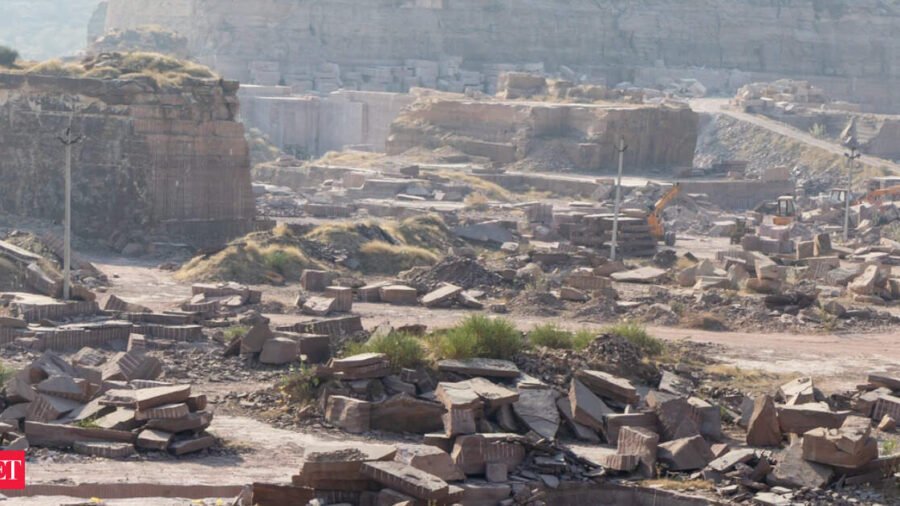
Kotputli-Behror: Manisha (27) sits with a group of women on a mattress laid out in one corner of her house's veranda in Rajasthan's Sikar's Syalodra village. In the other corner, there are stacks of large oxygen cylinders, used by her 32-year-old husband, Manjeet, for breathing up until his recent death.
Manjeet was a labourer at a nearby stone crushing unit, and for more than three years, he suffered from a debilitating, incurable lung illness called silicosis. Its trigger: inhaling silica dust, fine particles that are a by-product of rampant mining operations such as drilling, blasting, and stone crushing in the region.
Silicosis has claimed more than 50 people's lives over the years in Syalodra, part of the Aravalli range, say residents.
Death by breath
Sanjay, 43, lives a few steps away from Manisha's house. In July this year, he lost his brother, Manoj, who also worked at a stone crushing unit, to silicosis. The disease has claimed six members of his family.
"We do not have the money to move somewhere else. My kids have to live here and breathe the same poisonous air which has killed so many residents," he says.
A 2023 study, 'Prevalence of Silicosis in Stone Carving and Sandstone Mining Industry in Rajasthan', published in the Journal of Occupational and Environmental Medicine, examined the Rajasthan government's online portal for the registration, certification, and disbursement of relief to silicosis-affected persons.
The portal was launched under the Rajasthan Policy on Pneumoconiosis including Silicosis Detection, Prevention, Control and Rehabilitation – 2019.
At the time of the study, 23,436 cases of silicosis, including 6,876 deaths, had been certified on the portal. Data analysis of 4,977 silicosis cases, including 741 deaths, showed that detection of silicosis among districts with a preponderance of the stone carving industry was much higher.
The analysis also found that the prevalence of silicosis was the highest among people aged between 36 and 40.
The figures about silicosis cases and deaths, however, do not represent the true disease burden, which is considerably higher, says Kailash Meena, an environmentalist based in Sikar's Neem Ka Thana town.
One key reason for undercounts is that people face several hurdles in attaining certification of silicosis, given by community health centres or district hospitals based on medical examination and chest radiograph.
"The process requires patients and their family members to make multiple visits to hospitals. However, a lot of people cannot afford such frequent trips and fail to complete the process," says Meena.
For instance, Syalodra resident Prem Devi, who belongs to a Scheduled Caste community and is in her early 50s, has registered herself thrice on the portal in the past three years with the help of her son. But each time, it has been cancelled.
"Once the registration has been done, we have to go to the hospital where an X-ray of the lungs is done. The X-ray is then sent to a doctor for examination, based on which the certification is granted. We never get to know who this doctor is or where his office is. Each time my X-ray has gone for an analysis, my registration has been cancelled," she says.
For people like Prem Devi, a widow, certification is a lifeline, as they are bedridden on most days and have no source of income.
"Patients receive free medicines for the treatment, Rs 5,000 every month, and other facilities if they get the certification," says Meena.
The money becomes more significant once patients require oxygen support for breathing. Syalodra's residents say each oxygen cylinder costs around Rs 1,000. In the days leading up to his death, Manjit consumed 12 oxygen cylinders per day.
The problem extends beyond Syalodra to mining-affected areas of Kotputli-Behror, including Jodhpura-Mohanpura village.
Standing next to a temple on a hilltop, Kailash Yadav, secretary of the Jodhpura Sangharsh Samiti, says most village residents have breathing issues.
The temple is adjacent to a mining site, operated by UltraTech Cement Limited. The spot is dotted with JCBs busy excavating stones, which are sent via dumper trucks to a stone crushing unit installed next to the mine. According to Yadav, explosions to shatter rocks are frequent at the site, even at night.
Rekha, who is the mother of a seven-year-old girl and lives not far from the mining site, says, "Dust from these mining activities is infecting our kids as well. My daughter now has asthma, and she has to use inhalers to breathe properly."
An April 2023 survey in the village, conducted by the National Alliance of People's Movement (NAPM) and the People's Union for Civil Liberties (PUCL), gives a glimpse of the issue's severity.
Out of nearly 928 individuals surveyed, 478 reported multiple health issues, including skin diseases, breathing problems, tuberculosis, and itchiness in the eyes.
In their final report about the survey, NAPM and PUCL conclude that the diseases could be "dust-induced from blasting activities" and that further investigation is required.
Noting the severe mining-related impacts on Jodhpura-Mohanpura residents, the Central Zone Bench of the National Green Tribunal (NGT), last November, ordered the Rajasthan government to constitute a committee to rehabilitate the entire village.
The order also banned blasts within 500 metres of the village, and directed UltraTech Cement Limited to pay Rs 20,000 for health-related harm.
The court order says, "A list of health check-ups has been filed'¦ in which the medical officer has treated 298 persons; most of them are suffering from skin rashes, asthma, nose irritation, joint pain, deafness, allergy, breathlessness, eye irritation, allergy, etc., and the list is of 298 persons."
Despite this, residents are yet to be rehabilitated, and no action has been taken to curb mining operations, says Yadav.
A response by the Ministry of Environment, Forest and Climate Change, and UltraTech Cement regarding the allegations is awaited.
No sign of relief
Rekha says the Aravalli committee was supposed to visit her village on August 8, but did not arrive.
"A group of us, along with my daughter, waited for the members for more than five hours. I wanted to tell them what mining has done to us," she says.
The panel conducted its field visits between August 6 and 11, visiting nine districts in Delhi, Haryana, and Rajasthan, according to the Aravalli Virasat Jan Abhiyaan, a group of environmentalists, social activists, and others. Public hearings were held in Gurgaon, Alwar, Ajmer, and Udaipur.
A 2025 Forest Survey of India report identified 63 districts across Gujarat, Rajasthan, Uttar Pradesh, Haryana and Delhi as part of the Aravalli range.
In its compliance report, submitted on August 31, the committee said it needed six more months to submit the final report. The additional time would allow the panel to bring together spatial, ecological, geological, hydrological, socio-economic, and stakeholder evidence before arriving at its conclusions regarding the Aravallis.
However, the SC denied the request and asked it to submit the final report by November 30.
"Let the panel work day and night to submit a report on the Aravalli issue," said Chief Justice of India (CJI) Surya Kant while hearing the matter.
Yadav does not believe the panel members would visit Jodhpura-Mohanpura before submitting the final report. "When they did not come during their first field visit, why would they come now? Their final report will not change anything for us," he adds.
Add 

(You can now subscribe to our WhatsApp channel)
(You can now subscribe to our WhatsApp channel)
Read More News on
ultratech cementultratech cement limitedultratech cementsyalodrauttar pradeshpuclnapmforestmeenasandstone mining industry


Enter search text:
Stories you might be interested in

India’s core sector slows to 4.8% in August
By Sohail Khan · 21 Sep
Railways recover Rs 140.8 crore from offenders
By Sohail Khan · 21 Sep
AI is everywhere. Now IT firms need to prove it
By Sohail Khan · 21 Sep
Leave a Reply