Expert Explains | How India could solve its summertime power cuts problem
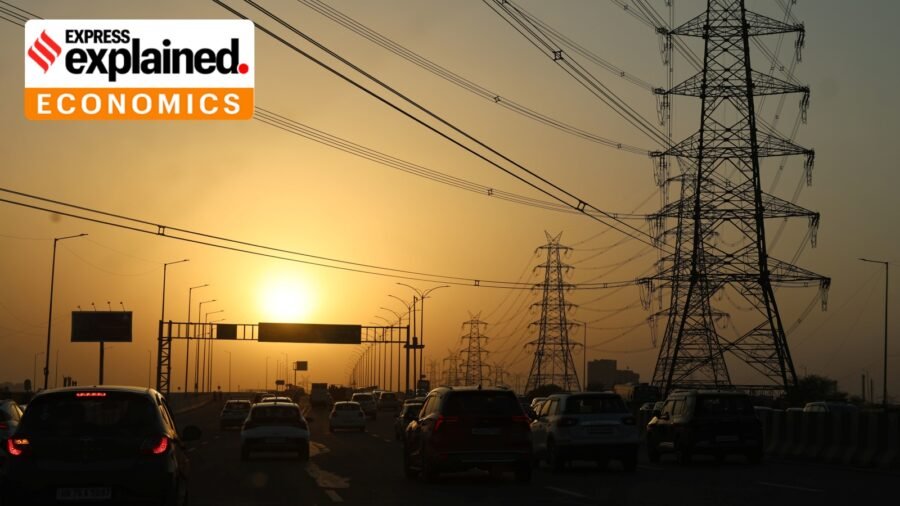
The summer months have presented sharp contrasts in perceptions of power supply. National peak demand reached record levels, and there was a sense of achievement in meeting it. Yet residents of Gurgaon’s wealthiest apartments experienced frequent power disruptions and had to fall back on backup diesel generators, with the resulting local air and noise pollution.
Neighbouring Delhi, by contrast, was practically free of power cuts. This contrast shows the vast difference in the performance of adjacent distribution companies (discoms). It is time for a hard-headed diagnosis of the power distribution problem, and how to fix it.
Story continues below.
Subscribe to see fewer ads.
Greater consumer choice
Discoms act as the provider of last-mile connectivity in the power sector. While power plants produce electricity and high-voltage towers transmit the same over long distances, discoms receive this high-voltage electricity and distribute it to the final consumers at usable voltage levels.
The Electricity Act, 2003 gives consumers the right to a reliable, quality power supply from the discom, with an independent and empowered regulatory commission to set rates and oversee the discom. The Act limits the state government’s role to making policy, deciding which consumer categories — farmers, for instance — should get free or nearly free electricity, and providing the discom with the subsidy needed for this.
Mumbai has allowed parallel distribution licensees (such as Tata Power, BEST, and Adani Electricity) to operate within the same area for close to two decades, and consumers there have exercised a real choice of supplier. This has worked, and allowing new licensees to enter will work in states where the political economy of governance and “rent-seeking” from distribution seems intractable. “Rent-seeking” refers to an economic practice where people profit from manipulating the system rather than creating value in the form of new products or services.
It is not widely known now that the short-lived H D Deve Gowda-led Central government in the mid-1990s decided to encourage parallel distribution licensees by the states in cities with a population of over a million, and offered them cheaper electricity from large Mega Power Projects (massive power stations designed with a capacity of 1,000 MW or more to bridge national electricity deficits), which would have import and excise duty exemptions so as to be able to supply cheaper power.
Story continues below this ad
The rationale was that, after removing supply to rural areas and irrigation, electricity supply for businesses should be commercially viable, and that this would be achieved through new licensees, given the intractable governance culture of inefficiency and rent-seeking in electricity distribution.
States gave written undertakings to privatise and took the cheap electricity. But they did not proceed with privatisation, given the political economy of state ownership. The Central government ultimately had to accept the failure of its Mega Power Policy after a decade, and it formally waived its conditionalities.
Summertime power cuts
Specifically, why did frequent power cuts take place in the summer? One reason could be that the capacity of the distribution network has not been augmented adequately for the rapid increase in demand from air conditioning in the summer heat. In these circumstances, even though adequate power is available at the national level, the discom has — out of technical necessity — no option but to impose power cuts to maintain grid stability. The distribution network’s carrying capacity must be continuously increased and kept above the anticipated increase in demand.
State governments and the regulators must ensure that this is done before the next summer. Parallel licensing is a viable solution, as it introduces competition, creates room for fresh investment, and encourages technology adoption, with a focus on quick redressal of consumer complaints.
Story continues below this ad
One constant refrain has been that regulator-fixed rates are too low and that discom revenues are never enough to make the necessary investments. The regulatory commissions should ensure that discoms receive enough revenue from the rates and actually undertake the requisite investments.
Sharing the load
Going forward, it would be prudent for the discoms to promote the rapid installation of solar panels in public spaces and on buildings, with an attractive feed-in tariff. Increased decentralised solar power generation will reduce discom costs, since solar power is significantly cheaper than thermal power and carries no transmission cost.
Further, discoms should install battery storage systems at load centres, optimally, as soon as possible. This will allow locally generated, cheap solar power to be stored to meet evening demand peaks.
With the adoption of storage, generation from thermal plants can also be raised, particularly during the summer months. At the national and discom levels, stranded assets need to be pooled and used to meet peaking power needs. These assets are gas-based plants whose electricity, generated from imported gas, is too expensive for normal operations but affordable for peaking power for a few hours during summer.
Story continues below this ad
The aim should be to ensure that residential localities do not need to run their backup diesel generators. A combination of these measures will ensure that frequent and prolonged power cuts become a thing of the past, whether in India’s rapidly evolving growth centres such as Gurugram or in far-flung remote areas. A two- to three-year runway for these reforms would be ideal.
The author is a retired IAS officer. He is former Secretary, Department of Industrial Policy and Promotion, Ministry of Commerce and Industry, and former Joint Secretary in the Ministry of Power.

For well-being at IITs, we must ask: What do we owe students beyond teaching and testing?
By Sohail Khan · 21 Sep

From Delhi University, the youth have spoken for progress
By Sohail Khan · 21 Sep
Leave a Reply