Houthis: How a local Yemeni movement became West Asia’s wildcard
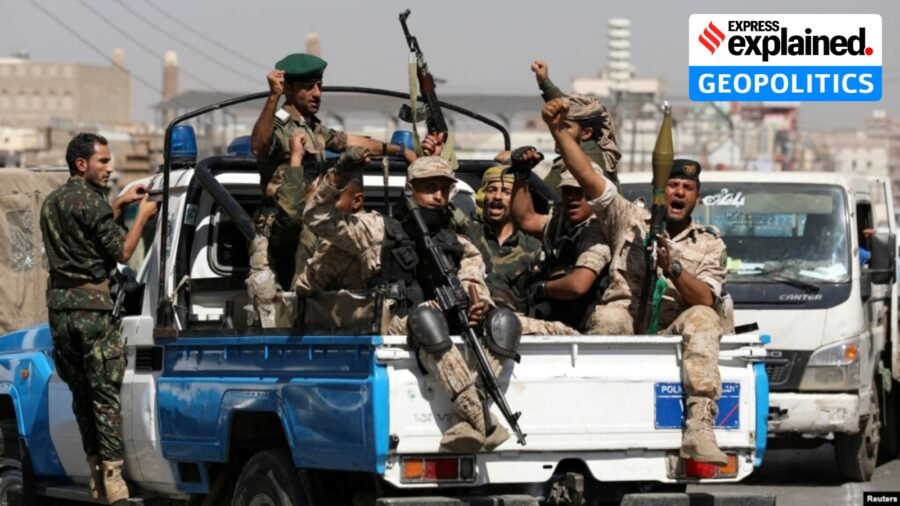
The tussle of power, faith, and influence is not new to Arab society. Various tribes living in different parts of the region are known to be battle-ready at a moment’s notice, no matter how mighty the opponent is. The outcome is rarely calculated. As the outsiders witness the advancement of Ansar Allah — or “Houthis”, as they are known — in the Red Sea, they seek explanation beyond David versus Goliath, Odysseus versus Polyphemus, or the Battle of Marathon. How does the Iran-backed armed group that is involved in a civil war and a geopolitical conflict at the same time survive?
We explain.
From localised group to regional actor
Ansar Allah’s journey began in the 1990s as a Zaidi Shia religious and cultural revivalist movement against the alleged neglect the community faced at the hands of the Sunni rulers, who came to power in 1962 after a revolt against the Zaidi Imamate that ruled Yemen for over a thousand years. The Zaidi Shias, who felt marginalised amid the rapid expansion of Saudi-funded Sunni proselytisation, looked up to their leaders, including Hussein Badreddin al-Houthi, who established a group called al-Shabab al-Mu’min (The Believing Youth) in 1992. It organised educational and social programmes aimed at preserving Zaidi cultural identity.
By the early 2000s, the movement began political activism against certain policies of Yemeni President Ali Abdullah Saleh and the 2003 US invasion of Iraq. The group members criticised Saleh’s government for its alignment with the US and Saudi Arabia. Tensions grew further into an armed insurgency in 2004 when Yemeni security forces attempted to arrest Hussein al-Houthi. His death in a battle later that year militarised and consolidated the movement under his family’s leadership, launching six successive wars against the Saudi-backed government between 2004 and 2010.
Story continues below.
Subscribe to see fewer ads.
Prasanta Kumar Pradhan, research fellow and coordinator, West Asia Centre, at the Manohar Parrikar Institute for Defence Studies and Analyses (MP-IDSA), New Delhi, told : “During the six Saada Wars (2004-2010), the central Yemeni government struggled to suppress the insurgency. Saudi Arabia directly entered the conflict in late 2009 after Houthi fighters crossed into the border region of Jizan. The Saudi military relied on heavy airpower and artillery but faced operational challenges in the rugged mountainous terrain, previewing the tactical difficulties that would characterise future campaigns.”
The group’s worldview is articulated in its controversial slogan, the Sarkha: “God is great, death to America, death to Israel, a curse upon the Jews, victory to Islam.” Its modern ideology borrows heavily from global anti-imperialist rhetoric and Iran’s 1979 Islamic Revolution. The Houthis view themselves not merely as a local political faction but as a sovereign vanguard fighting against Western hegemony and monarchies in the neighbourhood.
Parallel state
Over a decade of territorial control, the Houthis transitioned from an insurgent militia into a governing authority that manages a highly lucrative war economy. Through systematic restructuring of the state, the group, which included institutions and the private sector, established a comprehensive parallel economy.
Rana Friefer, writing for Al Majalla (“How the Houthis built a parallel economy in Yemen”), notes that recent economic assessments indicate that the Houthi administration generates roughly $2.5 billion annually through parallel tax and collection mechanisms. The key components of this financial system include internal customs checkpoints along the borders dividing Houthi-controlled territory from government-held regions and the collection of Zakat (religious alms) and control of state-owned telecom providers like TeleYemen and Yemen Mobile based in Sanaa.
Story continues below this ad
The Houthis are said to have prioritised the energy sector. Through state-run bodies like the Yemen Petroleum Company, the Houthis manage the distribution of fuel, divert shipments to black markets, and manipulate prices. The US Treasury Department has also accused the Houthis of generating more than $2 billion annually through the illicit trade of Iranian oil.
Joining the ‘Axis of Resistance’
Analysts consider the ties between Iran and the Houthis a key element of security in West Asia. While Houthis are generally dubbed as a direct Iranian proxy, some see the relationship through the prism of strategic alignment, technical dependency, and mutual benefit. Tehran, through the Islamic Revolutionary Guard Corps Quds Force, provides critical support that elevated Houthi military capabilities. Iranian advisers and Hezbollah operatives provide command-and-control training, media strategy, and operational planning.
The Houthis give Iran a strategic footprint along the Bab al-Mandeb and the southern flank of Saudi Arabia. This presence provides Tehran with asymmetric leverage over global trade routes without requiring direct Iranian state exposure. After the China-backed truce between Iran and Saudi Arabia, Tehran sought to normalise ties with Gulf monarchies to end economic isolation. Consequently, Iran attempts to balance its ties with Gulf states against its support for Houthi military operations.
“The Houthis are a strategic leverage for Iran vis-à-vis Saudi Arabia. While Iran would like the Houthis to increase pressure on Riyadh, it would not want a full-scale, uncontrollable war with the Kingdom. Even as it supports the Houthis in pressuring Saudi Arabia, Iran seeks to maintain the possibility of diplomacy and negotiation with Riyadh. Iranian strategy, in essence, is to sustain Houthi military pressure and diplomatic engagement simultaneously vis-à-vis the Kingdom,” Pradhan said.
Story continues below this ad
Domestically, the Houthis exhibit autonomous decision-making. Despite depending on Iranian technological assistance, Houthi leadership makes decisions based on domestic needs and political survival.
New theatre of war
Saudi Arabia and the Houthis engage in a high-stakes combination of coercive diplomacy and military expansion. Direct negotiations between Riyadh and the Houthis began after the April 2002 UN-brokered truce. But disagreements regarding resource allocation, sovereignty, and security guarantees stalled the communication.
Disputes over finances and economic pressure have fuelled the current surge in Houthi drone and missile attacks on southern Saudi Arabia. Peace negotiations stalled over Houthi demands that Saudi Arabia use Yemeni oil and gas revenues to pay public-sector salaries in Houthi-controlled areas. When Riyadh resisted underwriting these costs without a demilitarised border zone, the Houthis struck eastern Yemeni oil terminals, cutting off the government’s main income stream. Facing an economic squeeze of their own, the Houthis then redirected their strikes towards Saudi Arabia’s southern provinces to prove that Saudi infrastructure remained vulnerable until financial concessions were granted.
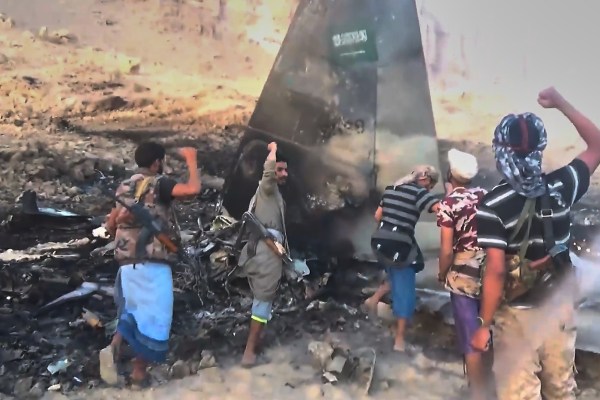 Houthi fighters chanting and raising their fists beside what the Houthis described as the wreckage of a downed Saudi F-15 fighter jet in Marib province, Yemen. Photo: Ansar Allah Media Office via AP
Simultaneously, the Houthis have expanded their military footprint along Yemen’s western coastline and the strategic Bab al-Mandeb strait, giving them the power to threaten global shipping lanes for geopolitical leverage. They have reinforced these military moves by framing their actions as anti-imperialist solidarity with Palestine amid broader regional conflicts. This ideological positioning boosts local recruitment while drastically raising the political costs for Gulf monarchies, making it much harder for Saudi Arabia to re-engage in a full-scale coalition against them.
Story continues below this ad
On the current situation, Pradhan said: “The situation between Saudi Arabia and the Houthis began to deteriorate in July 2026, when the Yemeni government carried out strikes on Sanaa airport to stop an Iranian Mahan Air aircraft carrying a Houthi delegation from landing. The Houthis held Saudi Arabia responsible for the attack and retaliated by striking Abha International Airport in the south of the Kingdom — the first major Houthi escalation against Saudi Arabia after a period of relative calm between the two sides. In the course of this escalation, the Houthis captured Mayun (Perim) Island in the Bab el-Mandeb Strait off the Yemeni coast. The situation between Saudi Arabia and the Houthis has thus become increasingly unmanageable.”
Variable in the regional equation
The Houthis’ active participation in regional security dynamics complicates diplomatic engagement between the US and Iran, introducing unpredictable variables into bilateral risk calculations. Moreover, according to Pradhan, the Houthi capture of Mayun Island, along with their seizure of the strategically important port of Mokha along the Red Sea coast, has considerably strengthened their position along these critical maritime corridors.
“Much as Iran has demonstrated that it holds effective power over the Strait of Hormuz and the capacity to disrupt maritime security in its vicinity, the Houthis are now projecting themselves as the dominant force in the Bab el-Mandeb and the Red Sea. Their capture of ports and islands along the Red Sea represents a direct challenge to Yemen’s internationally recognised government. Additionally, the growing instability in the Red Sea and the Bab el-Mandeb poses an increasingly complex security challenge for the Yemeni government, Saudi Arabia and for the wider regional order,” he said.
A major diplomatic hurdle is the disconnect between Iranian influence and true Houthi independence. Although Washington blames Tehran for supplying the Houthis with weapons, the group acts with substantial operational freedom — meaning Iranian pledges to reduce regional tensions do not guarantee Houthi restraint. As a result, Houthi attacks on Red Sea shipping force the United States into direct military action to protect trade routes, raising the risk of confrontation with Iran and undermining diplomatic efforts like nuclear and sanction negotiations.
Story continues below this ad
There’s also a direct clash between the motives of Houthis and those of the Gulf states. While Saudi Arabia and the UAE seek peace to concentrate on domestic infrastructure development, the Houthis seem to benefit from such a conflict. The current escalation allows it to justify its necessity to its supporters.

Tata Sons: After boardroom showdown, what lies ahead
By Sohail Khan · 18 Sep
From paan daan to luxury hampers: How the humble betel leaf is getting a premium makeover
By Sohail Khan · 18 Sep
Isha Ambani says part of her mind is always with her children: ‘That internal tug-of-war…’
By Sohail Khan · 18 Sep
Leave a Reply