Expert Explains | Why the Trump-Xi bonhomie doesn’t mean an end to US and China’s rivalry
Story continues below.
Subscribe to see fewer ads.
What does all this tell us about the arc of US-China relations? How are the two sides now managing their competition in AI and trade? And what are the other faultlines that remain?
G Venkat Raman, a professor at Indian Institute of Management-Indore, a Fulbright and Institute of Chinese Studies fellow, explains these issues and more.
What does the unusually elaborate welcome accorded to Xi Jinping tell us about how Washington now views China? After the tariff confrontation of 2025, what explains the shift from coercive pressure to renewed high-level engagement, and does it suggest that China has acquired greater bargaining leverage?
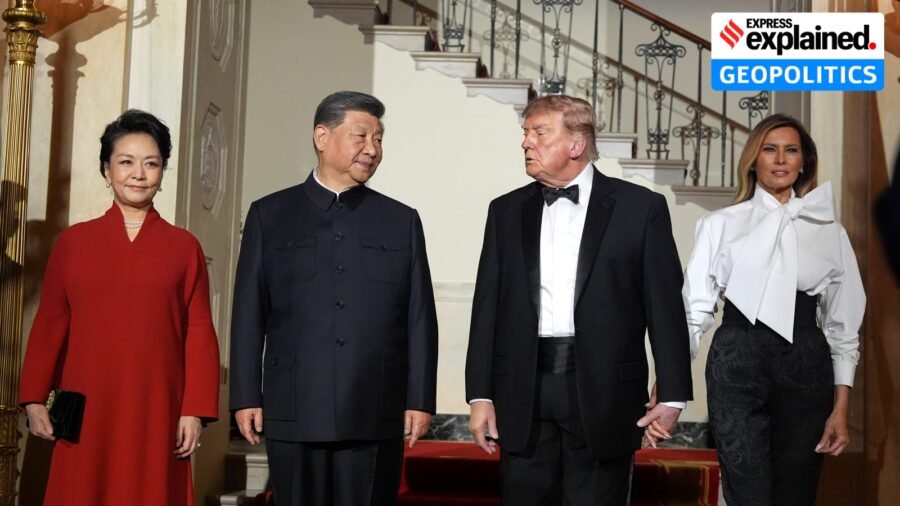
The elaborate welcome should not be mistaken for reconciliation. It signals recognition that the terms of US-China bargaining have changed. Washington still enjoys substantial advantages in military reach, alliances, global finance, and frontier technologies. But Beijing has demonstrated that it possesses leverage of its own, most visibly through Rare Earths and critical minerals. The tariff confrontation of 2025 showed that economic coercion could impose costs in both directions.
Story continues below this ad
This helps explain the return to summitry. Some American analysts go further, arguing that Beijing sees its Rare-Earth restrictions as having forced Washington to moderate its approach. But greater bargaining leverage is different from comprehensive parity. The US retains powerful economic and technological instruments, some of which it has chosen not to deploy.
Beijing interprets the changing relationship through “xianghu zunzhong” (mutual respect), the expectation that China should be treated as a major power whose interests cannot be overridden at will. The ceremony surrounding Xi’s visit reinforced that message domestically. From Washington’s perspective, however, engagement need not imply acceptance of Beijing’s conception of equality. The narrower conclusion is that China has accumulated sufficient capabilities in critical areas to make sustained coercion costlier, giving both sides stronger reasons to bargain.
The summit produced only a short extension of the tariff truce rather than a comprehensive trade agreement. Does this represent meaningful progress, or does it reveal the continuing fragility of US-China economic relations? What does it tell us about how the two sides are now managing economic competition?
The short extension captures the paradox of the economic relationship: Washington and Beijing have stepped back from escalation without resolving the disputes that gave rise to it. The truce postpones higher tariffs and keeps negotiations moving, but its limited duration also reflects continuing distrust. Some US officials and analysts view shorter extensions as checkpoints to assess Chinese implementation, particularly in Rare-Earth supplies and agricultural purchases. Beijing had sought a considerably longer arrangement.
Story continues below this ad
Both sides nevertheless have reasons to preserve the pause. The 2025 confrontation demonstrated that restrictions on Rare Earths and magnets could expose vulnerabilities in American supply chains. Beijing, meanwhile, benefits from a more predictable external environment while confronting domestic economic pressures and continuing to strengthen technological and industrial self-reliance.
This is therefore neither economic normalisation nor decoupling. Tariffs, export controls, and technology restrictions remain available as instruments of leverage even as negotiations, purchase agreements and new mechanisms for commercial engagement create channels for managing disputes.
Beijing presents such engagement through the language of “hùlì gòngyíng” (mutual benefit and win-win cooperation) while Washington emphasises reciprocity and compliance. The emerging pattern is better described as stabilisation without settlement: Economic competition continues, but both sides have incentives to prevent it from escalating uncontrollably.
Why are Washington and Beijing discussing AI guardrails even as their technological competition intensifies? Does the proposed AI dialogue suggest genuine convergence, or is it primarily an attempt to manage the risks created by an increasingly consequential rivalry?
Story continues below this ad
The AI dialogue points less to technological convergence than to a shared interest in preventing competition from producing dangerous unintended consequences. Washington and Beijing remain divided over the foundations of that competition. The US continues to restrict Chinese access to advanced chips and computing capabilities, while Beijing is seeking greater technological self-reliance. Their approaches to AI governance also differ: Xi has emphasised keeping AI under human control, while Trump has resisted regulation that could slow American innovation.
Yet intensifying competition itself creates incentives for communication. The two sides have discussed a notification mechanism for AI incidents with national security implications. However, important questions remain about how such a mechanism would operate and whether it would develop into something resembling existing crisis-communication channels.
The Chinese position is significant. Beijing argues for dialogue on risks that neither side can manage entirely on its own, even as it continues to pursue greater technological self-reliance. Washington similarly sees room for guardrails without relaxing technological competition.
The apparent contradiction is therefore misleading. The AI race is not being suspended: neither side has agreed to limit the pace of technological development. What they are exploring instead are mechanisms for communication and managing incidents that could have national security implications. As their capabilities grow, strategic competition and risk management may increasingly evolve in tandem.
Story continues below this ad
Beijing has described the emerging relationship as one of ‘constructive strategic stability’. What does this mean, and is Washington moving towards the same understanding of how US-China competition should be managed?
Beijing’s formulation of “jianshexing zhanlüe wending” (constructive strategic stability) envisages a relationship in which cooperation remains possible, competition is kept within bounds, differences are controlled, and confrontation is avoided. Chinese official commentary contrasts this with what it describes as Washington’s excessive fixation on ‘strategic competition’ and links stability to mutual respect, peaceful coexistence, and win-win cooperation.
Washington has not adopted Beijing’s vocabulary or its underlying assumptions. Its approach is more focused on risk management: preserving leverage while establishing guardrails, communication channels and negotiated arrangements that prevent individual disputes from destabilising the wider relationship. The short trade truce and discussions over AI risk illustrate this narrower conception of stability.
There is, nevertheless, a key area of convergence. Neither side expects strategic competition to disappear; both increasingly have reasons to make it more predictable.
Story continues below this ad
The disagreement concerns the terms on which that stability should rest. Beijing’s formulation seeks greater recognition of Chinese interests and fewer attempts to constrain its rise; Washington seeks stability without relinquishing technological restrictions, alliances or other sources of leverage.
Constructive strategic stability, therefore, describes less a shared strategic vision than an emerging framework for managing persistent disagreement.
If the summit has stabilised US-China relations without resolving their underlying rivalry, what are the principal faultlines that remain? Which of them will provide the clearest test of whether this emerging framework can endure?
A major unresolved issue is Taiwan. Beijing treats it as a core interest and used the summit to press Washington to move from saying it “does not support” Taiwan independence towards explicitly opposing it. Washington did not make that shift, while questions over future US arms sales remain a potential source of friction. The disagreement, therefore, reaches beyond terminology to the boundaries each side wants strategic stability to observe.
Story continues below this ad
Technology presents another test. Dialogue over AI risks has not removed US restrictions on advanced chips or Beijing’s drive for technological self-reliance. Nor has the trade truce eliminated tariffs, export controls, or disputes over critical minerals. Economic interdependence increasingly coexists with instruments designed to reduce vulnerability to the other side.
There is also a wider disagreement over the Asian security order. Beijing used the visit to emphasise its positions on Japan and regional security, while Washington has not abandoned its alliances or commitments in the region. This is why the emerging relationship should not be confused with détente. Washington and Beijing are building mechanisms to manage rivalry, not to resolve its causes. Their real test will come when one of these unresolved disputes collides with the boundaries each side believes the other should respect.
G Venkat Raman is a professor of Humanities and Social Sciences at the Indian Institute of Management, Indore.

Across generations, a shared love for coffee — and drinking it together
By Sohail Khan · 26 Sep

Woman’s 18th child sparks talk of ‘pregnancy addiction’: Psychiatrist explains
By Sohail Khan · 26 Sep
Leave a Reply