Expert Explains | What the BRICS 2026 summit achieved — and what challenges remain
By Vrinda Sahai
The 18th BRICS Summit, marking two decades of the group’s formulation, concluded on September 12-13. The summit, hosted by India, brought together the heads of states of all 11 member nations, providing an opportunity for both multilateral deliberations and significant bilateral engagements. It also tested the effectiveness of an expanded and increasingly diverse BRICS, questioning whether and to what extent consensus could be formulated.
What were the most notable outcomes of the BRICS Summit?
Two elements stand out from India’s 2026 BRICS presidency: the New Delhi Declaration and the diplomatic activity on the sidelines of the summit.
Story continues below.
Subscribe to see fewer ads.
The summit navigated sharp differences among members, adopting the 140-point New Delhi Declaration. Despite significant divergences over ongoing conflicts, the document used carefully calibrated language and avoided naming individual countries as offenders, allowing members with competing positions to remain within a common framework. The declaration also endorsed China as the 2027 chair.
For India, an important outcome was the reference to the April 2025 terror attack in Pahalgam. Unlike the Rio Declaration last year, the New Delhi Declaration explicitly condemned the attack: “We condemn in the strongest terms the terrorist attack in Jammu and Kashmir on 22 April 2025, during which 26 people were killed and many more injured.”
It also addressed the continuing conflict in West Asia. With Iran and the UAE now both BRICS members and directly affected by the conflict, the text expressed concern over the escalation of tensions, without naming any parties, yet reaffirming the UN Charter and calling for exercising maximum restraint. The Rio Summit had also addressed the situation in West Asia, but none of the countries directly involved in the conflict were BRICS members at the time.
At the bilateral level, the summit provided an important platform to engage key partners. Most notably, the meeting between Prime Minister Narendra Modi and Chinese President Xi Jinping signaled continued efforts to stabilize India-China ties, following the 2020 Galwan Valley clash leading to severe deterioration in the relationship. The two sides discussed areas of cooperation, including trade, business links, supply chains, and people-to-people exchanges, while also reiterating that peace and tranquility along the border remain essential to the development of bilateral ties. The statements from the two sides, however, differed in emphasis and tone.
Story continues below this ad
India also sought to address a larger problem within BRICS — the tendency for initiatives launched during one presidency to lose momentum under the next. PM Modi proposed the BRICS Continuity and Implementation Mechanism under which the troika (outgoing, current and incoming chairs) will track progress and systematically follow-up on outcomes. The proposal’s real test will come after the handover to China for the 2027 chairship.
India’s chairship also tried to move BRICS beyond leader-level statements and towards mechanisms with a more direct impact on trade, investment and businesses. This included advancing the BRICS Economic Partnership 2030 and working on development finance, infrastructure and investment. The practical significance of these initiatives, however, should not be overstated. Several proposals, including the investment platform, remain under development.
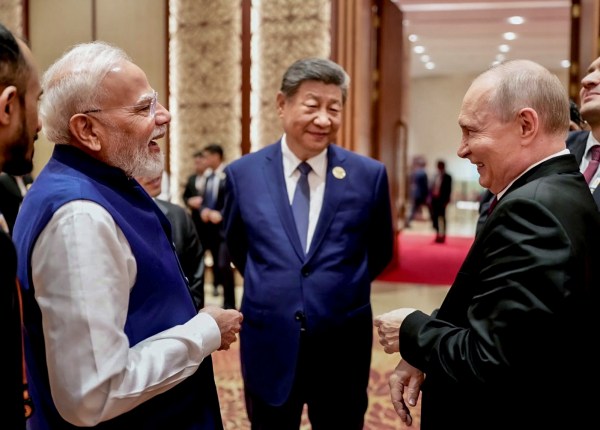 Prime Minister Narendra Modi with Russian President Vladimir Putin and Chinese President Xi Jinping on the sidelines of the 18th BRICS Summit, in New Delhi. PTI
How was India’s 2026 presidency different from its previous chairship in 2021?
There are three important differences between India’s 2021 and 2026 presidencies of the BRICS. First, the composition of the grouping has changed substantially. In 2021, the group comprised only the five original members whereas in 2026 it has expanded to 11 members and 10 partner countries. This has increased the group’s economic weight but made consensus more difficult.
Story continues below this ad
Second, the two presidencies took place in very different contexts. The 2021 Summit was held virtually following the outbreak of Covid-19 pandemic and against the backdrop of the India-China border standoff. In 2026, India was able to host an extensive programme of over 350 meetings across 30 Indian cities. Substantively, the 2021 Summit New Delhi Declaration focused on Global Health Challenges and combating the pandemic, particularly focusing on vaccine production and distribution.
In 2026, however, India placed greater emphasis on science and technology, agroecology, fintech, and economic cooperation, alongside its continued push for UN and multilateral reform around representation, responsiveness, and rulemaking.
Third, the economic relationship within BRICS has deepened. Indian trade with BRICS members has more than doubled from $203 billion in 2020-2021 to $417 billion in 2025-2026. Recognizing this expanded potential for intra-bloc trade and market opportunities in these developing economies, the group emphasised customs cooperation, trade finance, supply chains and digital payments while also addressing trade asymmetries.
What are the developments in the cross-border payments systems?
While efforts to boost intra-bloc trade and streamline payment mechanisms have expanded, BRICS does not yet have an operational system for cross-border trade in national currencies.
Story continues below this ad
The BRICS Payment Task Force will continue to explore practical solutions for efficient cross-border payments and enhancing interoperability of payment and messaging channels. This builds on the BRICS Cross-Border Payments Initiative referenced in the Kazan and Rio Declarations.
India pushed for a more ambitious approach, including linking the fast-payment systems of BRICS countries and examining interoperability between central-bank digital currencies. The objective is to make payments faster, cheaper and more reliable. Implementation is complicated by the fact that members have different exchange rate regimes, capital controls, exposure to sanctions, banking regulations, and payment standards. Intra-BRICS trade is also highly asymmetric, with China’s dominance accounting for a substantial share and several members running large trade deficits with it.
The discussions on trade in national currencies also help distinguish what BRICS is realistically pursuing from the often-repeated misconception of a common BRICS currency. Still, the members have not agreed on a common technical architecture, a shared settlement mechanism, or the launch of the payments platform, BRICS Pay, to materialise trade in national currencies beyond the existing initiatives at bilateral levels.
India’s attempt was to keep the group focused on its core concerns of development, trade and practical cooperation in technology, while securing meaningful language on conflicts despite a fragmented geopolitical environment. It is now increasingly necessary for these ambitious efforts to witness materialisation — such as on payment systems interoperability, MSME financing, greater investment announcements, and meaningful bilateral development under future presidencies.
The author is a Research Analyst at Carnegie India

The simple movement you shouldn’t give up as you get older: ‘Asian squat’
By Sohail Khan · 15 Sep
AI’s real danger is not the future. It is what we cannot control
By Sohail Khan · 15 Sep
C Raja Mohan writes: India may want a multipolar world, but we might be moving away from it
By Sohail Khan · 15 Sep
Leave a Reply