C Raja Mohan writes: India may want a multipolar world, but we might be moving away from it
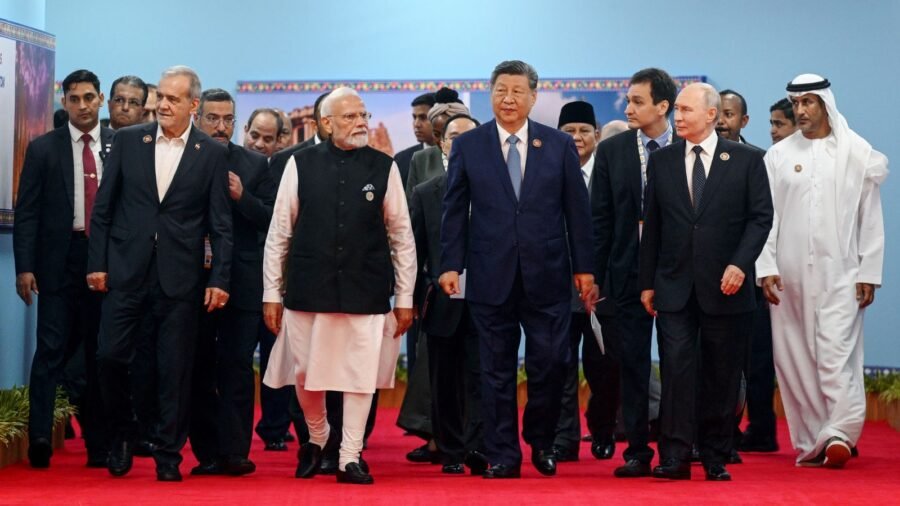
After the BRICS summit in New Delhi, global geopolitical attention shifts to Washington, where Chinese leader Xi Jinping is headed next week. If “multipolarity” was the theme song in Delhi, “bipolarity” will be the signature tune in Washington. The second meeting between presidents Donald Trump and Xi this year is part of an intensive series of exchanges. After Washington, Trump and Xi are likely to meet in Shenzhen, China, on the margins of the APEC summit. If the current buzz of a trilateral summit proves real, Russia’s Vladimir Putin could join Trump and Xi there. The focus would then turn from a G2 to a possible G3 world. Further opportunities for great-power diplomacy could present themselves in Miami, where Trump hosts the annual G20 summit in December.
Many of these multilateral gatherings, such as BRICS, APEC, and G20, are routine annual affairs. Despite the political glamour attached to these events in Delhi, significant collective progress in these meetings is rare. But these forums are useful venues where critical bilateral meetings take place. The highlight of the Delhi BRICS summit, for example, was the attempted reset of India-China relations by Prime Minister Narendra Modi and President Xi.
Advertisement
What gives the multilateral summits some salience this year is the churn in great-power politics triggered by Trump’s disruption of US foreign policy, relations with allies and rivals, and the American approach to the burdens of international order. Underlying that churn is the more important structural change in the distribution of global power in favour of China and America.
Both BRICS and the G7 are increasingly marked by the overwhelming economic weight of a single power — China in the first and the United States in the second. China accounted for less than half of BRICS’ combined GDP when the original BRIC forum with four members was formed in 2006. Despite subsequent enlargement to eleven members, China now accounts for roughly three-fifths. Whether we like it or not, Beijing continues to outgrow BRICS in economic size and geopolitical influence.
The G7 has seen a comparable shift. America now accounts for close to three-fifths of the group’s nominal output, against less than two-fifths three decades ago. Japan’s stagnation, Europe’s weaker growth and demographic pressures, and American advantages in energy, capital markets and artificial intelligence have widened the gap. Trump’s willingness to turn harshly on America’s closest partners — whether Canada or Britain in the Anglosphere or NATO and the EU — rests, in part, on this expanding American economic preponderance.
Advertisement
Does China’s dominance in BRICS and America’s preponderance in the G7 mean we are headed to a G2 world? Not necessarily. But it is quite evident that the world economy is developing a G2 structure, dominated by America and China. Washington and Beijing are the only states with the scale to shape global economic order, technology standards, and supply chains. They are also deeply interdependent. Each seeks to reduce vulnerability to the other, but neither can readily escape the other’s market, technology, capital or industrial capacity.
The Trump-Xi meetings this year are not likely to herald a US-China condominium. Their disputes over trade, technology and Taiwan are too deep. But they are based on the recognition that Washington and Beijing must manage their rivalry through sustained high-level contact. The nature of that management, however, has implications for the rest of the world.
Unlike the clear pattern in the global economic order, the situation on the strategic front is more complex. Although economically diminished, Russia retains enough military power, geographical reach and diplomatic weight to influence the balance between the two giants across Eurasia. Unsurprisingly, Moscow has drawn Beijing closer than ever before, while Trump has made an American overture to Russia. This does not mean that the US can easily detach Russia from China. Trump’s Russian play is complicated by the conflict between Moscow and Europe over Ukraine. Progress in Trump’s peace initiative in Ukraine, however, could set the stage for a US-Russian rapprochement, and a G3 summit as well as Putin’s presence at the G20 meeting. Unlike the G7, the G20 includes China, Russia, India, Brazil, Indonesia, Saudi Arabia, South Africa and other consequential non-Western powers. Unlike BRICS, it includes the US, Europe and Japan.
The changing distribution of power has helped America and China loom larger than ever before in the G20. Differences between the US and China at the G20 finance ministers’ meeting in Washington this month prevented the forum from issuing a joint statement, with China objecting to language on trade surpluses and export-led growth. When the US and China disagree, they undermine the hope that the G20 is capable of collective action on the economic front. But bilateral deal-making between Washington and Beijing could also come at the expense of other actors in the G20.
India might want a multipolar world, but we are not there yet; arguably, we might even be moving away from it. For now, Delhi must deal with the intensifying great game — whether it is G2 or G3 — that is set to define the future of the international order. Organisations like the APEC, BRICS, EU, G7 and NATO don’t shape the world order. They operate within the parameters set by great-power politics. With the BRICS party over in Delhi, the Indian foreign policy elite needs to wake up from its self-indulgent reverie and pay attention to the changing global distribution of power and the geopolitical realignment between America, China, and Russia.
The writer is a contributing editor on international affairs for . He is also a distinguished professor at the Motwani Jadeja Institute of American Studies, Jindal Global University, and the Korea Foundation Chair at the Council for Strategic and Defence Research, Delhi

The simple movement you shouldn’t give up as you get older: ‘Asian squat’
By Sohail Khan · 15 Sep
Expert Explains | What the BRICS 2026 summit achieved — and what challenges remain
By Sohail Khan · 15 Sep
AI’s real danger is not the future. It is what we cannot control
By Sohail Khan · 15 Sep
Leave a Reply