Behind the Xi-Modi thaw, a larger US-China game
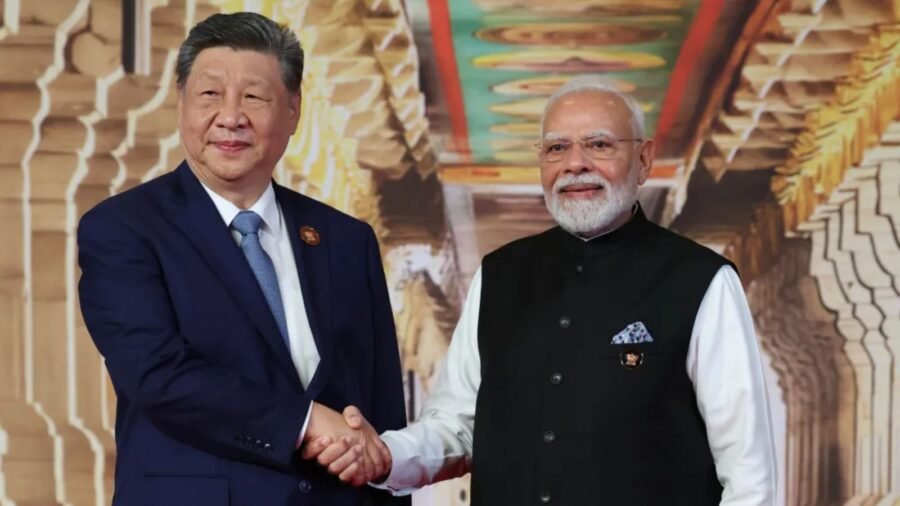
In terms of realpolitik, it is fair to say that the 18th BRICS Summit hosted by New Delhi was really all about whether Communist Party of China General Secretary and Chinese President Xi Jinping would even make it, and then after he did, about the bilateral meeting between him and Indian Prime Minister Narendra Modi. For India, this was about sustaining the thaw in bilateral ties for domestic economic reasons and about signalling to the US that it had other friends around the world and could influence those friends. For China, however, Xi’s turning up in New Delhi — after skipping the 2023 G20 summit India hosted — was less about India and primarily about signalling to the US less than two weeks before he embarks on a state visit to Washington, DC.
The Modi-Xi meeting on the sidelines of the Summit saw both countries produce their own statement. Comparing the two, there are four noteworthy aspects.
Advertisement
One, there is the question of focus. The Chinese statement is longer than the Indian one — the English version is almost thrice as long — but this does not necessarily mean the attention is on India. On the contrary, the Chinese seem to be speaking as much to the Americans as to the Indians. While there is no substantive reference to BRICS in the Indian statement, the Chinese statement has references to “great[er] BRICS cooperation” as well as to the Global South, the Shanghai Cooperation Organisation and the G20. If India was trying to walk a fine line between promoting its strategic autonomy through BRICS and keeping ties with the US on an even keel, China was less concerned about such niceties, using the BRICS shoulder to fire at the US.
Two, there is the different order in which each country prioritises bilateral issues. The issue of “peace and tranquility in the border areas” takes up the bulk of the Indian statement. It calls for “for both sides to observe existing agreements and understandings on border related issues”. While the Chinese statement refers to “maintain[ing] peace and tranquility in the border areas” twice, there is not the same level of detailing as it has for people-to-people exchanges and multilateral cooperation. Perhaps this is because the details are available in the “Eight Points of Outcomes and Consensus” at the end of the 25th round of talks between the two Special Representatives (SRs) on the boundary question last month.
It is worth pointing out that this joint statement largely comprises promises. One such is the agreement for expert groups to discuss “Early and Substantial Harvest of boundary delimitation and Border Management” but whose definitions are not clear and terms of reference yet to be agreed on. Another is to hold a meeting “about hydrological data sharing, and renewal of relevant MoUs” — an issue that the two SRs have been discussing for at least two years.
Advertisement
More importantly, and three, while both statements lay out their version of what good bilateral ties should look like, the Chinese are quite specific about what India ought to do. Xi says the two countries “are partners rather than adversaries, and are each other’s development opportunities rather than a threat”; should “eliminate interference”; and aim for “open and inclusive multilateral cooperation”. The statement underlines the need for India to commit to a “dual-track” of advancing ties in other areas and on border issues in parallel. This is a position that India has eventually come around to following the announcement of completion of the disengagement of troops in 2024, but the Chinese clearly want more — or more accurately, less Indian insistence on border issues.
What “interference” is, is left undefined, allowing for any number of issues that can be raised to pressure India later. China also expects India to “effectively improve the public opinion base of bilateral relations”, indicating as it has done frequently in recent years that critics of Chinese policies and those sceptical of the current India-China détente need to be muzzled for the sake of “positive energy” in the relationship. The Chinese have also tried to exert pressure by explicitly referring to India’s “policies and positions on Taiwan and Tibet” — references absent in the Indian statement.
Fourth, China takes out insurance when it says that the view of both nations as “partners rather than adversaries… is a strategic judgment based on the stage of development and the international environment of the two countries”. This position is a giveaway of Chinese thinking — in domestic politics as well as in external policies, Beijing has regularly changed course depending on these factors. Today, those circumstances — a difficult domestic economic situation and more significantly, the run-up to the 21st National Congress of the CPC a year from now — require stability in ties with India and the US, while also keeping the two apart through such mechanisms as BRICS.
When domestic and international circumstances change, China will be back to its more familiar avatar.
The writer is professor, Department of International Relations and Governance Studies, and director, Centre of Excellence for Himalayan Studies, Shiv Nadar University, Delhi NCR

Amitabh Bachchan’s ‘retire’ remark shows how our mind fills in the gaps
By Sohail Khan · 18 Sep
India needs a risk-based approach to food adulteration: Sukhvinder Pal Singh
By Sohail Khan · 18 Sep
High uric acid is often silent: Symptoms you should watch for
By Sohail Khan · 18 Sep
Leave a Reply