Why ‘rough sleeping’ remains such a persistent problem in the UK
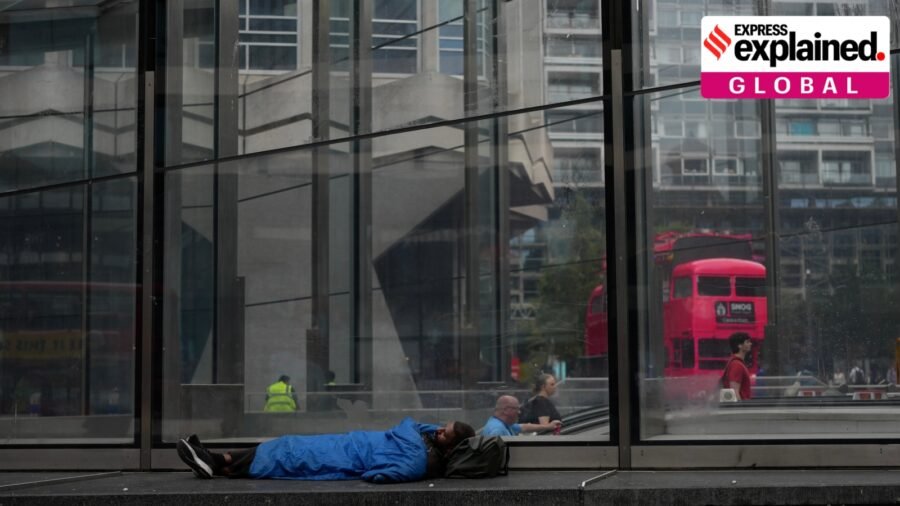
On August 19, UK Prime Minister Andy Burnham announced a national drive to end “rough sleeping” by Christmas. Rough sleeping refers to the widespread phenomenon of homeless people being forced to sleep out in the open.
According to autumn 2025 data posted by the UK government, there were 4,793 rough sleepers across England — crossing the 2017 peak which recorded 4,751 such individuals.
This July, shortly after taking charge as PM, Burnham had allocated £340 million pounds for the next three years to pay for the construction of 1,200 new homes and help support 3,000 people over five years. His announcement earlier this week supplemented that amount with an additional £102 million pounds, bringing the total package to £442 million.
Story continues below this ad
Why has rough sleeping been such a matter of concern in the UK in the recent decade?
What is rough sleeping?
Broadly, rough sleeping is the practice of individuals sleeping or bedding down in public spaces such as parks, streets or areas not designated for habitation. Usually, they possess minimal to no bedding materials and reside in make-shift structures.
The UK government classifies rough sleeping as the most visible and dangerous form of homelessness in a 2025 report published by the library of the House of Commons, the UK’s lower house of Parliament.
The statutory definition of homelessness, however, does not include references to rough sleeping. Rough sleeping is characterised by visibility and proximity whereas homelessness is defined by the lack of access to the legal right to property. Simply put, rough sleeping is a subset of homelessness.
Why has Burnham made this announcement now?
Story continues below this ad
Burnham’s pledge comes against the backdrop of worsening housing trends in the nation.
According to the UK Ministry of Housing, Communities and Local Government (MHCLG), rough sleeping has more than doubled since 2010. Burnham’s mayoral tenure in Manchester saw him launch initiatives like ‘A bed every night’ which offered essential provisions to rough sleepers excluded from statutory housing services like Council relief duty and the legal mandate to provide immediate interim accommodation.
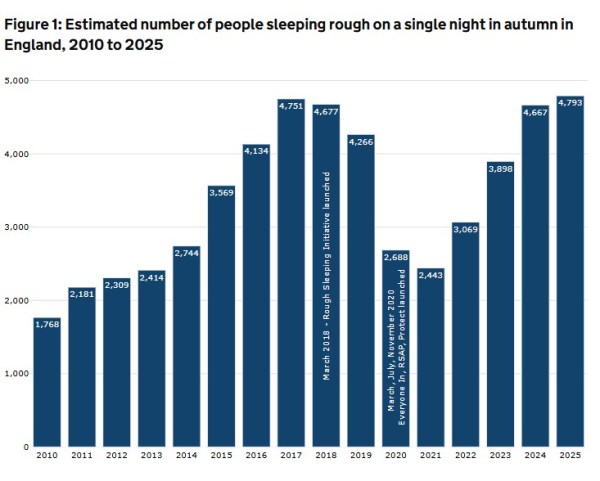 Rough sleeping in the UK
The autumn 2025 snapshot displays a 1% increase compared to the 2017 peak and a 171% increase from 2010 numbers. London consistently dominates the share with an estimated 27% of people sleeping rough on a single night in autumn 2025.
Interestingly, the majority of rough sleepers are predominantly from the UK, then the EU and finally, foreign individuals.
Story continues below this ad
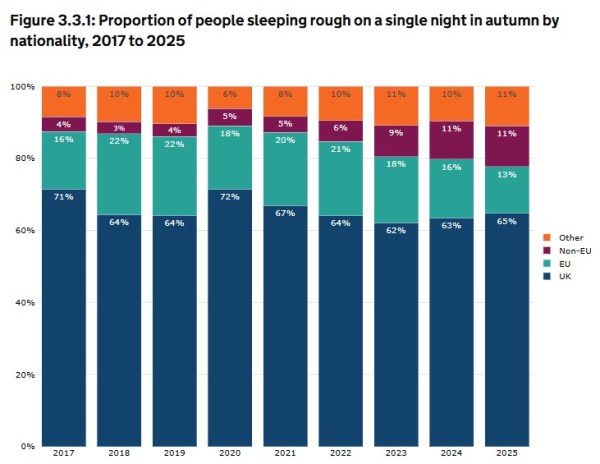 Rough sleeping: Break-up by nationality
Burnham’s push to tackle this issue is likely an attempt to capitalise upon the momentum previously generated by successes observed during Covid-19 in providing accommodation.
What factors have exacerbated the problem
The long-term failure to keep up with rising demand for housing has been at the heart of this issue and the larger housing crisis in the UK. To determine the amount of new housing required, the number of new households formed and the existing backlog must be understood.
When the Department for Work and Pensions capped the council reclamation amount for Temporary Accommodation (TA) at 90% of the local housing allowance rates as they stood in 2011, local council housing procurement capabilities dropped. The skyrocketing private rent costs influenced a 1077% increase in overall TA expenditure between 2011/12 and 2024/25.
Further, under Part VII of the Housing Act 1996, local housing authorities (LHA) must test applicants to discern which duty they are owed by the law.
Story continues below this ad
This approach had its own drawbacks and in 2019, a Supreme Court case (Samuels v Birmingham City Council) ruled that local authorities cannot expect low-income families to use welfare benefits meant for food and living costs to address rent shortfalls. The council had deemed Terryann Samuels (the appellant) ‘intentionally homeless’ — a decision reversed by the ruling.
Finally, the lack of social housing and a disproportionate distribution of state resources compound the issue, particularly outside major cities. Despite rural areas accounting for 38% of all rough sleepers in England (a record 1,821 people as of recent estimates), rural local authorities receive 65% less Homelessness Prevention Grant funding per capita (£2.50 compared to £7.15 in urban areas), leaving hidden homeless populations stranded in agricultural buildings or woodland without adequate municipal support.
Where the money has been allocated
The government has cited research by the Crisis homelessness charity which estimated that preventing 40,000 people from becoming homeless could save the taxpayer approximately £370 million in deferred public service costs.
Burnham, however, was quick to concede that government money might not be able to achieve the goal and that working “across sectors” was necessary. This integration is backed by a larger £3.6 billion pounds earmarked to tackle homelessness through sleeping support under the broader National Plan to End Homelessness.
Story continues below this ad
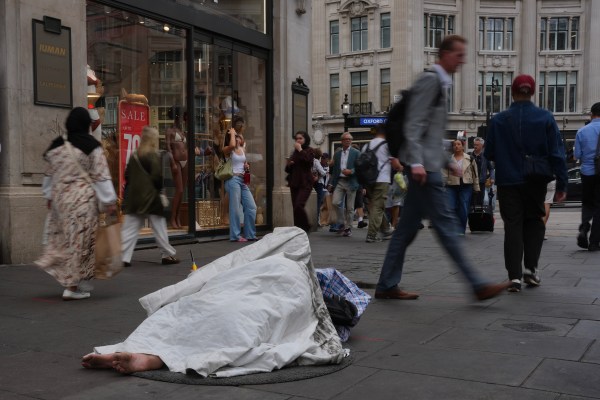 A homeless man sleeps on a street in central London on Aug 19. AP
The £442 million lump sum is split between operational expenditure and long-term investment. Firstly, £255.5 million is allocated as funding towards routes off the streets. It is designed to ensure local authorities offer immediate winter accommodation alongside wraparound services. A further £178 million is capital funding for the acquisition and development of settled accommodation. The aim here is to deliver over 1,200 permanent homes for rough sleepers over the next three years.
Finally, an £8.4 million pound uplift has been injected into the ‘Ending Homeless in Communities’ fund. This fund is meant to align with Burnham’s pledge that work across sectors is the need of the hour and empowers communities to play an active role.
What the fund allocation data tells us
In the fund allocation dataset released publicly by the government of UK operational expenditure is denoted by RDEL (Resource departmental Expenditure limits) and CDEL (capital departmental expenditure limits).
The dataset contains two sheets which detail the 15 Mayoral Strategic Authority (MSA) and Local Authority (LA) fund distribution for 2026-29.
Story continues below this ad
There has been a massive transfer of financial authority towards the mayoral allocations, slashing local authority standings down from an original £433.6 million down to just £156.9 million.
Because MSA’s represent urban metropolitans, this reallocation redirects resources away from rural county councils — which rely exclusively on general local authority grants — effectively defunding rural municipalities to bail out cities. Notably, rural areas account for nearly 38% of England’s rough sleeping population.
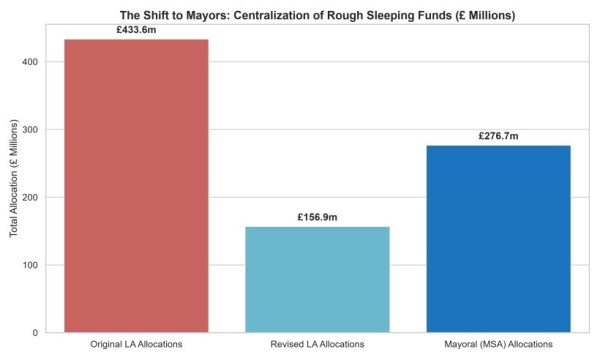 Shift in funding
This MSA funding, however, is concentrated in specific areas.
The Greater London Authority alone absorbs an overwhelming 60.8% (£168.4 million) of the entire MSA budget, leaving the remaining 13 mayoral authorities to share just 39.2%, thereby exacerbating the stark funding deficit facing rural councils where rough sleeping rates continue to climb.
Story continues below this ad
Furthermore, the policy’s structural timeline relies heavily on short-term prioritisation while delaying long-term solutions. Funding for immediate operational support and wraparound services (RDEL) peaks at £120.9 million in 2026–27 before plummeting by nearly half in subsequent years, whereas capital investment (CDEL) for actual permanent housing construction is entirely deferred to the backend of the three-year cycle.
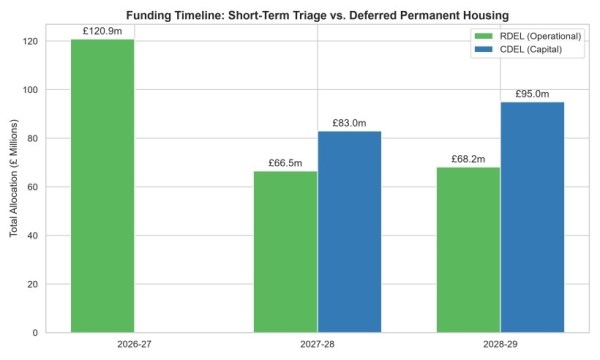 Funding timeline
Municipal authorities contend with skyrocketing temporary accommodation costs alongside legal prohibitions against shifting rent shortfalls onto low-income residents, these reduced and tapering operational funding caps risk trapping local councils in a fiscal bottleneck long before any new permanent housing stock ever materialises.

Sea level rise: Can a country retain its statehood even if it loses its territory?
By Sohail Khan · 28 Sep
No fuel without PUC in Delhi: What this certificate says about your vehicle
By Sohail Khan · 28 Sep