Why ethanol diversion is not to blame for soaring sugar prices
Dussehra is on October 20 and Diwali on November 8. But sugar is already tasting bitter, well before the festival season.
According to the department of consumer affairs, the all-India modal retail price, the rate at which most purchases are reported, was Rs 65 per kg on Friday. It was only Rs 45 on July 21 and rose to Rs 50 by July 31.
Simply put, retail prices of the sweetener — the most vital ingredient in every Diwali mithai and Cadbury Celebrations, Nestlé KitKat or Ferrero Rocher chocolates — have soared by Rs 20/kg in just a month.
Story continues below this ad
No less significant is ex-factory prices. These rates, which mills realise from selling sugar net of goods and sales tax, were at Rs 57-60 per kg in Uttar Pradesh, Rs 62.5-64 in Maharashtra and Rs 63-64 in Karnataka on August 20. The corresponding price range for the three states stood at Rs 44.95-46.7, Rs 46.2-46.9 and Rs 46.25-47 per kg respectively on August 1.
What explains this sudden surge?
The main reason is less-than-expected sugar production and stocks that are at a nine-year low.
In early-November 2025, the Indian Sugar & Bio-energy Manufacturers Association (ISMA) estimated the domestic production for the 2025-25 season (October-September) at 343.5 lakh tonnes (lt) in gross terms. After factoring in diversion of 34 lt towards ethanol manufacture, the net sugar output was pegged at 309.5 lt.
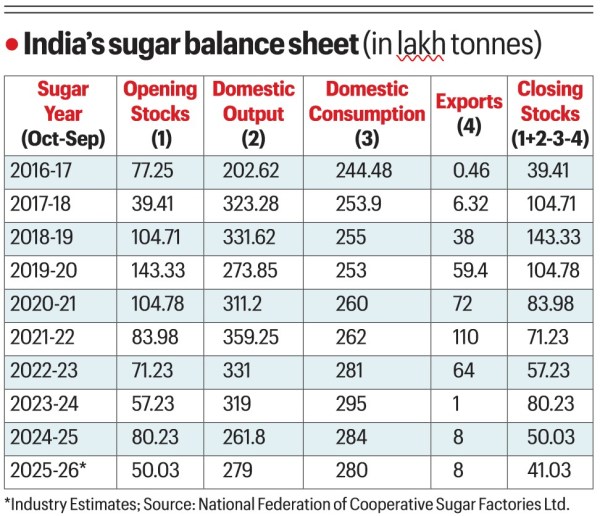 The sugar balance sheet
But the latest industry estimates put gross sugar production at 309 lt and diversion to ethanol at 30 lt, leaving a net output of 279 lt. That is 30.5 lt below the original projection by the apex association of private sugar mills in India.
Story continues below this ad
With opening stocks of just over 50 lt at the season’s start, the sugar available after adding production for 2025-26 would be about 329 lt. Deducting domestic consumption of 280 lt and exports of 8 lt, the season would close with stocks of around 41 lt. That, as the table (above) shows, is the lowest since the 39.4 lt for 2016-17.
There are some in the industry who say that the opening stocks for 2025-26 was only 48 lt and not 50.03 lt. If that were true, then the closing stock for this season would be 39 lt – the lowest since 2008-09.
Why have projections been so off the mark?
The sugarcane crop in Maharashtra, Karnataka and Gujarat suffered from excess rainfall in September-October last year with a delayed withdrawal of the southwest monsoon.
The resultant waterlogged fields, in combination with lack of sunshine, deprived the standing crop of aeration and daylight. If affected cane growth and accumulation of sucrose in the stalks, translating into lower yields and sugar recovery by mills.
Story continues below this ad
ISMA had, in November, projected sugar output in Maharashtra and Karnataka at 130 lt and 63.5 lt, whereas the mills there could only produce 99.2 lt and 47.2 lt respectively. Uttar Pradesh factories have also produced 89.7 lt, as against the earlier estimate of 103.2 l, with the red rot fungal disease and top shoot borer insect pest being the chief villains. The dominant Co-0238 sugarcane variety grown in the state has been increasingly susceptible to their attacks, showing up in yield and sugar recovery losses.
Average ex-factory sugar prices in Maharashtra fell from Rs 38.31 to Rs 36.98 per kg between September 2025 and April 2026, before recovering to Rs 38.23 by June. Prices really rose from July, averaging Rs 41.85 per kg that month.
“There were two key triggers. The first was the unexpected production shortfall and doubts on the actual stocks lying with mills. Some liquidity-strapped mills had already sold sugar beyond their government-fixed monthly quotas for releasing into the market. So they hardly had any sugar left and the stocks declared by them were on paper,” an industry source said.
Story continues below this ad
The second factor was this year’s monsoon. The high rainfall deficiency in June, particularly for Maharashtra and Karnataka, convinced the trade that cane yields and sugar production will take a hit in the ensuing 2026-27 season too.
“The bigger merchants and stockists, besides bulk industrial consumers, had begun taking positions even before July. From August, some mills themselves started holding back sales in anticipation of higher prices in the run-up to the festival season,” the source added.
How much is sugar diversion for ethanol to blame?
On the face of it, the 30 lt of sugar that went for making ethanol in the current season seems significant.
But the effect of that has been magnified by gross sugar production itself — i.e. before ethanol diversion — being 34.5 lt lower than the initial estimates. Not many would have envisaged this extent of decline, leave alone a spurt in prices from July, at the start of the season.
Story continues below this ad
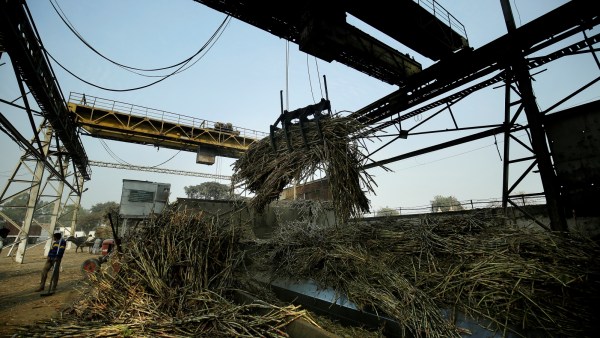 A sugar mill in Uttar Pradesh’s Shamli district. Praveen Khanna/file
Attributing the present skyrocketing of sugar prices to the ethanol-blending petrol programme may not be right for a second reason as well.
Out of the total 810.67 crore litres of ethanol supplied to oil marketing companies for blending during November 2025 to July 2026, only 259.24 crore litres or 32% was from sugarcane-based feedstock: direct juice/syrup (147.6 crore), B-heavy molasses (98.19 crore) and C-heavy molasses (13.45 crore).
The balance 551.43 crore litres or 68% ethanol came from distilleries using grain-based feedstock: maize (288 crore), Food Corporation of India rice (207.1 crore) and broken/damaged foodgrains (56.33 crore). Linking spiralling sugar prices to ethanol diversion is clearly an exaggeration.
What has the government done to check sugar prices? What more can it?
Story continues below this ad
On May 13, the Modi government banned export of all sugar from the country till September 30, 2026. This was more of a precautionary move on its part, rather than any firm conclusion of an impending supply shortage.
On Thursday, it allowed import of up to 10 lt of raw sugar at zero duty till October 31, as opposed to the standard tariff of 100% on the sweetener. This raw sugar can be processed by companies such as Shree Renuka Sugars and Shri Dutta India Private Ltd that operate refineries in Gujarat’s Kandla port.
The refined sugar from the imported raws can potentially supply the domestic market till Indian mills are ready to commence cane crushing operations from end-October to early-November.
Story continues below this ad
Besides banning exports and permitting duty-free imports, the Modi government, on July 28, imposed a stocking limit of 400 tonnes on all sugar dealers. Further, no dealer could hold any sugar beyond 30 days of receiving such stock.
On August 13, it issued a letter to all sugar mills directing them to furnish details of bulk consumers (soft drink and confectionery makers, sweetmeat sellers, etc) to whom 500 tonnes or more sugar had been sold annually “directly or through agents” during the 2025-26 financial year (April-March).
“One can expect the government to also direct mills not to manufacture any ethanol from direct sugarcane juice and B-molasses in the coming 2026-27 season. The priority is to somehow augment supply of sugar in the domestic market, including through imports and forcing mills and traders to sell,” the industry source said.

Sea level rise: Can a country retain its statehood even if it loses its territory?
By Sohail Khan · 28 Sep

No fuel without PUC in Delhi: What this certificate says about your vehicle
By Sohail Khan · 28 Sep