The Indian honeycomb: Ghewar’s place in our sweet tradition
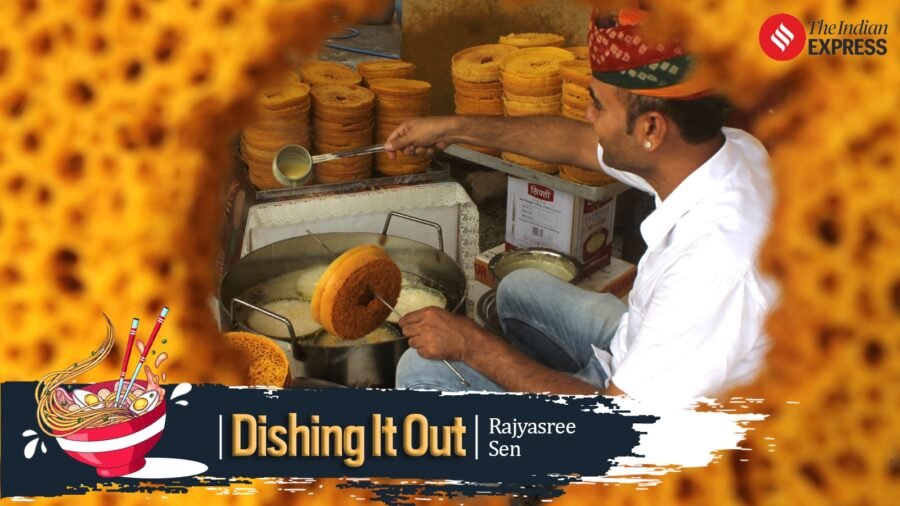
Last year, on MasterChef Australia, contestant Depinder Chhibber made “Indian honeycomb” for the judges, or ghewar, as we know it. I have to give it to Chhibber; this was a perfect description of the round, flat, perforated sweet dish sprinkled with saffron, dry fruits, and silver ‘varak’, a staple in sweet shops in North India.
Ghewar is made from wheat flour (or maida) and soaked in sugar syrup. The one difference between it and a ‘honeycomb’ is that the latter is baked, while the former is deep-fried.
Safe to say, I’m not a fan. As Chhibber had said on the show: “It’s literally just pastry, so it’s beautiful, crispy, crunchy, but very tricky to make. The oil has to be very hot, and the batter has to be ice cold. Add the chilled batter into the oil. You get that splattering; that’s what builds that honeycomb texture.”
Story continues below this ad
Whether I like it or not, North Indians and people who have tried ghewar seem to love it. In Rajasthan, ghewar is the flavour of the festival season. Usually prepared and gifted on Teej and Raksha Bandhan, it’s also given to newly married girls as a ritual.
There’s ghewar made with paneer, kesariya (saffron) ghewar, and even a malai (cream) version. I have to admit that biting into an inch of it is quite satisfying, given its surprising lightness despite being deep-fried in ghee and doused in sugar syrup. But an inch is all I can manage.
View this post on Instagram
A post shared by King’s Food Z | Aditya Baisla (@kingsfoodz)
Endless theories claim ghewar originated in Rajasthan or Madhya Pradesh. I have read various claims, but none are backed by written documentation. Last year, I even read an article that mentioned ghewar as one of the many Iranian and Persian delicacies which have become a part of India.
What I have heard on multiple occasions is that ghewar was introduced to Lucknow by Wajid Ali Shah, a lover of good food and kingdoms not his own, after battling the Rajputs in Jaipur. An interesting tidbit is that while ghewar is prepared and sold throughout the year in Rajasthan, sales peak in the monsoon. This is because ghewar produced in higher humidity rises more, thanks to the moisture-laden air. The rains are said to aid the fermentation process, resulting in a more beautiful honeycomb effect.
I recommend you do the opposite of me, for a change, and try a bite of ghewar. It is a true indulgence—especially if you like your sweets very sweet.
Story continues below this ad
On that sugary sweet note, I would like to say that this has been a fun ride. I have written this column for just over a couple of years now, and it’s time to take a step back and see what more I can bring to the table. So goodbye for now—keep eating, reading, and trying new foods.

Priyanka Chopra remembers when her late father was happiest: ‘I really miss him’
By Sohail Khan · 21 Aug
On Vande Mataram, Congress hasn’t learnt from its past
By Sohail Khan · 21 Aug
Naxalism’s ideological front hides behind democratic ideals
By Sohail Khan · 21 Aug
Leave a Reply