India to have homegrown mobile brand by mid-2027: Ashwini Vaishnaw
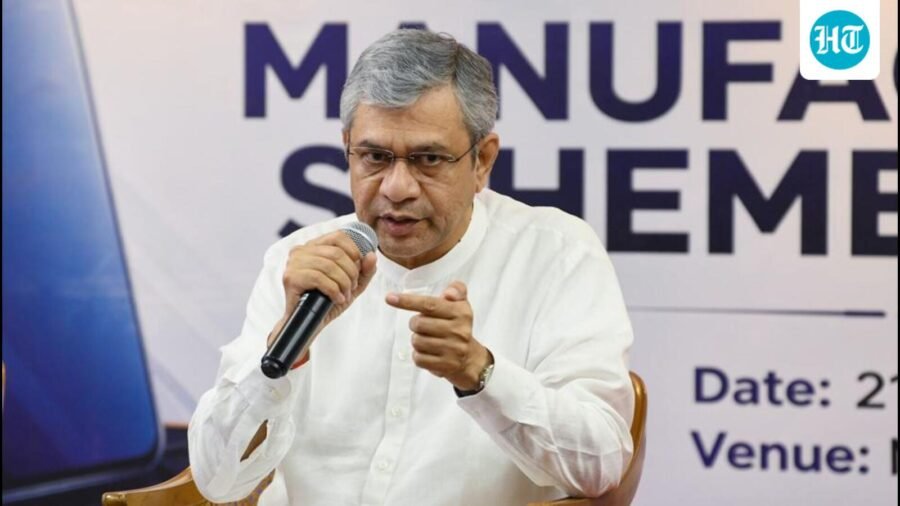
The Ministry of Electronics and Information Technology (MeitY) notified the ₹62,500 crore Mobile Phone Manufacturing Scheme (MPMS)
Published on: Aug 21, 2026, 20:24:48 IST
Prefer HTon Google
Share via
Copy link
The government expects India to have a competitive homegrown mobile phone brand by the middle of next year, with three Indian players currently vying for the position, electronics and IT minister Ashwini Vaishnaw said at an event on Friday.
The Ministry of Electronics and Information Technology (MeitY) notified the ₹62,500 crore Mobile Phone Manufacturing Scheme (MPMS), which provides fiscal and non-fiscal support for Indian brands, alongside incentives for large-scale mobile phone manufacturing, in the Gazette on Friday, after the Union Cabinet approved it on July 15.
The scheme will run from Financial Year (FY) 2026-27 to FY 2030-31 and has two target segments: big mobile phone manufacturing companies and Indian mobile phone brands.
“We used to have a mobile manufacturing ecosystem, but tax issues and the Chinese onslaught made it impossible for Indian players to compete in the market. Now that we have rebuilt the ecosystem in the country, the time has come to refocus on building an Indian brand, with Indian IP and Indian design,” Vaishnaw said.
India’s smartphone market remains heavily dominated by foreign brands, particularly Chinese. Four of the country’s top five smartphone brands by shipments in the April-June quarter were Chinese — vivo with a 17.8% share, OPPO with 13.6%, Xiaomi (including POCO) with 13.4% and realme with 10% — together accounting for roughly 55% of the market, according to Counterpoint Research. Samsung and Apple had a 17.6% and 7% share, respectively.
Homegrown Lava, which is currently the most prominent Indian smartphone brand, remains a small player despite rapid growth in the budget segment. Other homegrown names such as Micromax, Jio and Ai+ have much smaller or more limited smartphone businesses.
Eligibility and incentives
Under the manufacturing segment, mobile phone manufacturers, including electronics manufacturing services (EMS) companies registered in India with a minimum turnover of ₹10,000 crore in FY 2025-26, will be eligible. Existing brands will have to meet annual threshold sales over and above their FY 2025-26 sales to claim incentives.
For Indian brands, the eligibility threshold is ₹1,000 crore in FY 2025-26. Brands must be incorporated in India, hold their IP and trademarks in India, have management control with Indian citizens, have more than 51% Indian citizen shareholding, and maintain in-house R&D and design capabilities in India.
Indian brands will receive a 5% incentive on eligible sales, and an additional 3% for Indian design and R&D. Applicants under the Indian-brand segment can opt for a one-year gestation period, shifting the first performance year to FY 2027-28.
The scheme will provide both fiscal and non-fiscal support to Indian mobile phone brands, while offering only production-linked incentives to mobile phone manufacturers.
Both segments are eligible for an additional incentive of up to 1.5% for domestic sourcing of key components and sub-assemblies. To qualify, these components or sub-assemblies must be localised for at least 25% of the total mobile phone units sold during the year.
The scheme will be implemented through a Project Management Agency, which will appraise applications, verify eligibility and examine claims. An inter-ministerial Empowered Committee chaired by the MeitY secretary will oversee approvals, disbursements and periodic reviews of participating companies’ performance under the scheme. Detailed scheme guidelines will be issued separately.
The scheme was effective retrospectively from April 1, 2026, with applications to remain open on a continuous basis.
See Less

Students’ body supports demonstrations against polytechnic merger with SHAKTI
By Sohail Khan · 21 Aug
TGIIC auction fetches ₹264 crore per acre in Raidurg
By Sohail Khan · 21 Aug
Now, protesters at Jantar Mantar seek overhaul of reservation system
By Sohail Khan · 21 Aug
Leave a Reply