Rahul’s street politics signals a new Opposition playbook
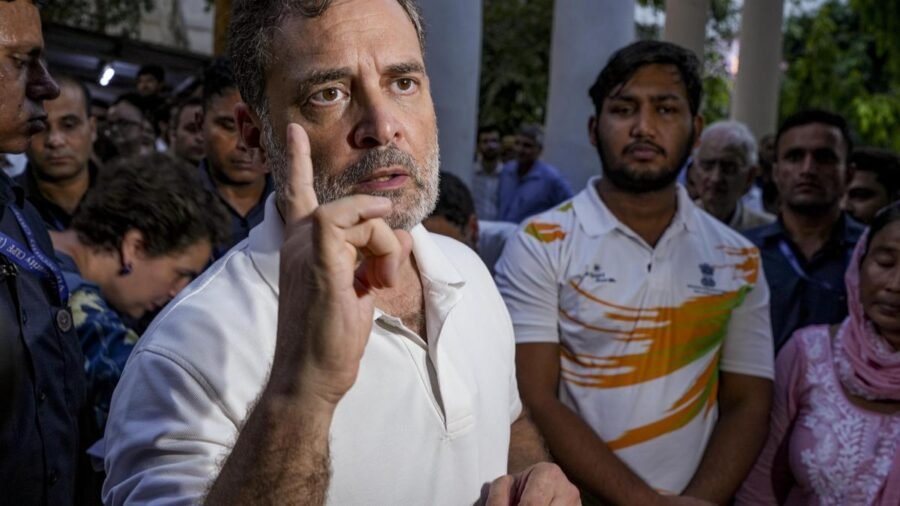
A month after his sudden dharna outside the Prime Minister’s residence over students’ protests, Leader of the Opposition in the Lok Sabha Rahul Gandhi’s unannounced protest outside the Parliament Street police station to get an FIR registered on a complaint by pellet-gun victim Sahil Lochav reveals a new political strategy.
For the second time in a month, the Opposition leader not only caught the authorities by surprise but also his own party colleagues. The element of surprise, combined with direct action and sustained engagement, suggests that Mr. Gandhi is willing to experiment with a new political playbook.
The Congress’s escalation came a day after Union Home Minister Amit Shah sharpened his attack on the party over its decision to sing only two stanzas of Vande Mataram, describing the move as “anti-national”.
Mr. Gandhi, however, sought to shift the political focus from the nationalism debate to the use of pellet guns against protesting students and, crucially, to the role of the Ministry of Home Affairs, which Mr. Shah heads.
Congress president Mallikarjun Kharge and party general secretary (organisation) K.C. Venugopal both sought to frame the registration of the FIR as a consequence of Mr. Gandhi’s intervention.
“Those shedding crocodile tears over nationalism are, in reality, the biggest enemies of the country’s youth!” Mr. Kharge said in a post on X. “Sahil is not alone. Shri Rahul Gandhi and the Congress Party stand with every affected youth,” he added.
Mr. Venugopal said basic constitutional rights were being granted as “favours” only after massive pressure was applied. “They have bent. They were forced to bend,” he said in a post on X, claiming that the Delhi Police was compelled to register the FIR after Mr. Gandhi protested for hours demanding action over Mr. Lochav’s pellet injuries.
By personally following up on the case and eventually ensuring that the FIR sought by Mr. Lochav was registered, Mr. Gandhi appears to be seeking consistency in his politics and, in the process, addressing a criticism that he is an inconsistent politician.
The street protests also point to a larger political calculation: reaching out to, and attempting to create, a distinct constituency among Gen Z voters — a generation that will form a substantial part of the electorate by the 2029 Lok Sabha election. By some estimates, there could be 370-400 million voters in the 18-29 age group by then.
There is also a subtler message in Mr. Gandhi’s decision to repeatedly take his politics to the streets. The Opposition leader has increasingly alleged that institutions have become partisan and that constitutional safeguards are being weakened. By physically confronting police authorities, he is signalling that institutions should recognise that political power is not permanent and that the political Opposition is entitled to a fair and transparent response.
Finally, Mr. Gandhi is seeking to weave the question of accountability of the Home Ministry into the larger political debate over students’ grievances.

Syria requests to join anti-chemical weapons partnership
By Sohail Khan · 22 Aug

Mexican governor accused by US of cartel ties returns to office
By Sohail Khan · 22 Aug
Leave a Reply