Five years after Kabul fell, how India has warmed up to the Taliban
The Afghanistan embassy in New Delhi celebrated “victory day” on August 15, marking the Taliban’s takeover of the country five years ago. Much has changed in these five years when it comes to the Indian position on the Taliban dispensation.
On August 17, 2021, New Delhi had hurriedly evacuated its entire embassy from Kabul. Now, it is openly conducting business with the Islamist regime, albeit without granting it official diplomatic recognition.
The “victory day” celebration, attended by Indian diplomats and about two dozen foreign diplomats, was the latest sign that the India-Taliban relationship is now increasingly shifting from the shadows to the foreground.
Story continues below this ad
While Indian officials have called this a case of “cautious engagement”, others have criticised it as “opportunistic”. How did we get to this point? What does it mean for India’s stated positions on human rights and women’s education? And what about the security concerns? We explain:
Why India is deepening engagement
While most of the world shuns the Taliban, India has stepped up diplomatic exchanges with the hardline Islamist group.
Taliban Foreign Minister Amir Khan Muttaqi made a high-profile visit to New Delhi in October 2025. The Afghan embassy has come under the control of the Taliban since around that time. And the Taliban-appointed Charge d’affaires, Mufti Noor Ahmad Noor, has been part of multiple significant events in Delhi — the Prime Minister’s Independence Day address, the President’s At-home reception at Rashtrapati Bhawan, and even a diplomatic reception at the Norwegian embassy. So what’s behind all this?
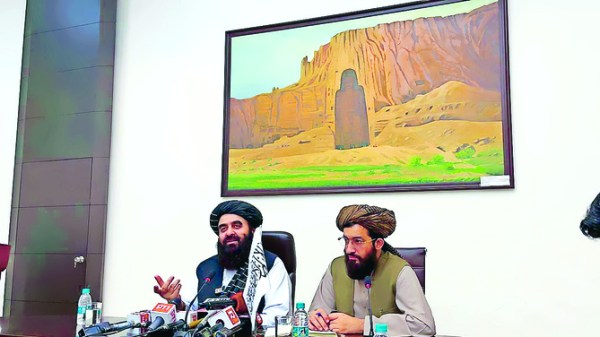 Afghanistan’s Taliban Foreign Minister Amir Khan Muttaqi (left) in New Delhi in October last year. On the wall hangs a painting of the Bamiyan Buddhas —which the Taliban had destroyed in 2001. Shubhajit Roy
India invested for years in Afghanistan after the fall of the Taliban in 2001. In 2021, the Ashraf Ghani-led government collapsed within a matter of weeks after President Joe Biden announced a withdrawal of US troops from the country.
Story continues below this ad
In the months and years since, the Indian government came to the conclusion that it was time to upgrade the level of official engagement without giving official recognition — or watch its $2-3-billion investment go down the drain. That was meant for the people of Afghanistan, and create some kind of leverage and influence in the country.
A key factor has been the fact that Taliban’s benefactor and ally, Pakistan, has turned into a deadly adversary. Both sides have seen multiple clashes along their contested border. For New Delhi, the fractured ties between the Taliban and Pakistan has been a window of opportunity.
Another factor hastening India’s engagement is China. Beijing has started building bridges and eyeing natural resources in Afghanistan — filling the vacuum left behind by the US, Europe and the West.
Story continues below this ad
Russia too has been engaging with the Taliban, and is the only country to have established diplomatic ties with them. Delhi has been working with Moscow on Taliban, to keep track of the Chinese influence.
New Delhi started sending serious signals in December 2021 itself when it sent a consignment of medicines to Afghanistan. The government was essentially choosing to distinguish the Taliban regime from the Afghan people. The intent was to open a window to the new Afghanistan and get a foot in the door.
Are there security concerns?
New Delhi has operated on the simple principle that Afghanistan’s territory should not be used for anti-India activities and support for terrorist groups.
An August 10 report by the UN Security Council’s 1267 sanctions committee states: “The terrorist threat emanating from Afghanistan remained largely unchanged. The ability of numerous terrorist groups to operate in Afghanistan constituted an enduring threat to neighbouring countries and the Central Asian region. Despite efforts by the de facto authorities to combat Islamic State in Iraq and the Levant-Khorasan (ISIL-K) and contain other terrorist groups, the authorities were unable to suppress the terrorist problem.” It also said that the Al-Qaeda terror group’s status and strength in Afghanistan remains unchanged.
Story continues below this ad
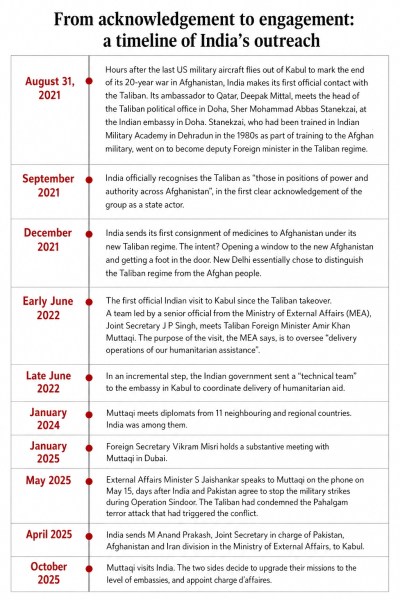 India’s outreach to the Taliban
New Delhi would be relieved that the report contains no mention of anti-India terror groups, such as Lashkar-e-Taiba and Jaish-e-Mohammad. But it is keeping its fingers crossed.
So far, New Delhi’s engagement has been “limited” and the Taliban has indicated that they will be “reasonable” in the way they “handle” Indian concerns. The security provided to the Indian diplomats in Kabul has given some confidence to the Indian establishment.
Charge d’affaires Noor delivered a 21-minute speech where he addressed the security concerns on everybody’s mind.
Story continues below this ad
“One of the important achievements of the past five years has been the implementation of the sacred Sharia, the strengthening of the country’s security and independent decision-making, as well as the consolidation of stability. This security is not only a necessity for Afghans, but also serves the shared interests of the region and the world. A peaceful, stable and responsible Afghanistan creates new opportunities for regional connectivity, trade, investment and economic cooperation, while also playing a constructive role in preventing shared security threats.”
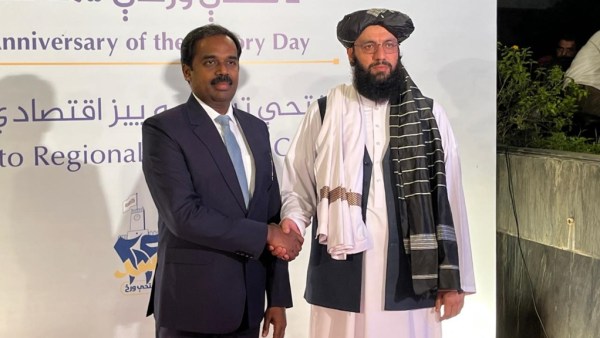 Chargé d’affaires Mufti Noor Ahmad Noor with Joint Secretary (Pakistan, Afghanistan and Iran) Anand Prakash at the embassy on Monday. Shubhajit Roy
As he spoke, the screen on the stage read: “From victory to regional economic connectivity”. The message was that Afghanistan was a centre for economic activity, not a den of terror groups.
Noor said: “The Islamic Emirate of Afghanistan believes that Afghanistan’s geography should not be a field for negative competition, but rather a bridge for connectivity, cooperation and shared prosperity. Therefore, Afghanistan has continued its practical efforts to expand regional economic and transit cooperation, facilitate trade, and strengthen relations based on mutual interests.”
This was seen as a message to India and Pakistan, who have long battled for influence in Afghanistan.
But what about rights issues?
Story continues below this ad
Since August 2021, India has delivered substantial humanitarian aid to Afghanistan, including 50,000 metric tons of wheat, over 445 tons of essential life-saving medicines, vaccines, and disaster relief materials — including tents and food materials for floods and earthquakes.
But the important issue of human rights and the rights of women to study and work, and rights of minorities have not been part of either Taliban’s or India’s publicly stated red lines anymore.
The Islamist group has been eroding the rights of the 22 million women in the country since regaining control — barring access to school for girls over 12, restricting travel without a male chaperone and bringing in a law implying legal approval for child marriage — according to international media reports.
At the Afghan “victory day” reception in New Delhi, only a handful of women were present — these included an Indian woman diplomat (Sneha Dubey, the director of Afghanistan, Pakistan and Iran in the MEA), a few Indian women journalists, and the wives and family members of foreign diplomats in a crowd of about 200 people.
Story continues below this ad
Shortly after the Taliban takeover, the UN Security Council adopted a resolution that talked about the need for upholding human rights and women’s rights in Afghanistan. The August 30 resolution, adopted under India’s rotating presidency, demanded that Afghan territory should not be used for terrorism and that a negotiated political settlement should be found to the crisis.
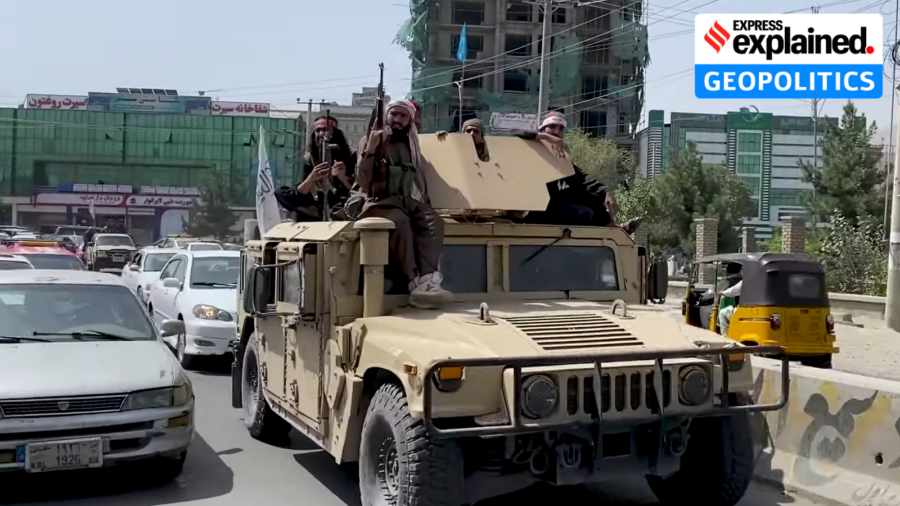
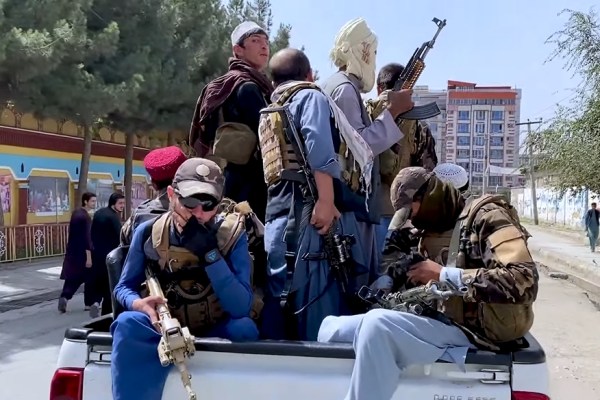 Taliban fighters in Kabul on August 17, 2021. Wikimedia Commons
In December 2022, India expressed concerns over reports that the Taliban had banned women from universities in Afghanistan. It renewed its call for setting up an inclusive government in Kabul that ensures the equal rights of women and girls in all aspects of Afghan society, referring to the Security Council resolution.
Now the Indian side has not insisted on any of those old red lines on women’s rights and human rights. It has agreed to move forward with development cooperation on Indian-funded projects and visas for Afghans visiting India for medical treatment, business and even education.
Story continues below this ad
It’s a telling silence. India’s strategic embrace of the Taliban is nearly complete. The Afghan missions in Delhi, Mumbai and Hyderabad are now manned by Taliban-appointed diplomats; they only lack official diplomatic recognition. Until that happens, the main flagpole of the embassy in Delhi will continue to fly the old Afghan Republic’s tricolour.

Priyanka Chopra remembers when her late father was happiest: ‘I really miss him’
By Sohail Khan · 21 Aug
On Vande Mataram, Congress hasn’t learnt from its past
By Sohail Khan · 21 Aug
Naxalism’s ideological front hides behind democratic ideals
By Sohail Khan · 21 Aug
Leave a Reply