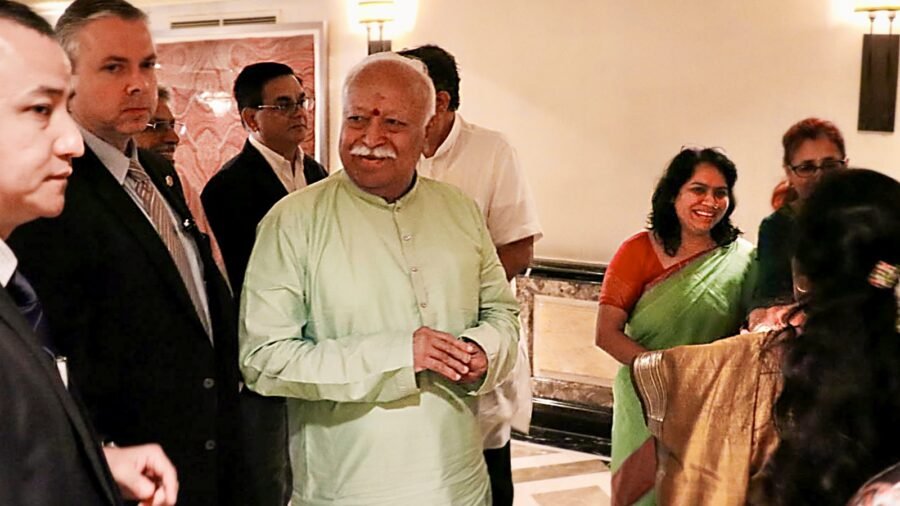
Dear Zohran Mamdani, here are some things you may not know about Mohan Bhagwat
Dear Mr Mamdani,
I’m writing this in response to your comments about Mohan Bhagwat, the head of the Rashtriya Swayamsevak Sangh, India.
Advertisement
I understand where your antipathy to Mr Bhagwat comes from. His organisation has long been regarded as the one pivotal body opposed to Muslims in India.
However, there are a couple of things about him that you need to know. I am a secular and liberal Indian, as secular and liberal as they come. I was one of the three mediators tasked with mediating the Ayodhya-Babri Masjid-Ram Janmabhoomi dispute in 2019. This was the single biggest flashpoint of conflict between India’s Muslims and Hindus.
It reached a crisis point when, in 1949, Hindu zealots sneaked in and put an idol of Ram Lalla inside the mosque. The other flashpoint was 1992, when a mob scaled the barriers and, within hours, brought down the mosque.
Advertisement
This was arguably India’s biggest communal conflict. You may not have followed the outcome of the dispute, but very briefly, there was an agreement between most of the significant stakeholders which led to an outcome which enabled India to close this dispute without a single loss of life.
While the actual result came through a controversial court ruling, it was predicated on the feeling amongst large sections of Muslims that it was in their interests to reach a settlement whereby they were protected for all other places of worship and, based on that, they could contemplate giving up the contentious site of the Babri Masjid, which had ceased to be an effective place of worship from 1949.
However, it was also necessary for India’s Hindus to step up to the plate and play a role that saw them avoid jubilation and celebration and allow the moment in history to pass virtually unnoticed. To a large extent, this was because of Mohan Bhagwat and his insistence that there should be no celebration or jubilation, which would be irksome to the other side.
Bhagwat also said that the RSS was in this matter only for the Ram Mandir, and that it was not interested in going after any other place of worship, that is, any other mosque. This was a balm for the Muslim mind, especially since the Vishwa Hindu Parishad had made no secret about the fact that it had a long list of mosques in different parts of the country and was prepared to go after each one of them. Mr Bhagwat’s statement was no doubt meant to dampen that organisation, which has since tempered its activity in this regard.
One more piece of information. There was litigation concerning the Gyanvapi Mosque in Varanasi. The BJP zealots made much of the fact that an object resembling a Shivling had been discovered on the mosque premises. They were using this to agitate for the return of the mosque to the Hindu fold, claiming that it had indeed been a temple.
The case went up to the Supreme Court. It came before D Y Chandrachud, then a puisne judge of the Court. Chandrachud was one of the judges who had delivered the judgment in the Babri Masjid case. In that judgment, the Court had said that the Places of Worship (Special Protection) Act, 1992 embodied the virtues of secularism and was therefore part of the Basic Structure of the Constitution, hence unalterable by Parliament. The Act provided that the character of all places of worship, as of 1947, had to be respected and could not be forcibly changed.
When the Gyanvapi case came before him, all that Chandrachud had to do was reaffirm his judgment in the Ram Mandir case and put a lid on the controversy forever. Instead, he remarked that it was still open to the Court to see whether the place was a mosque or a temple. This was in stark violation of the prescription of the Act. It was a recipe for continuing communal turmoil.
It was Mohan Bhagwat who stepped in the next day with a remark that one cannot go looking for Shivlings in every mosque. With this, he restored sanity.
It was a strange turn of events. The senior judge of the country, soon to be Chief Justice, pitched a disharmonious line, while the head of the RSS was rooting for harmony and closure of controversy.
Mr Bhagwat has, since then, made other statements which speak to his recognition of the importance of harmony between India’s different communities. For him, harmony is a rooted necessity for India. It comes from the Indian scriptures and their teachings. For others, it comes from constitutional prescriptions. What is important is that the belief is held, articulated, and maintained.
Mr Mamdani, while I do understand your antipathy towards the RSS, I would like you, please, to take note of some of these aspects pertaining to Mr Mohan Bhagwat.
It would be good for you, and for him, to have a conversation while he’s in your country.
The writer is Senior Advocate and Mediator
Building BRICS for the world
By Sohail Khan · 27 Aug

Flu questions answered: N95s, crowds, precautions, and the 2-metre rule
By Sohail Khan · 27 Aug
Leave a Reply