Building BRICS for the world
By Qin Jie
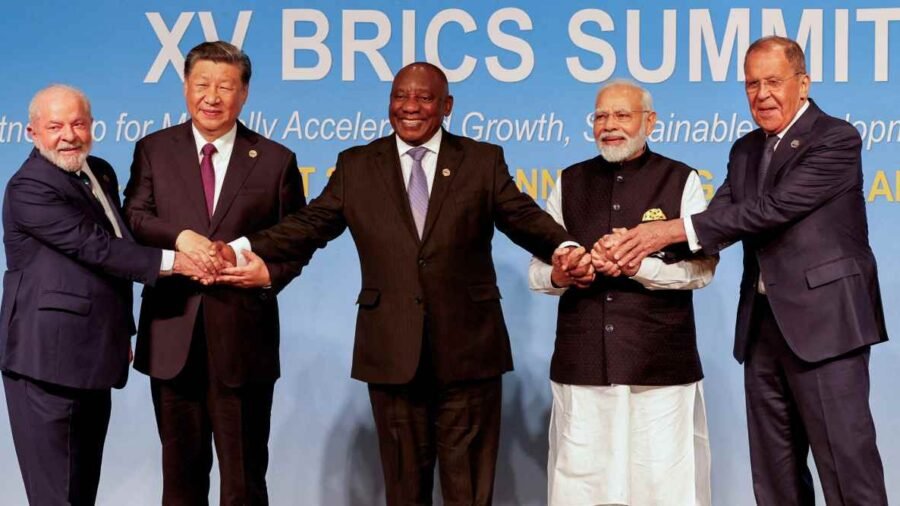
The idea of “BRIC” was first mooted by the former chief economist of Goldman Sachs, Jim O’Neill, in 2001. The four-nation group had its first high-level ministerial meeting in 2006, and held its inaugural summit in 2009. South Africa officially joined the group in December 2010, and BRICS emerged.
Advertisement
In the Chinese language, BRICS is referred to as jinzhuan (golden brick), which emphasises its significance. Today, BRICS+ has expanded to include 11 member countries (Brazil, Russia, India, China, South Africa, Egypt, Ethiopia, Indonesia, Iran, United Arab Emirates, and Saudi Arabia) and 10 partner countries (Belarus, Bolivia, Cuba, Kazakhstan, Malaysia, Nigeria, Thailand, Uganda, Uzbekistan, and Vietnam).
BRICS and BRICS+ now account for 45 per cent and 55 per cent of the world’s population respectively and are rapidly closing in on 35 per cent to 45 per cent of global GDP (by purchasing power parity; even in nominal terms, BRICS+ economies now collectively surpass $30 trillion in GDP). Naturally, this collective voice cannot be neglected. BRICS+ is emerging as the world’s most dynamic economic alliance, and according to international agencies like the IMF, it is to grow nearly three times faster than the G7 nations by 2028. As ancient civilisations that had led the world for centuries, BRICS countries are on their way to revival and reclaiming the global centre of gravity. More countries like Argentina, Algeria, and Türkiye have expressed interest in formally joining the group. These simple facts show that BRICS provides a special platform for dialogue and cooperation. It is an inclusive, rather than exclusive, platform.
In less than a month, the 2026 BRICS Summit will be held in New Delhi. As an important platform for cooperation among emerging markets and developing economies, BRICS+ has to expand its agenda to respond to changing global realities while remaining focused on economic growth and people-centric development. Following India’s 2026 agenda, the four priorities are resilience, innovation, cooperation and sustainability, which will advance through three pillars of the group: Political and security cooperation, economic and financial partnership, and cultural and people-to-people exchanges.
Advertisement
China has pledged firm support for India’s role in the summit. Given China and India’s size, whether in population, economy, or markets, cooperation is the best choice for our two countries and two peoples. For instance, our economies are already the first and third largest in terms of Purchasing Power Parity (PPP), and the combined population of the two countries is about 35 per cent of the world’s total. As important neighbours, we are both at a critical stage of national development and rejuvenation. Cooperation brings common prosperity, while confrontation and antagonism can lead to a lose-lose situation. Recently, multiple direct flights between China and India have resumed. Exchanges and cooperation between sister cities, universities, and businesses have been increasing.
Of course, China-India solidarity benefits not only our two countries, but the region and the world. In the near future, China and India will remain strong engines of global economic growth. Our combined GDP will climb from the current 28.4 per cent using PPP terms, and roughly 20 per cent in nominal terms, of the world’s total. The Five Principles of Peaceful Coexistence (Panchsheel) jointly advocated by our two countries have become the basic norms of international relations and the fundamental principles of international law. Under our leaders’ strategic guidance, China and India can build more synergy and achieve mutual success. In the long run, more and more youth from both countries can become bridges and links between China and India.
The writer is consul general of the People’s Republic of China in Mumbai
Light on truth: on the Tamil Nadu G.O. and RTI
By Sohail Khan · 29 Sep
Tackling food loss and waste — India’s opportunity
By Sohail Khan · 28 Sep
Revisiting the farmer question
By Sohail Khan · 28 Sep