Chinese robot sprints 100m faster than Usain Bolt: Why teaching robots to run matters
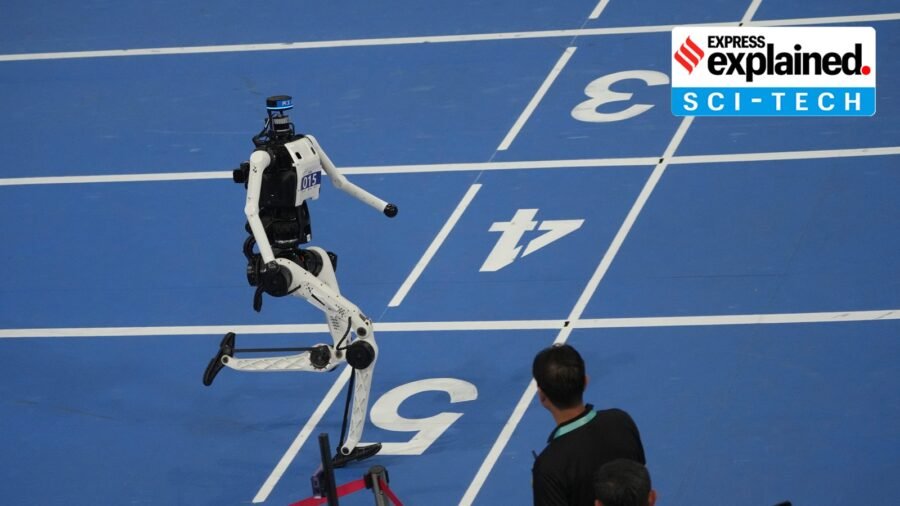
A Chinese humanoid robot has just done something that sounds both remarkable and faintly absurd: it ran 100 metres faster than Usain Bolt.
Tiangong Ultra, developed by the Beijing Humanoid Robot Innovation Center, covered the 100 metres in 9.39 seconds in a preliminary round at the World Humanoid Robot Games in Beijing on August 22. The human record is of 9.58 seconds, set by Bolt in 2009.
Tiangong Ultra wasn’t the only one. Another robot called Lightning, the made by the Chinese smartphone manufacturer Honor, finished in 9.47 seconds, although it had to then be carried away of a stretcher.
Story continues below this ad
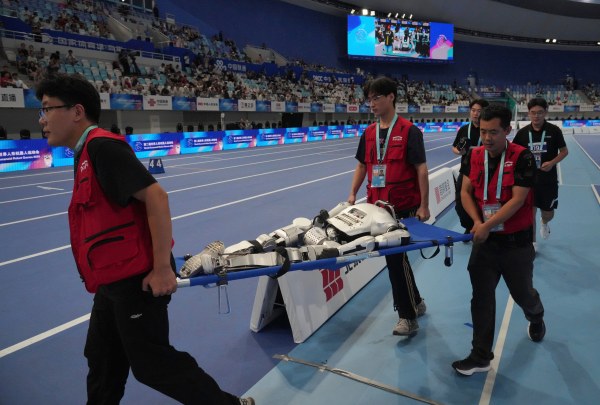 A humanoid robot is carried off the field after competing in the 1500m run race during the World Humanoid Robot Games in Beijing on Aug. 23.
While this is a feat of science and another sign of China’s total dominance over the humanoid robot industry, why make a robot run at all? Who does it help, and how?
Racing to do what humans can
This is the second edition of the World Humanoid Robot Games, where, apart from racing, the humanoid robots will compete in football, and in tasks such as connecting cables, charging electric vehicles, and moving materials from one location to another.
The tasks are not just for the spectacle. They are a way of demonstrating how adept the robots are at handling real-world situations humans routinely face.
The human body is an extraordinarily good machine. It can move through a messy, unpredictable environment while constantly processing information from its eyes, ears, nose, and muscles.
Story continues below this ad
Take something as mundane as tripping. A person catches a toe on an uneven surface. In a fraction of a second, the brain has to register that the body’s balance has changed, work out where the body is moving, decide how to correct it and coordinate dozens of muscles to put a foot down, shift the weight and stay upright. Sometimes we stretch out a hand or change our posture. Sometimes we simply take an extra step.
Thus, the seemingly clumsy act of tripping and righting yourself involves sensing, prediction, decision-making and physical action, in a fraction of a second.
Teaching a robot to do all of this reliably is enormously difficult.
A 100-metre sprint, or other games, are useful because they force engineers to solve several of these problems at once. The robot has to accelerate, coordinate its limbs, maintain balance, respond to tiny changes in its position and then decelerate.
Story continues below this ad
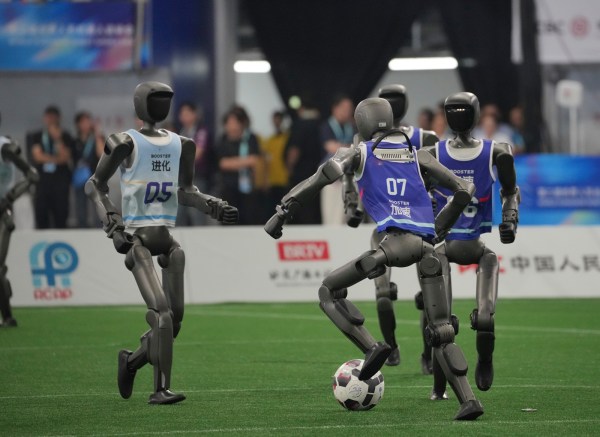 Humanoid robots play soccer ahead of the opening ceremony of the World Humanoid Robot Games in Beijing, on August 22.
Once a robot can do all this, it can perform a variety of tasks, from delivering food in restaurants to cleaning your house to sweeping a mine to rescuing people trapped under rubble.
Consider disaster response. A robot sent into a burning building, collapsed structure or hazardous industrial site needs to negotiate stairs, rubble and uneven surfaces. It may need to move on inclined surfaces, find something, pick it up, open a door or turn a valve.
The USA’s National Institute of Standards and Technology is running a project to develop robots that can help with disaster relief. Its website says, “Categories of elemental robot tasks include maneuvering, mobility, dexterity, sensing, endurance, radio communication, durability, reliability, autonomy, logistics, and safety.”
The same principle applies to warfare.
Story continues below this ad
A drone is a good example of a machine capable of moving through the physical world while sensing and responding to it. A military drone can navigate, observe, carry equipment or operate in places where putting a human would be dangerous.
Physical dimension of Artificial Intelligence
While AI chatbots are becoming ubiquitous, as large language models become better and better at processing large amounts of information, the next frontier is giving machines more sophisticated physical capabilities — including ground robots that can move through terrain, carry supplies or potentially work alongside soldiers.
This is also why China is investing so heavily in robotics. The International Federation of Robotics says that China’s latest Five-Year Plan (2026-2030) places robotics at the “heart of its modern industrial system.” The report points out that even at present, 54% of annual industrial robots installed worldwide were in China.
In the new plan, the “aim is to pivot its AI research towards physical applications with robots as main drivers for economic growth. This is a next step in the country´s strong automation development,” the report says.

How South Africa’s new exchangeable pitches could shape the 2027 Cricket World Cup
By Sohail Khan · 28 Sep
The mindset shift Virat Kohli is talking about: ‘Promised myself…to play more freely’
By Sohail Khan · 28 Sep
Safe and healthy workplace as a legal right: Does the OSH code deliver?
By Sohail Khan · 28 Sep