Should the EC take action against those filing forms for mass deletions?
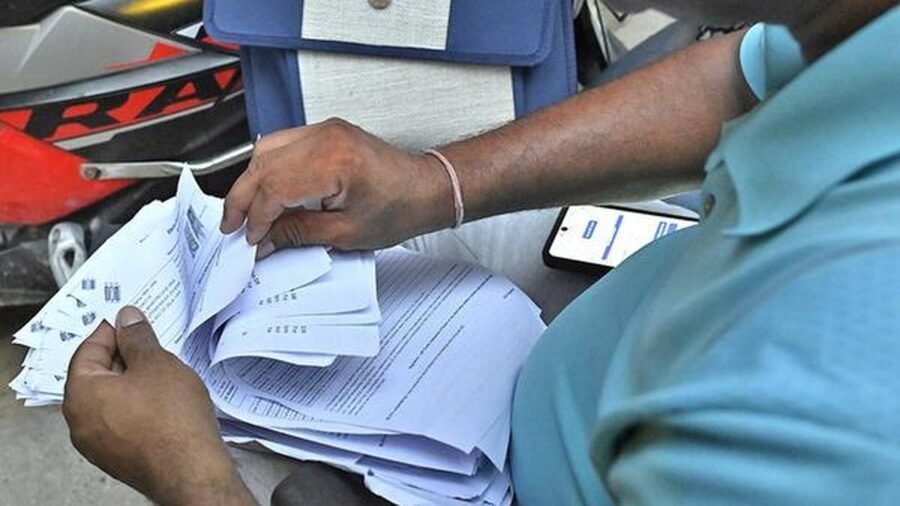
As Phase 3 of the Special Intensive Revision (SIR) of electoral rolls unfolds, a surge in Form 7 applications, the mechanism for seeking deletion of names, in Karnataka has raised concerns. More than 4,000 such forms were filed in the State, with 1,363 in one place coming from just 10 electors, many reportedly targeting Muslim names. Uttarakhand has seen objections filed in an Electoral Registration Officer’s (ERO) name without his knowledge, while in West Bengal, data shows that nearly 90% of Form 7 applications were accepted. Similar cases have been reported by from Rajasthan and Gujarat as well. Should the Election Commission (EC) take action against those filing forms for mass deletions? Ashok Lavasa and Prasenjit Bose discuss the question in a conversation moderated by Sreeparna Chakrabarty. Edited excerpts:

What is the ERO legally required to do when a Form 7 arrives?
 Ashok Lavasa: Under the Registration of Electors Rule 1960, all the steps that are required for registration, for deletion, and for amendment are listed. Form 7 applications are typically used to object to the entry of a person in the electoral roll. As soon as a Form 7 notice is received by the ERO, the Rules prescribe that first of all they should be put on the notice board for the public to know that objections have been received against such and such person. After this, a specific notice is to be given to the person against whom a complaint has been received. The Rules provide that in case an inquiry is demanded, the ERO or the officer designated cannot take a decision on his own without conducting a formal inquiry in which he can even summon the complainant and the person against whom the complaint has been received. He can ask the complainant to testify under oath that the particulars that he is presenting and the documents that he is giving are true. He is also informed that in case this is found incorrect, there is a penalty under Section 31 of the Representation of the People Act (RPA) for which he can be penalised with imprisonment for giving false information. This is the procedure. The spirit behind this is that no name should be deleted without giving adequate opportunity to the person against whom a complaint has been received.
How do these bulk forms emerge and is there a limit on how many objections one person can file? Also, can Section 31 of the RPA, which penalises false declarations, be invoked if somebody files bulk Form 7s?
AL: I think the EC has issued instructions from time to time; it is not given in the Rules as such. But instructions have been given that you should not receive more than, I think, five or six forms according to current norms. With respect to Section 31, I don’t think it can be invoked. It is specifically to do with giving false information.
In Karnataka’s Babaleshwar, 1,363 of Form 7 applications came from just 10 electors. Reports have said that many of the deletions targeted Muslim names.
AL: Clearly, this is a misuse of the procedure. The concerned authorities need to act against people who are misusing the system. You would recall that in Karnataka last year, when the Leader of Opposition had given some instances, the EC had itself clarified that out of some 2,000-odd applications that it received, only roughly 28 had been found to be correct. The question here is that we still do not know whether the EC has proceeded against somebody for making a false declaration. This penal provision, to the best of my knowledge, has hardly been used against anyone. And unless there is a deterrence, this provision will lose its efficacy.
West Bengal has seen one of the highest rates of acceptance of Form 7s. What is the petition against this in the SC about?
Prasenjit Bose: There are specific formats in which aggregated data on all Forms — 6, 7 and 8 — have to be recorded and disclosed at the end of any revision period by the EC. But that has not been followed in most States, especially in West Bengal. So, we had to request the disclosure of that data because we found anomalies in the data that were disclosed during the claims and objections period.
As per the facts revealed by the affidavit filed by the EC in response to the petition that we had filed, the total Form 6 applications for inclusion were 34 lakh, out of which 7,26,000 were rejected. As far as Form 7 is concerned, the total number received was 6,39,000, which, by itself, if you compare with States of similar sizes such as Bihar or Tamil Nadu, is on the higher side. And out of the 6,39,000 Form 7 applications received, 5,72,000 were accepted. So, you have an almost 90% rate of acceptance of Form 7 and less than 21% for Form 6. This anomaly is quite glaring. The problem lies in the deterrence mechanism of Section 31 of the RPA.
In many cases, the person in whose name the forms were filed denied having knowledge of the same. Is there some central mechanism which can be used to file forms?
PB: I will give you the latest example from Uttarakhand. I have on record the ERO of Haridwar Rural constituency confirming that he has not submitted any Form 7 filed in his name. In one constituency, 3,500 Form 7 applications were submitted just hours before the window for claims and objections was about to get over, and all the objections were in the name of the ERO. It has been done in an automated manner.
A similar mechanism was used in West Bengal vis-a-vis the appellate tribunals where automated appeals for exclusion have been filed which one of the Election Commissioners had flagged. Judicial intervention is needed to stop this as these illegalities are depriving genuine electors from their right to vote.
AL: This is quite absurd and calls for a probe. Clearly, the ERO cannot file objections. Although in the Rules there is a provision that the ERO can make some corrections on his own, that does not amount to filing so many objections.
And it is the responsibility of the Chief Electoral Officer of the State and the EC to thoroughly investigate this matter. However, just because applications are filed, we should not condemn the system. I think we need to actually hold the system accountable.
As far as the centralisation of data or generating objections in a centralised fashion is concerned, I think we are speculating. There is no evidence of that. But, we do know that one of the Election Commissioners has actually red-flagged the issue saying that it creates the possibility of manipulation at the central level.
What can be done to deter this?
AL: I think there are some safeguards in place, but the point is whether they are being enforced. The EC generally, after filing FIRs, is not following them up systematically because it is presumed that this is now the responsibility of the concerned law enforcement machinery. This is where the EC needs to put in place a very strong monitoring mechanism. Earlier, I have suggested that the National Crime Records Bureau must have a separate data set on election-related crimes. And they should be reported separately so that all these figures are in the public domain. Once this data is in the public domain, people will analyse and flag these issues. The EC also has certain internal norms, such as if, in any polling booth, there are more than 2% additions or deletions, that particular booth is taken up for greater scrutiny.
In all these instances where we are saying that 2,000 or more applications were received, the point is whether the system is accepting them. Is it actually leading to unjustified removal or addition? And finally, whether the system is taking note of the possibility of misuse.
PB: My point is that if the institution itself which is supposed to uphold the law and administer it, if at least a section within that institution starts violating the law, then the entire system breaks down. I think that is what has happened.
In terms of reform, what has happened is that the electoral laws, RPA Act and especially these Forms were framed at a time in the 1950s and 60s. It was a non-digital era. Today we have digital databases and online submission of Forms. I think our laws have become out of sync with the way the process is being conducted today. There is a need for legal reforms.
AL: If people are committing fraud that obviously cannot be dealt with under the RPA. This is a weak link in the system; our law-and-order machinery is not taking these cases seriously. That is why I suggested there has to be a specific monitoring mechanism for electoral offences.
Listen to the conversation
Ashok Lavasa is Former Election Commissioner. Prasenjit Bose is Congress leader and petitioner in West Bengal SIR case in Supreme Court

Gandhiji’s many ways of understanding ‘genius’
By Sohail Khan · 2 Oct
A reflection on two songs and their nationalisms
By Sohail Khan · 2 Oct
Gandhiji’s unfinished work on the world stage
By Sohail Khan · 2 Oct
Leave a Reply