Gandhiji’s unfinished work on the world stage
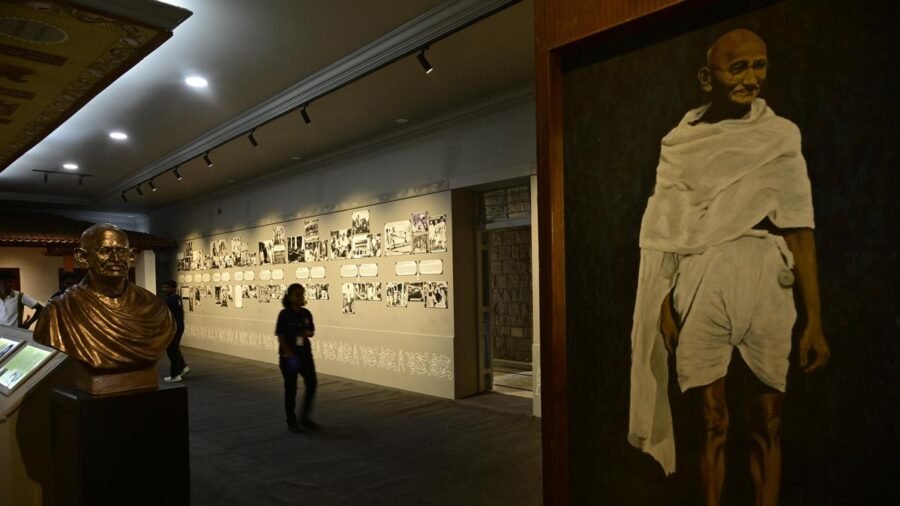
Writing about Gandhiji’s death on his birthday may not be an entirely odd thing, given how he died and how that conflicted with what he stood for. In popular perception, Gandhiji was a tired, old man whose life’s work was over when he was assassinated.
In any case, the people he sought to train and transform into compassionate human beings had turned bigoted murderers or condoned bigotry and mass murder during Partition. The last eccentric, going-against-the-grain act they allowed him was fasting in favour of Pakistan. Revisionist history of today seeks to downgrade his role in India’s freedom by counterposing Netaji.
The evolution of Gandhi’s thought
But it can be argued that Gandhiji’s best years were yet to come even if India had failed him then and now. At 78, Gandhiji was healthy enough to have gone on a village-to-village walk in Noakhali, fasted for three days in Calcutta to stop the rioting before the five-day Delhi fast, and talked about a fast-unto-death to stop the killing of Muslims in Bihar. His health may well have facilitated his shining on the world stage for several more years.
The emergence of a global image
Gandhiji had already ascended the world stage a few decades before in-part due to the rapid growth of print media in the first half 20th century that sought out new and novel stories. Among a non-violent campaign’s advantages was that it was carried out in the public domain, transparently — far easier to cover than a clandestine plot. A report on the Dharasana beatings ran in some 1,300 papers worldwide. And photos of Gandhiji, with his dress, or the lack of it, quirks and eccentricities, looked great on newsprint.
Among the many influences Gandhiji had globally was the Black civil rights movement. In America, African-American newspapers were only eager to see parallels and seek inspiration. And it was not symbolic or philosophical but direct and tactical, too. A Harlem ashram and an Ohio ahimsa farm sprang up. Even the goat-milking transmuted to America.
Martin Luther King may have been the most famous of civil rights leaders’ visits to India, but there were many other organisers such as Bayard Rustin and James Lawson who had immersive sojourns in India. A report in quotes Rustin — he was the organiser of the 1963 March on Washington, at which King delivered the “I Have a Dream” speech — as saying in 1948 that the “Indian non-violent revolution has much to teach us”.
During the Montgomery Bus Boycott, described as the practical kick-off of the civil rights protests led by King, Rustin put his learnings to successful use. He insisted that Montgomery should only be one of many such sites. He ticked off King for having armed guards in his house, saying that Gandhiji would not do that. In a move that caught the attention of many, but which Rustin owed to Gandhiji’s methods, he asked that the leaders should go and voluntarily surrender to the police, saying that, yes, they had broken the law, but that it was the right thing to do. Lawson set up a Satyagraha training school in Nashville.
Non-violence on a global scale
Gandhiji did become a global icon, posthumously. For sure, his methods drew from the past. A peaceful march organised by a priest in St. Petersburg was violently put down by the Tsar, although it triggered the 1905 revolution. But what was new was that Gandhiji showed that they were duplicable on a mass scale in an organised manner. This was the novelty that caught the imagination of the world later.
Scholars have shown that in the latter half of the 20th century, when asymmetries of power solidified, only non-violent campaigns could succeed and did so. East Timor was a sterling example.
Perhaps the best chance that the Palestinians had for Swaraj was in the initial stages of the Intifada. Though known more for the stone-throwing, the initial protests were largely non-violent but forceful in a Gandhian way. More than all the bombings, assassinations and the plane hijacks engineered by the Palestinians, it could be argued that Intifada 1 forced the Israeli leadership to negotiate and at least on paper commit to a two-state solution eventually though subsequent events upended all that.
It would seem that Gandhiji had planned to play an active global role after India’s Independence. A report in on March 9, 1948, quotes Horace Alexander as saying that Gandhiji, in England in 1931, had told his friends that when India would be free, he would take part in a world movement for spreading the gospel of non-violence. Another report in August 1947 says that “discussions are now going on between Mahatma Gandhi and some of his American, Indian and European friends” for the world conference.
The conference was held in 1949, a year after his death. International participants discussed setting up an organisation. A.J. Muste wanted to set up a training institute in India. But, without the man himself, Gandhiji became only a soul force, not a physical presence, for non-violent activists across the world.
The Palestine test
If idle speculation could be allowed, a living Gandhiji would have electrified the world that had just gone through a monstrous war and the Holocaust. Instead of becoming just a memorial possibility and vague idealism, non-violence and compassion would have been far more rooted in global discourse.
The best test for Gandhiji would have been Palestine.
If he could make an Englishman ashamed of himself, could he not have made Israeli Jews ashamed of inflicting on Palestinians the suffering Jews had endured for centuries?
kalyanaraman.m@thehindu.co.in

Should the EC take action against those filing forms for mass deletions?
By Sohail Khan · 2 Oct
Gandhiji’s many ways of understanding ‘genius’
By Sohail Khan · 2 Oct
A reflection on two songs and their nationalisms
By Sohail Khan · 2 Oct
Leave a Reply