Hyderabad’s Ganesh puja: Big on devotion, bigger on moolah
A helicopter hovering over a Ganesh idol is not an everyday sight, even in a city that goes all out for its biggest festival. On September 24, as an immersion procession wound its way towards the Hussainsagar, the six-seater Airbus H125 showered the idol with flower petals from above. It was a fleeting spectacle, but one that involved considerable logistical arrangements and expense. And it was only a small part of the elaborate machinery that keeps Hyderabad’s Ganesh Chaturthi celebrations running.
Behind the towering idols, elaborate pandals and processions that stretch late into the night lies an economy of its own. Idol-makers, decorators, sound operators, transporters, crane companies, caterers and scores of workers find business in the festival while organisers marshal donations and sponsorships to pay for the spectacle.
The flower shower was organised by Hanuman Youth Association, which installed an idol in Bowrampet.
“An aviation agent contacted me for parking space for the helicopter. It was to arrive from Bengaluru, shower petals on the second day and leave on the third. Since the Rajiv Gandhi International Airport and Begumpet Airport charge a lot, they looked at my aerofarm as a parking spot,” says P.R. Singh, owner of Singh Aerofarm in Sangareddy and a retired Indian Air Force squadron leader.
Mr. Singh estimates that the operation, including the related arrangements, could have cost the organisers around ₹20 lakh.
Crunching the numbers
There is no single account book for Ganesh Chaturthi in Hyderabad. The Bhagyanagar Ganesh Utsav Samithi (BGUS) estimates that the festival generates ₹6,000 crore to ₹7,000 crore in economic activity in the city.
BGUS general secretary R. Shashidhar says the festival provides direct employment to around two lakh families and indirect employment to another 4.5 lakh people. Other estimates put the economic activity at upwards of ₹10,000 crore when months of preparation are factored in.
Read |Immersion procession of Khairatabad Ganesh idol in Hyderabad passes off without a hitch
The money flows from organisers to idol-makers, tent-house operators, decorators, lighting contractors, transporters, sound-system providers, bands, flower sellers, caterers and other workers. Expenditure ranges from a few thousand rupees to several lakhs, beginning well before the idol reaches the mandap.
According to Telangana Police, around 1.24 lakh Ganesh idols were registered on the State’s Ganesh portal this year. This figure covers all of Telangana, not just Hyderabad. Director General of Police C.V. Anand says the actual number across the State could range from 3.5 lakh to 4 lakh if idols installed in homes, apartments and other private premises were included.
Expenditure varies with the scale of the celebrations. A small neighbourhood mandap may spend relatively little on the idol, structure and decoration, while a large one can incur costs running into several lakhs on the pandal, lighting, flowers, manpower and other arrangements.
At Balapur, one of Hyderabad’s best-known Ganesh celebrations, the committee spent around ₹98 lakh on the festival last year, says Kalyan Niranjan Reddy, chairman of the Balapur Ganesh Utsava Samithi. The amount covered the idol, workers, flowers, decoration and pandal arrangements. The committee is yet to complete its accounts for this year.
Mr. Reddy says around ₹30 lakh to ₹40 lakh was collected through chanda (contributions). The remainder came from other donations, advertisements and sponsorships. The procession adds to these expenses, creating another stream of business for transporters, sound operators and other service providers.
At Balapur, the 21-foot idol required a heavy vehicle, says Kalyan Reddy. The vehicle, driver and diesel together cost around ₹40,000.
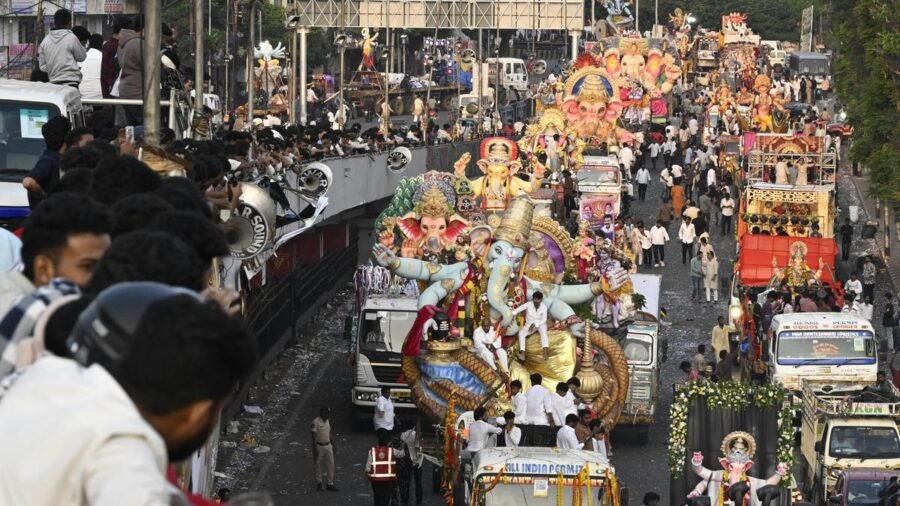
Ganesh idols being carried in a procession for immersion in Hussainsagar, Hyderabad, on September 26.
RAMAKRISHNA G.
The expense generates business for transporters, vehicle owners, drivers and workers involved in loading and securing the idol. At major immersion points, cranes and other equipment are also needed to lower idols into the water.
The next bill is often heard before it is seen. For a small mandap, a basic speaker arrangement can cost around ₹5,000 to ₹6,000, while a DJ setup can cost around ₹15,000 for eight hours, says Hyderabad-based sound-system operator Mohammed Saber Hussain.
“Usually, DJs and sound operators have an eight-hour booking period because that is considered the industry standard,” he explains. The actual amount depends on the size of the system, the equipment hired and the duration.
Larger packages combining sound boxes, truss structures, lighting and DJ equipment can cost up to ₹75,000. Hussain says he also received a booking worth ₹2 lakh during this year’s festival season. Packages vary according to the equipment hired, while the customer bears generator and diesel costs.
Traditional performers also find business during the festival. Marfa bands charged around ₹20,000 to ₹40,000 for performances this year, with popular troupes commanding ₹50,000 to ₹60,000 on immersion day.
Unlike many Hyderabad processions, the Balapur Ganesh Utsava Samithi does not hire DJs. It has followed the tradition of playing bhajans on immersion day since the 1980s. Yet its total festival expenditure was around ₹98 lakh last year, reflecting the cumulative cost of the many arrangements that go into the celebrations.
Prasadam adds another layer of spending, covering ingredients, cooking, packaging, transport and distribution, says Shashidhar. At a large mandap, food distributed to thousands of devotees over several days can add up to a substantial bill, even when the per-person cost is modest.
Beyond the obvious
The expenditure extends beyond the organisers to the government, which provides electricity and deploys personnel and equipment for immersion arrangements.
This year, the Telangana Southern Power Distribution Company Limited (TGSPDCL) supplied free electricity to 51,207 registered Ganesh idols and pandals across its 21 circles, with a sanctioned connected load of 1.12 lakh kW.
The government’s estimated expenditure this year was ₹17.8 crore, up from ₹15.59 crore in 2025-26, when 47,649 pandals received free power.
Public spending also covers the personnel and infrastructure needed to manage the celebrations. Power utility staff worked round the clock to monitor feeders, transformers, lighting and emergency arrangements, particularly at major immersion points.
Anand says more than 25,000 police personnel were deployed in Hyderabad for immersion arrangements over the 10-day festival period. Cranes, barricades, traffic management, sanitation, lighting, emergency services and waste removal add to the logistical costs.
Heavy-duty cranes stationed on the banks of Hussainsagar for idol immersion.
NAGARA GOPAL
The scale of the immersion operation is evident in the cranes deployed along major routes.
Syed Faraz and Syed Ausaf, owners of Super Cranes, which participates in the Greater Hyderabad Municipal Corporation’s (GHMC) immersion operations, says 10 cranes were deployed at NTR Marg and 12 at People’s Plaza. Their capacities varied according to the size and weight of the idols.
GHMC norms require cranes with a minimum capacity of 50 tonnes, they point out. “The Khairatabad Ganesh idol required a much larger machine for immersion: a SANY SAC 3000 crane with a capacity of 300 to 350 tonnes, an 80-metre main boom and 100 tonnes of counterweights,” says Faraz.
Transporting the crane requires at least three 40-foot trailers, accompanied by a signal-flag vehicle to guide the convoy through narrow roads and sharp turns. The six-axle crane has 12 tyres and may require traffic management even before reaching the immersion site, the owners say. “Moving such a machine to an immersion site is itself a logistical operation.”
Each crane requires five skilled workers and a skilled rigger for safe lifting operations, with one supervisor deployed for every five cranes. Workers are provided orange jerseys and identity cards at the immersion sites.
Unlike private bookings by Ganesh committees, the immersion crane operations are awarded through the GHMC tender process. The contract runs for 12 days, with 12-hour shifts during the first eight days and 24-hour shifts thereafter.
Operators inspect sites six to seven days before deployment, assessing the idol’s weight and height, lifting radius and other conditions to determine the required crane capacity and commercial terms.
Super Cranes executed the GHMC work in association with other crane operators deployed at various immersion points.
Laddu auction and local causes
If the festival has an economy of expenditure, it also has an economy of transactions that can be difficult to explain in ordinary terms.
The Balapur Ganesh laddu fetched 39 lakh in an auction. The bid was won by Sama Praneeth Reddy, a resident of Hayatnagar in Rangareddy district.
RAMAKRISHNA G.
Balapur’s famous 21-kg Ganesh laddu fetched a record ₹39 lakh at auction this year. Sama Praneeth Reddy of Urban Realty Group won the bid, surpassing last year’s ₹35 lakh. Nine participants had registered for the auction, including representatives of five companies, while one bidder participated from London.
At Keerthi Richmond Villas in Bandlaguda Jagir, a 5-kg Ganesh laddu fetched ₹1.01 crore this year, compared with ₹2.31 crore last year. Despite weighing a quarter as much as Balapur’s laddu, it fetched more than twice the latter’s auction price. Such bids illustrate how the value attached to the laddu can far exceed its production cost.
In both cases, the auction proceeds are separate from festival expenditure and generally go towards community development, welfare or other local causes.
There is no price tag on the festival itself. But almost every part of putting it together — from installing an idol to lowering it into the lake — comes at a cost. Together, these expenses, along with the businesses, jobs and transactions the festival generates, form an economy that runs alongside the celebrations.


Leave a Reply