‘Blessing in disguise’: Mirzapur director on replacing Vikrant Massey with Jitendra Kumar
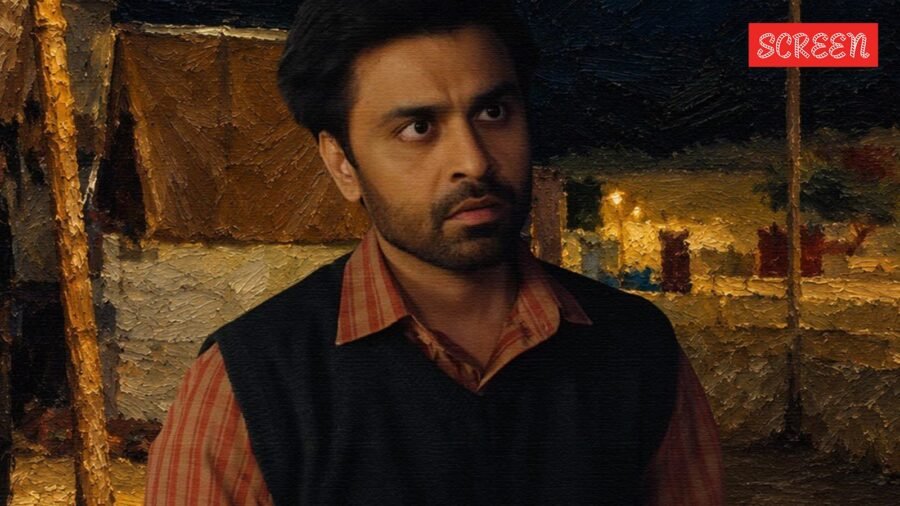
Gurmmeet Singh on replacing Vikrant Massey with Jitendra Kumar as Bablu Pandit
Mirzapur: The Movie revisits the characters and world introduced in the first season of the series, in which Vikrant Massey played Bablu Pandit, the younger brother of Guddu Pandit. However, in the film, Jitendra Kumar steps into the role. Talking about the casting change and how it influenced the story, Gurmmeet Singh said, “I think the beauty about a make-believe world or doing something creative and fiction is that as an artiste, one always needs to have choices, right? As creators, as actors, what’s the one thing that we all desperately want? It’s to have choices and to be able to make that choice. And it’s a good lesson to learn that everyone needs to be able to follow what their heart is telling them to do. No story, no character, no journey is bound down by anybody, right? The show will always move forward, and that’s the beauty we can take forward from this, that with Jitendra coming in, it brought a new energy into the show. It also gave the film its own identity.”
Story continues below.
Subscribe to see fewer ads.
The director further explained how the casting change allowed the team to reimagine Bablu and give him a more prominent role in the story. He added, “It gave it its own life, which is very different from the show, which is what we always wanted anyways. So it became a blessing in disguise. We were able to reimagine Bablu and give him more agency. The Bablu in the show was almost aiding his brother and was a victim, never having agency or an agenda of his own. But this Bablu is playing the game. He’s the one driving the narrative. So, I think that’s a great learning we’ve taken away, to always use your setbacks to your advantage, because that’s what creativity is meant to do. Look ahead, and with the film doing as well as it has, I think it only opens up so many doors for us.”
On Ali Fazal and Divyenndu improvising the car-chase scene
When asked whether the actors frequently add their own inputs while performing scenes, Gurmmeet Singh said, “All the time. For us, in a way, it’s almost like capturing theatre in motion. Our job is to keep the playground as happy as possible so that they can actually go out and find the best versions of themselves and the scenes, without inhibiting them in any way. Our job and our aim is to try and keep the writing as sharp as possible, but where they want to take it, we don’t want to stop them. We want to be constantly surprised by them, and they keep surprising us all the time.”
Sharing an example of how the actors went beyond the script, Gurmmeet spoke about the car race between Guddu and Munna, which has become one of the film’s memorable sequences. He revealed that much of the banter between the two characters was improvised by Ali Fazal and Divyenndu. “We have a section of the race which is actually 12 minutes long; what you see on screen is only four and a half minutes, but there is constant banter. So while the script might have said that Guddu comes and says his line and is supposed to zoom off, Munna retorts, and Guddu responds, none of that was actually written. It’s all improvised,” he said.
Story continues below this ad
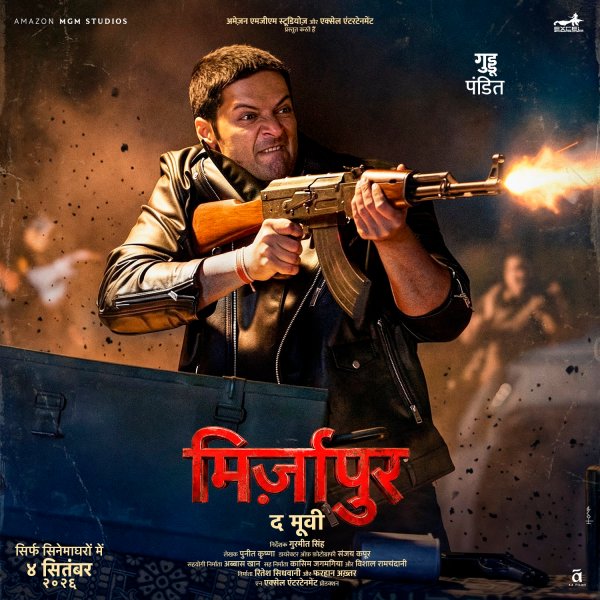 Ali Fazal in Mirzapur The Movie.
Gurmmeet further revealed that even the action in the sequence evolved on the sets, with Ali Fazal coming up with ideas while driving the car. He recalled how the original script only required Guddu and Munna to take out their guns and fire at each other. He shared, “This was all improvised between them. What was scripted was that Munna would take out a gun and fire, and then Guddu would take out his gun and fire. That’s all that was planned or written. But Munna takes out his gun and fires, and then Guddu is like, ‘Oh, so he takes out two guns.’ And this is Ali telling me, ‘I have thought of something.’ And we’re in moving cars right now, okay? He’s driving this car at 60 km/h, he’s gotten out of the car while driving it with two arms out, and he’s firing both guns.”
He added that Divyenndu then had to come up with a response to Guddu’s move, as the actors continued to build on their characters’ one-upmanship during the sequence. And then Munna looks at it like, ‘He’s firing with two guns, what do I do?’ He’s on the talkback saying, ‘I need to do something, give me something, give me something.’ So I said, ‘Ask for your Anaconda and fire that.’ So they’re trying to do that one-upmanship as their characters as they go on. So we were building that as they were going along. There are many versions of this with every scene where they constantly keep pulling things in.”
Gurmmeet said that the actors’ spontaneous inputs were not limited to the car-chase sequence, and even Pankaj Tripathi contributed to Kaleen Bhaiyya’s dialogues. “Even for Pankaj ji, this word ‘bhusandayyi’ is something that he came up with. We hear him say it, but that was the first time we heard it on take. So they constantly keep doing that,” he shared.
Gurmmeet Singh on Mohitt Maalik’s preparation for Birju Lohar
Story continues below this ad
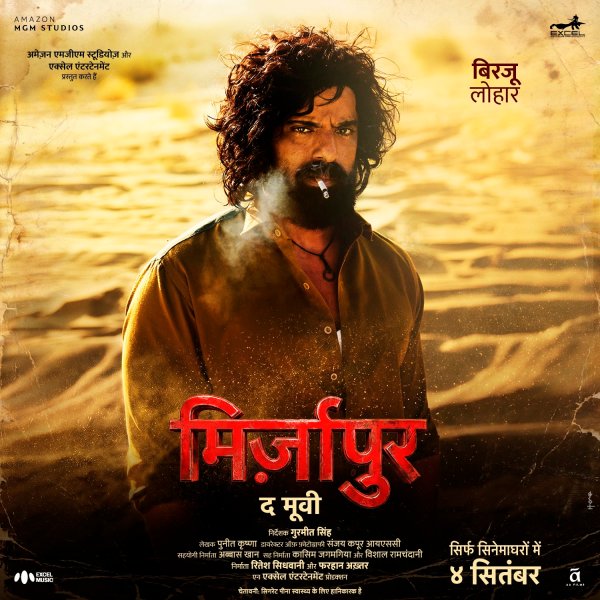 Mohitt Maalik in Mirzapur The Movie.
One of the new characters that caught the audience’s attention is Birju Lohar, played by Mohitt Maalik. Despite speaking very little, Birju emerges as a dangerous character, driven by his intense and unrequited love for Beena Tripathi, played by Rasika Dugal. Talking about why Birju has resonated with audiences, Gurmmeet said, “The strongest emotion rests with Birju in the film, and I think that’s why it resonates so much, right? It’s also a love that you can never find, unrequited love. It’s almost devotional in that aspect. And all credit to Mohit for playing it with that intensity and keeping every moment that he’s on screen so taut, right? He completely immersed himself into the character, he grew a beard, all of that. And this is stuff that he came up with.”
The director also revealed the extent of preparation that went into bringing Birju’s backstory to life. “He wrote five years of letters for Beena in Hindi and narrated them to us, saying, ‘This is my backstory.’ So all the work that he put in is visible on screen. Because that emotion is so pure and all of us connect with it is why Birju stands out,” Gurmmeet said.
Gurmmeet Singh on Beena Tripathi’s character arc
Rasika Dugal’s Beena Tripathi has undergone a significant transformation throughout the series. When asked whether her character’s evolution was always planned or developed gradually over the seasons, Gurmmeet credited creator and writer Puneet Krishna for building a world in which every character has their own story. “Puneet Krishna, who is the creator and writer of Mirzapur, I don’t think even he could have imagined where this world would turn up. Now it’s almost going to be a decade of storytelling that has happened. But the beauty about Puneet’s writing and his characters is that he imagines every character to be the hero of their own story, right? There is a larger story going on, but even if someone walks in for one line, they’re the hero of their lives. And if the camera were to turn and follow them, there would be an interesting film to happen with each character,” he said.
Story continues below this ad
Gurmmeet added that Beena’s character was always expected to grow stronger after the events of the first season, particularly given the circumstances she was left in. He also praised Rasika’s performance, which, according to him, brought together the many layers of Beena’s personality.
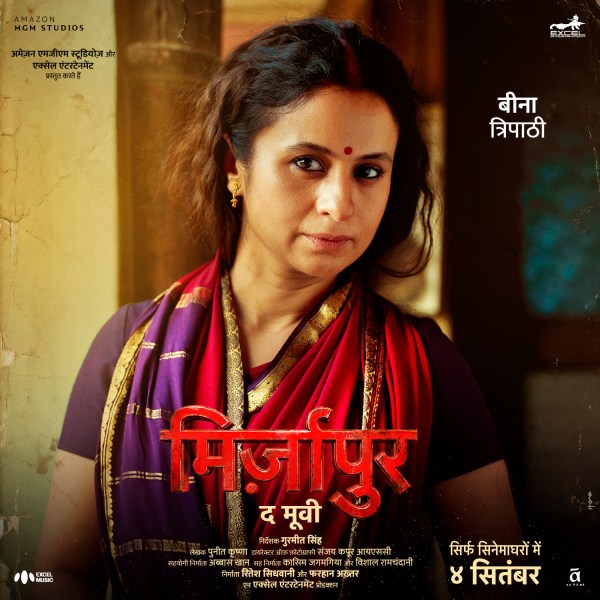 Rasika Dugal in Mirzapur The Movie.
“The way Season 1 eventually pans out, and the dramatic end that we leave Beena with, her character was going to go from strength to strength. We knew that because I don’t think anybody else gets to deal with that kind of manipulation, trauma, mystery, and ‘sone pe suhaga’ (cherry on the cake) if you add Rasika Dugal in that form. She’s able to bring such charm, viciousness, and enigma to it. It’s unbelievable, and I think it was just the correct mix falling into place,” said the director.
Concluding the conversation, Gurmmeet said, “This film just completely adds to her legacy, where you now see what made Beena Tripathi, and what her pain and wound were all along.”

Vvaan box office day 7: Sidharth Malhotra film earns Rs 69 crore, faces Drishyam 3 test
By Sohail Khan · 2 Oct

Leave a Reply