Expert explains | As Israel heads to polls this month, will unpopular Netanyahu make a comeback?
Story continues below.
Subscribe to see fewer ads.
Still, Netanyahu is Israel’s longest-serving prime minister for a reason. He is a master of the political comeback, someone known for forging unlikely alliances.
So what could happen in the elections? What are the issues that matter for Israeli voters? Is there an alternative to Netanyahu? Will any party focus on ending the wars or the violence unleashed by Israeli settlers in the West Bank? What happens to the far-right figures in Netanyahu’s cabinet? What is the mood among Arab citizens?
Answering everything you need to know about the Israeli elections is Professor Tamar Hermann, a senior research fellow at the Israel Democracy Institute and the academic director of the Viterbi Family Center for Public Opinion and Policy Research. Hermann, who has headed the team producing the annual Israeli Democracy Index and the monthly Israeli Voice Index, spoke to Moinuddin Ahmad.
As Israel approaches the October 27 elections, what are the key issues for voters this time?
Story continues below this ad
A poll conducted by the Israel Democracy Institute in August found out that the top issues were, as one might expect, security and foreign relations. People voted very closely on issues like the economy and the cost of living. The interesting thing here is that before the October 7 attacks, people were only interested in the economy and cost of living; even political parties were talking about it.
As we approach elections, all the political parties agree on national security, but differ on violence in the West Bank. The current government and its allies are soft on the violent settlers in the West Bank, but if the government changes, I am sure that the security forces will be tougher on these settlers. Overall, security is the top agenda in Israel.
Prime Minister Netanyahu has historically managed to hold his right-wing coalition together. Given the post-war national security and October 7 accountability, do you think he will be able to secure the 61-seat majority with his existing allies?
According to the polls, it seems very difficult that Netanyahu will get even close to 61 seats in the 120-member Knesset. However, he is the only one among the current politicians who is capable of holding his block together. Netanyahu is a highly capable politician. Although I don’t like him personally, he remains a political marvel with an unbroken grip on Israeli politics.
Story continues below this ad
He has survived so far despite not being able to deliver any of the promises he made at the beginning of the war: he failed to topple the Iranian regime, he couldn’t dismantle Hezbollah in Lebanon, and Hamas is still operating in Gaza. Yet, he stays the frontrunner for the post of Prime Minister.
The Centre-right and centrist opposition leaders, including Gadi Eisenkot and Naftali Bennett, have shown strong polling numbers. Does the opposition possess a cohesive policy alternative, or are they still bound primarily by an ‘anyone-but-Bibi’ coalition dynamic?
Yes, that’s the main issue. They all mention the [military] drafting of the Haredim [ultra-orthodox Jewish men] as a unifying factor. However, they diverge on the issue of partnering with the Arabs. There seems no unity in contesting the elections as a unit, taking the Arab parties together. Recently, they met at the home of Yair Lapid and issued a document which says nothing.
It only says: “We commit ourselves not to cannibalise each other,” which is what they have been doing for quite some time. All the talk of opposition unity is just empty rhetoric.
Story continues below this ad
The debate over drafting ultra-orthodox (Haredi) men and passing laws around religious exemptions has strained Netanyahu’s coalition and angered secular and national-religious voters. How damaging is this issue to the alliance between Likud and Haredi parties like Shas and United Torah Judaism (UTJ)?
Well, it is, because the Haredim — mainly Yahadut HaTorah — expected a Netanyahu government to capitulate to their demands. From their perspective, he didn’t deliver. So yesterday, one of the key members of Knesset on behalf of Yahadut HaTorah said that they will not hesitate in joining the (Gadi) Eisenkot-led alliance, which means that they actually threatened Netanyahu.
But threatening now is of no avail, because they cannot presently pass any law in this regard until the new government is formed. Also, it looks very unlikely that Haredi parties will actually join Eisenkot camp.
Leaders like Bezalel Smotrich (Religious Zionism) and Itamar Ben-Gvir (Otzma Yehudit) moved from the political fringes directly into major ministerial roles. Has their ideology permanently reshaped the mainstream Israeli right, or is it likely that we see them pushed back to the margins if a strong centrist coalition emerges after the elections?
Story continues below this ad
Well, there is a difference between Ben-Gvir and Smotrich. Ben-Gvir addresses a different set of people. He is non-Ashkenazi. He is more representative of the periphery. Smotrich is an ideologue who belongs to the dominant Ashkenazi group. On the other hand, Ben-Gvir is a pragmatist.
So, despite being located on the political right — radical Right, if you wish to call it — they are very different. Over the last four years, they had bad personal relations because they did not agree with each other. Smotrich looks down at Ben-Gvir from the intellectual perspective, and Ben-Gvir looks down at Smotrich from the electoral perspective. I trust more the viability of the Ben-Gvir chunk in the electorate than that of Smotrich. Smotrich was unlikely to cross the threshold, and only Netanyahu put much pressure on him to merge with (Moshe) Feiglin, who is also an Ashkenazi intellectual and also on the radical Right. Ben-Gvir is a permanent fixture now.
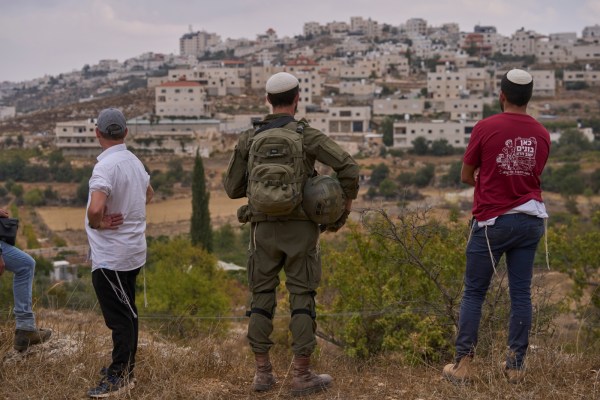 An Israeli soldier and settlers look out toward the Palestinian village of al‑Shuyukh from agricultural land near the Gad Natan settlement in the occupied West Bank.
But Smotrich appears to have become the face of the expansion of occupation; does this help him?
From an average Israeli’s perspective, we are there to stay for the foreseeable future, as no one is talking about a Palestinian state. And the expansion of the settlements is now based on the fact that people no longer move from Israel within the Green Line to the settlements, as they did in the past. This is natural expansion. I mean, they have six kids; they have to have homes for their kids and grandchildren.
Story continues below this ad
And in fact, the second, now already the third generation of settlers, do not see themselves as settlers. They see themselves as natives of the West Bank. So in a way, what is happening now between the Palestinians and the third generation of the settlers is a biblical kind of conflict, like between Cain and Abel. Both sides see themselves as not only owners but also natives of the place, unlike the early settlers, who used to say, “We are settlers; we came from another place.”
The judicial reform push revealed deep faultlines in Israeli society. To what extent will democratic governance, judicial independence and civil rights remain active campaign issues in this election cycle?
Not very significant at the moment. It started to disappear from the media reports about a year and a half ago. Very recently, Minister of Justice Yariv Levin was trying to resume these efforts. He was pretty successful, but most people in our poll said that the moment was not the right time to start these activities, as elections are already on the horizon.
We should also take into account that even if there is a government change, they will not be able to abolish everything that was already done.
Story continues below this ad
And the idea that the Supreme Court should somehow be politically representative of political power is now deeply ingrained in many people’s minds. Nowadays, the idea that you should also have very conservative or very religious judges is something that many people accept. Also, many people accept the idea that the entire judicial system should be somehow reformed, not necessarily in the direction that Netanyahu and Levin are planning.
What is the current mood among Arab citizens of Israel regarding participation in national elections? Is there growing despair over political marginalisation, or is there a pragmatic demand for leaders who can deliver on local socio-economic issues?
There are both kinds of advocacy. Some would say, like actually Ra’am [an Arab party] says: “This country is a Jewish country; willing or not, we should make the best out of participating in the political process.” The purists say, “Well, never mind, we have no impact, so why would we bother?” In the past elections, it was 50-52%. A year ago, it seemed their participation might be as low as 30%, but now it appears to be between 52% and 55%.
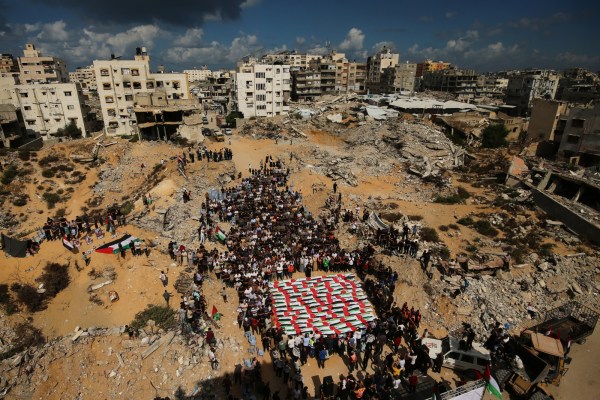 A mass funeral for Palestinians, whose bodies were recovered from the rubble of buildings destroyed by Israeli airstrikes, on October 1.
If the election results produce another political stalemate without a clear majority for either bloc, what structural changes or alternative political alignments might emerge to break Israel’s cycle of repeated elections?
Story continues below this ad
Structural changes will not be made in the foreseeable future. There could be four possible outcomes —
First, if Netanyahu wins, with the help of smaller parties, then there will be no need for new elections.
The second option is that the Change Bloc will have the majority; I don’t see that happening.
The third option is that the Netanyahu government will work as a caretaker government, and there will be reelections.
The last option is that we will have a minority government by the Change Bloc, in which case I believe at least one Haredi party will join them. If that happens, the two Haredi parties will compete, as the Haredi party on the Change side may have to concede some of its demands.
What is the reaction of the Israeli opposition parties to the reports that say that Netanyahu was warned about the October 7 attacks by the UAE and Egypt? Is it becoming a political issue?
Obviously, it is, because it works against Netanyahu. But in my view it will not make much impact. The opposition parties were already saying that the Netanyahu government failed in stopping the attack. At the same time people are asking why such reports are coming now, just before the elections.
So, it is considered a part of the anti-Netanyahu campaign. And secondly, they will tell you that he did not do a preemptive strike on Gaza because it could have impacted a peace treaty with Saudi Arabia, something that is supported in Israel across the political spectrum.
Perhaps Netanyahu could not make the right decision at that time. If he had been able to achieve peace with Saudi Arabia and keep Hamas quiet by blocking the Qatari money, he would be praised for that. He just took a chance that didn’t work for him.
Singing, for unity or division
By Sohail Khan · 3 Oct
The tussle for top posts in India’s CAPFs: IPS officers or force veterans?
By Sohail Khan · 3 Oct
Monkey vs langur: How to spot the difference
By Sohail Khan · 3 Oct
Leave a Reply