The tussle for top posts in India’s CAPFs: IPS officers or force veterans?
Story continues below.
Subscribe to see fewer ads.
The case was scheduled for September 29, when the Ministry of Home Affairs (MHA) was supposed to explain why, despite the court’s direction to progressively reduce IPS deputation, 46 IPS officers had subsequently been brought into the forces. Although the case appeared in the cause list, by the time it came up for hearing, it had been struck off.
The bench ordered it to be listed the following day and sought an explanation from the Registry. But on September 30, the contempt cases were placed before a specially constituted bench of Justices Manoj Misra and Bhuyan instead of the regular bench of Justices Bhuyan and Chandurkar.
The Registry said the Centre had earlier requested the Chief Justice of India to have the contempt cases heard along with a separate petition challenging the new CAPF law since the government’s defence in the two overlapped. Lawyers for CAPF officers objected, arguing that alleged violation of the 2025 judgment was distinct from the subsequent challenge to the Act.
But the courtroom dispute is only the latest development in a battle running for over a decade.
What is the dispute?
Story continues below this ad
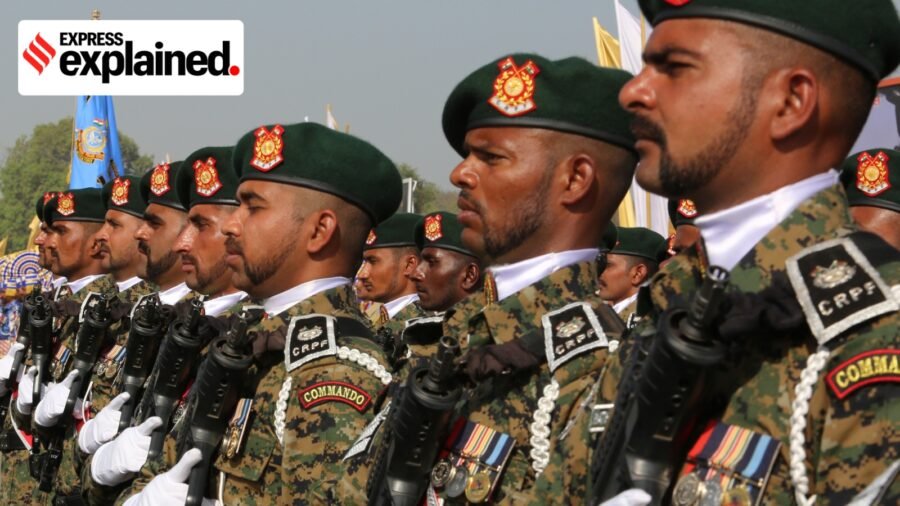
Five forces are at the centre of it — Central Reserved Police Force (CRPF), Border Security Force (BSF), Central Industrial Security Force (CISF), Indo-Tibetan Border Police (ITBP) and Sashastra Seema Bal (SSB). Each has its own cadre of Group A executive officers, generally recruited as Assistant Commandants, who can rise through the hierarchy to senior command positions.
However, senior positions have traditionally also been filled through deputation, particularly by IPS officers. Before the 2026 law, recruitment rules provided for 20% of DIG and 50% of IG posts to be filled through deputation.
CAPF cadre officers contend that this creates a structural bottleneck. As the number of posts narrows higher up the hierarchy, setting aside senior posts for deputation further reduces promotional opportunities for officers who have spent their careers within the forces.
This was one reason behind their long battle for Non-Functional Financial Upgradation (NFFU), which allows an officer who cannot be promoted for want of vacancies to nevertheless receive the financial benefits of a higher grade.
Story continues below this ad
The Delhi High Court ruled in favour of CAPF officers in 2015. The Supreme Court upheld the decision in 2019, following which the Union Cabinet granted Organised Group A Service (OGAS) status and NFFU benefits to Group A executive cadre officers of the CAPFs.
Why did the problem continue?
CAPF officers say NFFU has only partially addressed stagnation because it has been implemented through existing Recruitment Rules. These require an officer to spend a prescribed number of years in each rank before becoming eligible for the next grade. Thus, even when NFFU gives an officer the pay of a higher rank without an actual promotion, the clock for his next financial upgradation may not start until he is actually promoted.
For instance, an officer who gets 2IC-level pay after five years as Deputy Commandant may remain stuck there financially if he is not actually promoted as 2IC — the prescribed service for the next grade does not begin. CAPF officers say this perpetuates the very stagnation NFFU was intended to overcome, and have sought Service Rules that provide for progression based on overall qualifying service rather than actual vacancy-based promotions.
The matter returned to the Supreme Court in 2025. In its May 23 judgment, the court held that CAPFs had to be treated as OGAS not merely for NFFU but for other cadre-related purposes as well. It ordered a cadre review and review of existing service and recruitment rules after hearing representatives of the CAPF cadres.
Story continues below this ad
Most significantly, it directed that posts earmarked for deputation up to the Senior Administrative Grade (DIG and IG) be progressively reduced, within an outer limit of two years. The Centre’s review petition was dismissed in October 2025.
Why does the MHA want IPS deputation to continue?
The MHA argued before the Supreme Court that the CAPFs, given their operational role, could not be treated on a par with ordinary civilian Group A services, and that IPS officers provided an institutional link between the Centre and state police establishments when the forces were deployed in states. IPS officers who intervened in the litigation also defended the deputation system.
The Supreme Court did not order an end to IPS deputation. It instead sought to balance the government’s stated operational requirement against the stagnation faced by cadre officers, directing a progressive reduction of deputation posts up to SAG.
CAPF officers argue that personnel who have spent decades commanding units and serving in conflict areas should not find the upper reaches of their own organisations partly closed to them.
Story continues below this ad
There is also a paradox: the Centre has itself struggled to fill posts reserved for IPS officers because states have been reluctant to release them on central deputation.
What is the new CAPF Act?
While the court battle continued, the government brought the Central Armed Police Forces (General Administration) Bill in Parliament. Introduced in Rajya Sabha on March 25, it was passed by both Houses in early April and has since become law.
The Act creates an umbrella framework for Group A officers of the five CAPFs and empowers the Central government to frame rules governing recruitment, promotion, deputation and service conditions.
Crucially, this rule-making power operates notwithstanding an inconsistent judgment, decree or order of a court, while rules framed under the Act prevail over inconsistent rules or government orders.
Story continues below this ad
The legislation also protects a sizeable deputation component at senior levels: 50% of IG posts and at least 67% of Additional DG posts are to be filled through deputation, while all Special DG and DG posts are to be filled through deputation.
The government argued that the law was necessary to create a uniform framework for the five forces and that IPS deputation remained necessary for operational requirements and Centre-state coordination.
Opposition MPs, however, argued that the legislation was effectively seeking to overcome the Supreme Court’s 2025 judgment and perpetuate the disadvantage faced by CAPF cadre officers. They sought its referral to a Select Committee and eventually walked out during its passage in both Houses.
CAPF officers have separately challenged the new law in the Supreme Court. There are therefore now two overlapping proceedings — the contempt petitions over whether the government complied with the 2025 judgment, and a challenge to the 2026 law that subsequently changed the statutory framework — to be decided by the same bench.

In India’s education debate, the ‘fourth language’ we are leaving out
By Sohail Khan · 3 Oct

Leave a Reply