Economists map the road to cheaper food in India
Benchmarks
Nifty22,547.65125.71
FEATURED FUNDS★★★★★
Motilal Oswal Midcap Fund Direct-Growth
5Y Return
19.6 %
Invest Now
Enter search text:
Business News›News›Economy›Indicators›Double Trouble at the Dinner Table: When will food prices normalise for Indians
Read Today's Paper
Double Trouble at the Dinner Table: When will food prices normalise for Indians
Synopsis
India’s food inflation: Food prices are rising unevenly, impacting household budgets, while inflation is projected to persist in upcoming months. Economists expect food inflation to reach up to 7% in the near future due to various factors. Weather risks, particularly from El Niño, could significantly affect crop yields and consequently food prices. Additionally, global events in West Asia contribute to higher energy and logistic costs.

Listen to this article in summarized format
Loading…
×
×
Unlock AI Briefing and Premium Content
New Year Offer 24 Hours Left
Already a member? Sign In
What's Included
- Exclusive Stories
- Daily ePaper Access
- Smart Market Tools
- Curated Investment Ideas
- Ad-lite Experience
Subscription

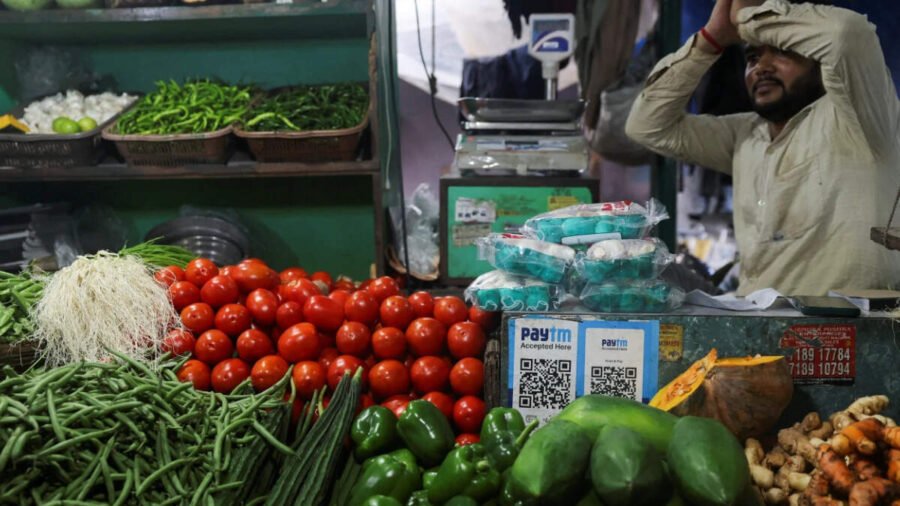
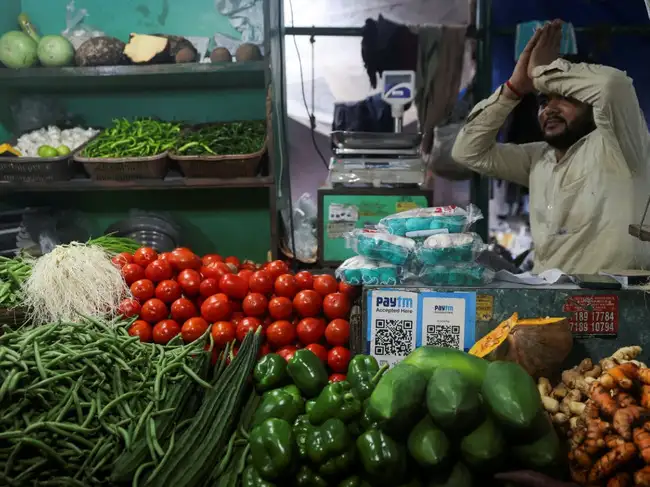 Reuters
For any household, the impact of rising food prices is rarely felt all at once. It creeps into the monthly budget gradually.
Costlier onions, higher cooking oil prices, a jump in the cost of pulses, and the same shopping list can start becoming noticeably more expensive over time.
But the price pressure is not uniform across the grocery basket this time. Government data showed that onion prices, for instance, were up 48.27% year-on-year in August, even as tomato prices fell 31.09% and potato prices declined 13.14%.

Onion, tomato, potato prices, as per government data for August
Yet the decline in some items has not been enough to offset the rise in others.
Also Read: Beyond the 7% headline: S&P maps the forces driving India’s next growth phase
Overall food inflation, meanwhile, rose to 5.95% in August from 5.52% in July, while headline consumer price inflation climbed to 4.82% from 4.45%.
The bigger question now is how long that pressure on household food bills will last. With the monsoon running below normal, the Kharif harvest approaching, and El Niño adding to weather risks, the next few months could determine when food inflation finally begins to ease.
Food inflation may stay high through the coming months
The immediate outlook is hardly comforting. Vikram Chhabra, senior economist at 360 ONE Asset, expects food inflation to rise from around 6% in August to 7-8% over the next three to six months, meaning grocery bills are unlikely to feel lighter in the near term.
The view is broadly shared by other economists.
Aditi Nayar, chief economist at ICRA, expects food inflation to cross 7% by October 2026 and remain above 5% for the rest of the financial year.
“Risks are tilted to the upside,” Nayar said, pointing to the uneven distribution of the monsoon and the uncertainty over its impact on crop output.
Rajeev Juneja, president of PHDCCI, also expects food inflation to remain elevated in the near term, with the trajectory differing sharply across commodities. A broader easing is more likely from late 2026 into early 2027, provided Kharif output and market arrivals remain healthy, he said.
Food inflation trends
Similarly, Dhiraj Nim, economist and FX strategist at ANZ, expects pressure to persist at least through October-November, with some relief possible when winter Rabi harvests and fresh Kharif supplies reach mandis.
That makes the timing and quality of the next harvest crucial. If supplies improve, some of the current pressure can unwind; if they do not, households could face another round of elevated prices.
The onion shock is only part of the problem
Onions illustrate how quickly a supply disruption can reach the household kitchen.
PHDCCI's Juneja told that elevated wholesale onion prices can pass through to retail markets relatively quickly, as onions are frequently purchased and retailers replenish stocks regularly.
However, the pass-through is not one-to-one, he said, with transportation, handling, storage, wastage, and wholesale and retail margins also influencing the final price.
The current onion spike has already lasted longer than a typical vegetable-price surge. Gaura Sen Gupta, chief economist at IDFC First Bank, said vegetable price surges generally last around two months, with supply-side measures helping to ease pressure. The onion price rise has entered its third month and coincides with the festival season, which may have added to demand pressures.
Also Read: Pulses prices surge up to 11% in a month as festive demand, crop concerns bite
Still, she expects onion price pressure to subside in the near term, helped by multiple cropping seasons for vegetables and government supply-side measures.
That offers one possible route to relief, but economists caution that onions are only one part of a much broader food basket.
El Niño could turn a short-term food shock into a longer one
The more consequential risk lies in the weather.
The Reserve Bank of India has been flagging this risk for months. In April, the central bank said upside risks to inflation had increased because of higher energy prices and probable weather disturbances affecting food prices.
By June, the Monetary Policy Committee said the food outlook remained uncertain because of the subnormal southwest monsoon forecast and El Niño.
The latest data show why that concern has persisted. The cumulative monsoon rainfall deficit is around 15% as of September 21, according to the India Meteorological Department, while rainfall distribution has also been uneven.
“The erratic monsoon is the single biggest risk,” said Chhabra of 360 ONE Asset, placing elevated crude prices a close second.
Calling El Niño the “dominant risk factor”, Nim of ANZ cautioned that it could affect both Kharif yields and reservoir replenishment. Lower reservoir levels can constrain irrigation-dependent Rabi crops such as wheat and pulses in early 2027.
ICRA's Nayar echoed those concerns, pointing out that reservoir levels below the historical average could delay Rabi sowing and affect winter crops. She added that yields could also be affected by moisture conditions and the availability of farm inputs, some of which have become more expensive partly because of the West Asia crisis.
IDFC First's Sen Gupta similarly warned that strong El Niño conditions could affect both Kharif and Rabi output. Warmer winters could also keep pressure on perishables and affect Rabi crop yields.
Rice, oilseeds and pulses are on the watchlist
The risks are not evenly distributed across crops.
Oilseeds, particularly soybean and groundnut, face significant upside price risk because of limited carry-in stocks, firm crushing demand and elevated global edible-oil prices, according to CRISIL Intelligence director Pushan Sharma.
Paddy prices are also expected to remain firm on strong domestic and export demand, although comfortable opening stocks could provide some cushion.
Nayar said rice sowing has declined year-on-year, which could put pressure on prices, while pulses sowing is above last year's level. However, higher sowing does not necessarily guarantee a larger harvest, as yields will also depend on moisture conditions and the availability of inputs.
Pulses and coarse cereals remain vulnerable to weather disruptions, with tur and maize particularly exposed, Sharma added.
QuantEco Research's economist Vivek Kumar also pointed to a contraction in acreage for rice, cotton, sugarcane and oilseeds in the latest Kharif sowing data.
There is, however, a cushion for some cereals. According to Sen Gupta, cereals with a longer shelf life should see a more stable price trend because India has more than adequate buffer stocks.
The overall outlook, therefore, is unlikely to be uniform: some food prices could ease while others remain under pressure, depending on crops, stocks and weather conditions.
West Asia adds another layer of pressure
Just as farmers and households deal with persistent weather risks, the West Asia conflict has opened another channel of inflationary pressure.
The transmission to kitchen budgets is less immediate but potentially more persistent. Crude oil feeds into diesel used by farm machinery and irrigation pumps, while liquefied natural gas (LNG) is an important feedstock for urea production. Freight costs affect the movement of crops from farms to mandis and retailers, while higher energy and logistics costs can also raise processing and storage expenses.
August Inflation Snapshot
India's wholesale price index-based inflation (WPI) rose to 9.92% in August on a year-on-year (YoY) basis, from 9.78% in July, while the WPI Food Index rose to 7.05% from 6.65%. Fuel and power inflation was 22.93% in August.
Economists, however, urge caution against linking every spike in food prices to the conflict.
“The recent sharp increases in onion, garlic and ginger prices also reflect crop availability, weather conditions, market arrivals and other supply-side factors,” Juneja said.
For some products, however, the global connection is already clearer. India is heavily dependent on imports for edible oils, making the category particularly exposed to international prices, said Sen Gupta.
Additionally, higher freight rates, petrochemical raw-material and packaging costs had pushed up crop-protection product prices by an estimated 5-15%, according to CRISIL's Sharma. Crops like apples, grapes, paddy, soybean and cotton are particularly exposed because of their relatively high dependence on these inputs.
Echoing that view, Nayar pointed out that some farm inputs have become more expensive partly because of the West Asia crisis, adding yet another layer of cost pressure for farmers.
The 2027 question is beginning to matter
The Asian Development Bank's (ADB) latest outlook adds a longer shadow to the near-term food story.
A stronger-than-expected El Niño could hit crop yields and raise food inflation, with higher irrigation, energy and fertiliser costs adding to the pressure, the ADB warned. The effects could widen considerably in 2027, when commodity-price shocks are expected to peak.
That does not mean Indian food inflation will necessarily remain elevated until then. But it does underline why economists are reluctant to put a quick end-date on the current food-price pressure.
Also Read: Worsening El Nino threatens Asia with drought, potentially raising food prices globally
For now, the outlook depends on many factors turning favourable together: If Kharif arrivals are healthy, onion prices ease, reservoirs recover and the West Asia energy shock fades, food inflation could begin to moderate from late 2026 or early 2027.
If El Niño remains severe, Rabi sowing is affected and energy and fertiliser costs stay high, the adjustment could take longer.
Add 

(You can now subscribe to our WhatsApp channel)
(You can now subscribe to our WhatsApp channel)
Read More News on
icraOnion prices IndiaEl Niño impact on cropsfood inflation India 2026food prices in Indiafood inflationIndia food inflation August 2026grocery prices Indiaonion prices IndiaWest Asia conflict food prices


Enter search text:
Continue reading with one of these options:
Limited Access
Free
Login to get access to some exclusive stories
& personalised newsletters
Login Now
Unlimited Access
Starting @ Rs120/month
Get access to exclusive stories, expert opinions &
in-depth stock reports
Subscribe Now
ET
Unlock Access to All Exclusives with ETPrime FREE TRIAL
15 Days Free: Unlock All ETPrime Exclusives, Market Tools & ePapers
Trial offer expiring in00 : 05 : 00
I'd rather pay ₹2599 now


Uh-oh! This is an exclusive story available for selected readers only.
Worry not. You’re just a step away.

Prime Account Detected!
It seems like you're already an ETPrime member with
Login using your ET Prime credentials to enjoy all member benefits
Log out of your current logged-in account and log in again using your ET Prime credentials to enjoy all member benefits.
Unlock ETPrime's Exclusive Stories Today!
Subscribe to gain powerful insights on business, stock market and industry trends.
Big Price Drop! Flat 40% Off
Student Only Offer
Already a Member? Sign In now
Already a Member? Sign In now
Already a Member? Sign In now
Offer Exclusively For You
Save up to Rs. 700/-
ON ET PRIME MEMBERSHIP
Avail Offer
Offer Exclusively For You
Get 1 Year Free
With 1 and 2-Year ET prime membership
Avail Offer
Offer Exclusively For You
Get 1 Year Free
With 1 and 2-Year ET prime membership
Avail Offer
Offer Exclusively For You
Get Flat 40% Off
Then ₹ 1749 for 1 year
Avail Offer
Offer Exclusively For You
ET Prime at ₹ 49 for 1 month
Then ₹ 1749 for 1 year
Avail Offer
Special Offer
Get flat 40% off on ETPrime
Avail Offer
Avail Offer
Claim NowAlready a Member? Sign In now
Need Assistance?
Connect with an ETPrime expert for personalized support and guidance
+91 9484700004
' + h3 + '
' + h4 + '
- ' + listing + '
What’s Included with

1Exclusive Insights That Matter
Uncover the truth with our investigative stories
Make strategic moves using the real-world case studies
Read industry-specific stories to identify emerging trends
Spot opportunities with in-depth insights that matter

Trump temper on H-1B visas is forcing Indians to do these things to stay put in US

What Adani’s US indictment means for India Inc’s overseas fundraising

Why veterans like Reliance, L&T are on acquisition spree? Aswath Damodaran has an answer.

Will China’s dollar bond sale in Saudi Arabia trump the US in financial world?

Huawei launches its own OS to compete with Google and Apple. But can it win beyond China?

The problem with lab grown diamonds

Why a falling rupee is a better option for the economy

A list of top 20 momentum stocks that have delivered massive returns in one year
2Invest Wisely With Smart Market Tools & Investment Ideas
Alpha Trade

Get daily trade ideas from SEBI-registered research analysts.
Investment Ideas

Grow your wealth with stock ideas & sectoral trends.
Stock Reports Plus

All-in-one stock research with Stock Score, peer comparison & key signals.
BigBull Portfolio

Get to know where the market bulls are investing to identify the right stocks.
Stock Analyzer
Check the score based on the company's fundamentals, solvency, growth, risk & ownership to decide the right stocks.
Market Mood

Analyze the market sentiments & identify the trend reversal for strategic decisions.
Stock Talk Live at 9 AM Daily

Ask your stock queries & get assured replies by ET appointed, SEBI registered experts.
3Stay informed anytime, anywhere with ET ePaper
ePaper – Print View

Read the PDF version of ET newspaper. Download & access it offline anytime.
ePaper – Digital View

Read your daily newspaper in Digital View & get it delivered to your inbox everyday.
Wealth Edition

Manage your money efficiently with this weekly money management guide.
4Times Of India Subscription (1 Year)
ePaper

Read the PDF version of newspaper. Download & access it offline anytime.
Deep Explainers

Explore the In-depth explanation of complex topics for everyday life decisions.
Health+ Stories

Get fitter with daily health insights committed to your well-being.
Personal Finance+ Stories

Manage your wealth better with in-depth insights & updates on finance.
5Enjoy Complimentary Subscriptions From Top Brands
Docubay Subscription

Stream new documentaries from all across the world every day.
Stories you might be interested in

Protesters demand FIR over alleged sexual harrasment
By Sohail Khan · 5 Oct
Taxpayer wins Rs 85.3L unexplained cash gift case
By Sohail Khan · 5 Oct
Intel Wildcat Lake chips find an elusive formula and Acer Swift Air 14 proves it
By Sohail Khan · 5 Oct
Leave a Reply